Suffering Before Death

In this week's New Yorker Aleksandar Hemon talks (paywalled) about his daughter, who was diagnosed with cancer at 9 months old. Hemon raises the issue of suffering:

One of the most despicable religious fallacies is that suffering is ennobling—that it is a step on the path to some kind of enlightenment or salvation. Isabel’s suffering and death did nothing for her, or us, or the world.

Margaret O'Brien Steinfels responds and echoes discussions of assisted suicide:

At the last, desperate efforts are made to resuscitate her when her heart fails (her kidney are gone and she has suffered several seizures). “Teri and I held our dead child—our beautiful, every-smiling daughter, her body bloated with liqud and battered by compression [from the effort to resuscitate her]—kissing her cheeks and toes.” What can one say?

Nonetheless, let us ask: Since survival rates for teratoids in children under three are less than 10 percent, what if the doctors had offered palliative care at some point? Isabel would almost certainly have died–but so brutally?

“At what point do we decide that a political system has become decadent?”

EJ Dionne takes the Weiner "scandal" as the moment he realized we were late imperial Rome. PM Carpenter takes the Bush vs Gore Supreme Court ruling. Personally, I think it was some moment between the Congress's assent to torture in 2006 and when Sarah Palin was selected as a serious vice-presidential nominee in 2008.

Any thoughts?

Getting A Job After Prison

It's not easy:

We ran an audit experiment that sent trained testers to apply for more than 1,000 entry-level jobs throughout New York City. The fake job applicants were dressed similarly, gave similar answers, and provided résumés with identical education and work experience. At each job interview, however, one randomly chosen tester would tick the application box indicating a criminal record and submit a résumé that mentioned a prison and provided a parole officer as a reference.

White testers who were assigned a criminal record received call-backs or job offers from employers only half as often as testers with clean records. For African Americans, a criminal record reduced employment opportunities by two-thirds. Labor force data from the National Longitudinal Survey of Youth paint a similar picture of incarceration’s negative effects: Wages fall by about 15 percent after prison, yearly earnings are reduced by about 40 percent, and the pay of former prisoners (unlike compensation for the rest of the labor force) remains stagnant as they get older.

What Fat Costs

David Stipp largely blames rising healthcare costs on obesity:

[T]here’s a giant exception to the rule that the longer life tends to be a healthier one: Obese people are living longer, thanks to factors such as cholesterol-cutting medicines (as is the entire population), but much of their extra time is spent in ill health, and as a result, their annual medical bills are some 42 percent higher than those of normal-weight people. In fact, the obesity epidemic has greatly increased the prevalence of chronic diseases such as diabetes, but contrary to much of the media coverage on the epidemic, it has had little effect on mortality rates. As the title of one study put it, “Smoking kills, obesity disables.”

Chart Of The Day

Hollywood_Career

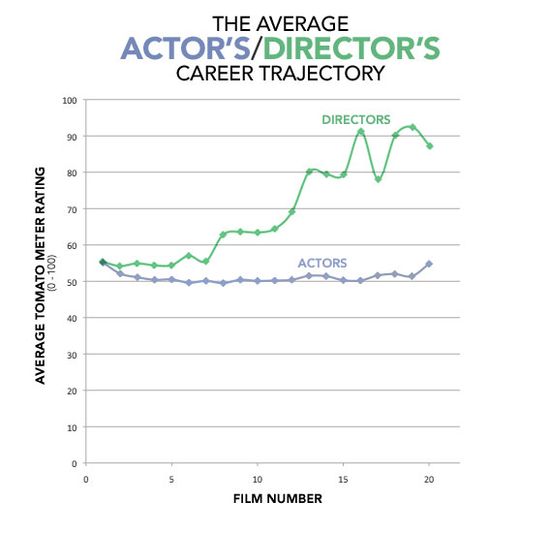
Christopher Beam and Jeremy Singer-Vine have turned Rotten Tomatoes' database into an interactive "Hollywood Career-o-Matic tool" that lets you "map the career of any major actor or director from the last 26 years." Above are the averages for actors and directors:

These trends seem to make sense. Most actors have to appear in good movies early in their career. Those who don't risk being flushed out of the business. Once they've established themselves with a good film or two, they can safely make some bad ones. But all in all, they don't have nearly as much control over film quality as directors do. Directors' scores spike over time, presumably because only the best ones stick around long enough to make so many films.

A Right To Die? Ctd

A reader writes:

I don't think Douthat is stepping back enough to analyze what he's saying here. He appears to be saying that a middle-aged, wheelchair-bound friend who had been severely depressed for YEARS should not be allowed to choose to die. You don't even need the wheelchair for this one; how about an able-bodied person who is severely depressed? Does Douthat have any idea how horrible clinical depression can be? What exactly is his "fix" here, other than making that person live on under a black cloud of misery?

Secondly, what on earth is this nonsense about a doctor being a murderer for handing over the prescription? The doctor is doing nothing in this scenario other than handing over the option (after checks and balances), thus putting the choice directly in the hands of the patient. Are we going to start accusing people of being murderers because they sold alcohol to a chronic alcoholic? Will the kid at the hardware store get brought in for selling rope to a guy whose wife just left him? It's ridiculous and paternalistic.

The Daily Wrap

Today on the Dish, Andrew marveled at American puritanism about sex, and picked apart what it means to live, both online and off, while we all seek out our authentic selves. Feds broke up nice marriages, and Andrew examined what it could mean for children to never consider closeting themselves and exited the holding pen of gay pride parades.

Andrew praised Huntsman's moderate conservatism, but Nate Silver thought it doomed him. Andrew dismissed Pawlenty's insane tax cuts, McArdle chalked it up to the inflated candidate ego, while the rest of the GOP geared up to out-tea-party him. Bachmann started a brawl with Palin, Palin's team fought back, and Andrew dismantled Palin's answers to "gotcha questions." Andrew drew comparisons about Palin's post-pregnancy look, the real Palinization was backwards enough, headlines battled over polling, and business cred doesn't help a GOP candidate for the most part.

Syria's impending civil war differed from Libya's, we wondered if the Gay Girl In Damascus could be a hoax, the Syrian regime forced young men to become snipers, and Peter Van Buren made the case for shrinking the embassy in Iraq. We debated pain vs depression as to when people request assisted suicides, and readers recommended and spoke highly of hospice care. Incarceration doesn't stop drug addiction, we stressed the importance of keeping DNA evidence for exonerations, and a man hid a cellphone SIM card in his mouth to save his recording of the cops. We experienced walking on a minefield in the first person, snake oil medicines used to fool us pretty easily, and the social cost of smoking totals about $40 a pack. The French deconstructed the Smurfs, and X-men remained a good metaphor for the gay rights movement.

Yglesias award here, cool ad watch here, quotes for the day here, here and here, chart of the day here, VFYW here, MHB here, and FOTD here.

–Z.P.

Hospice And Assisted Suicide, Ctd

442372023_67a0e78230_o

A reader writes:

Hospice is wonderful. I had two amazing aunts who passed away at home, in their own beds, in comfort, thanks to hospice care. One was 61, the other 96. Both died shortly after they got to a point where they refused food and almost all liquid. Morphine kept them comfortable.

The big problem is that so few people take the time, well before they are ill, to make their wishes known to their loved ones or doctors. I was lucky. My aunts had living wills. They had appointed healthcare powers of attorney. And we had spoken about death. The forethought made the losses easier to bear for everyone.

Here's a project that is worth letting people know about: The One Slide Project, from an organization called Engage With Grace, that encourages people to think about how they want to die, and shares stories about people who have lost loved ones.

Another writes:

I’m glad that your reader brought up hospice.  My mother died some years ago, and it was my first experience with hospice.  I’ll try to make the story short. 

My mom lived to be 92 and was relatively healthy until the last six weeks of her life.  She fell and broke her hip, then had it ‘fixed’ and got through rehab until the pin failed.  She went back to the hospital with an infection and her doctor was convinced he could get her well and reset the hip and send her home (it's a small town; he had been her doctor for 22 years; she had babysat his kids).  So we tried; she took her medicine, smiled when we sat with her and tried to rally. 

When my children came to visit her after Christmas that year, my daughter came out of her room in tears.  I asked what was wrong and she told me that mom had told her that she was tired; she just didn’t want to fight anymore.  My sister and I had her power of attorney and her DNR order.  We had a talk with her doctor and decided that we should bring in hospice.  She was too weak to move back to her apartment so they just gave us the whole hospital room – with an extra bed for my sister and me.  We had a hospice nurse come in at night so we could sleep and the nurses at the hospital took care of her during the day.  We talked with mom’s priest as well and he gave her last rites. Either he or a nun from her parish came every day to pray for her so the Church didn’t seem to have a problem with our choice.

Mom died a week after we took all medications away from her. She went peacefully; the hospice nurse called us at 4 a.m. and we rushed to the hospital but she was gone.  A friend who has been a hospice volunteer for years told us that it happens most times … as soon as the family is out of the room, people will breathe their last.  The nurse told us that as soon as she hung up the phone, mom took her last breath.  Somehow she knew and didn’t want us there to see her die … at least I think that anyway.

I never expected to feel "good" about losing my mom and I still miss her, but to watch her be made comfortable – with whatever they were giving her to make her so – was an incredibly loving experience.  My sister and I are ten years apart and have been close, but sharing my mom’s death with her brought us so much closer I can’t even really explain it.

The hardest part for both of us was that it was the year of Terry Schiavo, when President Bush left Texas to sign a bill to keep her alive against the wishes of her husband.  Even though I thought that the politicians should never get involved in a case like that, it was so much more real to me because of the decisions my sister and I had to make about our mom.  It was such a personal decision – our husbands and children didn’t even participate except to say that they would support whatever we wanted. To think that some politician – because of his/her ideology or just to earn political capital – would insert him/herself into our personal life just made me sad, angry and a bit sick to my stomach.

I will forever be grateful to hospice, to my mom for making certain that we understood what she wanted, her doctor who allowed us to do it, her priest who gave her comfort and our family and friends who supported our choice.

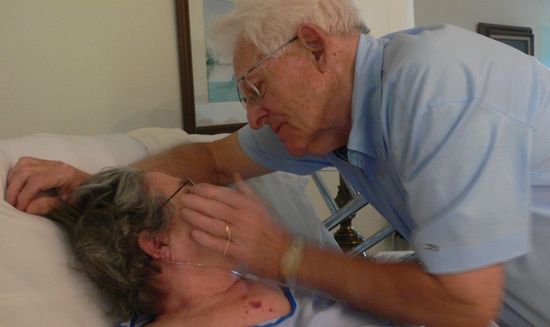
(Photo by Kelly Sue DeConnick, who writes, "He doesn't want to see this picture … because he doesn't want to remember her that way.")