About Those Twitter Revolutions

Losthope
by Zoë Pollock

Aaron Bady draws out an interesting angle to the social media aspect of the Arab Spring;

[I]nstead of the personality cult by which Presidents-for-life like Ben Ali and Mubarak have ruled for decades, the masses of nameless Cairenes and Tunisians—assembled on Facebook and in the street—represents a kind of anti-personality cult. When everyone is "Khaled Said" (or "Mohamed Bouazizi" in Tunisia), after all, the story being told is not only that the nation is united, but that it is united by the common experience of having suffered at the hands of the state. In this sense, instead of "leaderless revolutions," perhaps we might think about how Facebook helped facilitate a "revolution of leaderlessness"?…

In other words, what Gladwell flags as a weakness of social media—the difficulty of producing strong commitment to a single idea or plan—might actually be what makes it uniquely valuable. By uniting around the crimes of Ben Ali and Mubarak, the much more difficult political question of what kind of government was to succeed him could be deferred until later.

(Image via Arrested Motion)

A Technicolor Lining To The Storm?

by Chris Bodenner

Hurricane Irene could cause a boom of boomers:

[O]ne of the strange aftermaths of a hurricane is an increased amount of mushrooms popping up — especially the psilocybin — or "magic" kind — the ones that cause hallucinations. According to Dr. Casey Simon, an addiction expert based in Orange County, Calif., hurricanes create the perfect climactic conditions for the mushrooms to grow. "Mushrooms are spores and they multiply in moisture and are spread by wind," he told [David Moye].

But a word of caution:

Simon says the real danger of the mushrooms isn't the psilocybin. "Some mushrooms can attract a fungus that makes them more toxic," he said. "It looks like a gray mold on the under side. Just a few differences in temperature can make a difference." 

[Dr. Suneil] Jain says that's why experienced mushroom experts pick mushrooms when they are as fresh as possible. "The optimal time to pick is right after the storm before the other elements can affect them," he said.

Happy hunting.

The Postal Service On The Precipice, Ctd

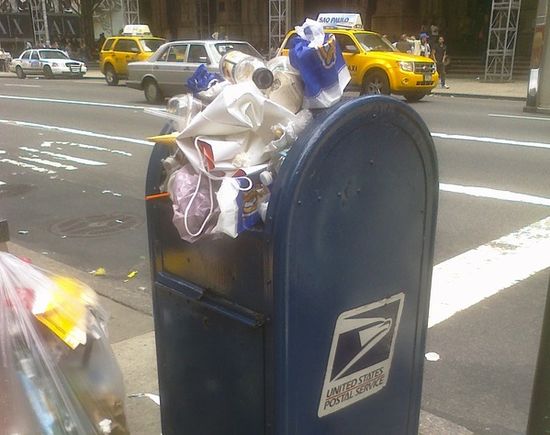
Junk-mail-16154-1303755453-28

by Chris Bodenner

A reader continues the popular thread:

I can’t believe all the love that the Postal Service is getting from your readers.  With each passing year, there are fewer and fewer things that require physical delivery.  A good 90% of what is deposited in my mailbox goes straight into the recycling bin unopened. I still get a red Netflix disc in my mail every week, but if I could access Netflix’s entire library online, I would drop that service in a heartbeat.  It’s only a matter of time. 

How much would we need to spend to build out the infrastructure so that every home that has access to electricity also has access to broadband?   How does that compare to the USPS’s annual budget?

Another writes:

I've been waiting for someone to question how "green" the postal service is.

Every week, my house receives massive amounts of coupon booklets and catalogues, many of which either are sent to everyone regardless of subscription or we receive because the previous tenants signed up for them. I know I need to unsubscribe from them, but companies don't make changing the subscription process easy, mostly because they don't want to.

The fact is, the postal service subsidizes and offers extremely low rates for catalogues and coupon books and generally junk mail. It's part of the idea that junk mail should be cheaper in bulk than individual mail. But those companies pay a way lower rate than the 42 cents we pay for a regular letter, and they don't have the same weight and size limits.

If, however, USPS charged more for delivering junk mail, it would have two effects: it would raise more money and it would reduce the amount, thereby reducing the amount of paper being wasted. But broadly, I think we should be asking, why are individual letters being used to subsidize junk mail from corporations?

(Photo by Gavon Laessig)

Picking Someone Out Of A Lineup

by Patrick Appel

Spurred on by a New Jersey Surpreme Court case, Adam Serwer reflects on the unreliability of eyewitnesses:

The most complex part of eyewitness misidentification … is the fact that people who wrongly identify someone are often really confident they've made the right choice–and that confidence is persuasive in court. The ruling notes that a previous ruling's observation that while “there is almost nothing more convincing [to a jury] than a live human being who takes the stand, points a finger at the defendant, and says ‘That’s the one!’” the fact is that "accuracy and confidence “may not be related to one another at all.” There's not necessarily any malice in this–it's simply an artifact of how our brains work.

Steve Chapman argues along the same lines.

The Politics Of Disaster

by Patrick Appel

Summarizing an old post, Ilya Somin explains natural disaster political incentives:

[P]olitical ignorance makes disaster policy less effective than it might be otherwise. “Rationally ignorant” voters over-reward disaster relief spending and under-reward disaster prevention spending, even though the latter is demonstrably more effective. They also give politicians insufficient incentives to prepare for very rare but extremely devastating disasters, such as Hurricane Katrina and the massive earthquake that hit Japan earlier this year.

Joyner sympathizes with public officials:

Governors and mayors have to make decisions about evacuation in time to actually affect an evacuation safely. The safe course is to take the worst projections, add 50 percent, and act accordingly. Nine times out of ten, though, people will be pissed that they were forced to evacuate unnecessarily. The other time, though, countless lives will be saved.

In the same ballpark, Joshua Tucker points to a paper that finds that "voters are willing to blame incumbents for just about anything, including things beyond the control of government like the weather."

Pre-Terrorism

by Zoë Pollock

Petra Bartosiewicz probes our disturbing efforts to catch domestic Muslim "terrorists." Sting operations have been set up where the government provides "the script, the arms, the cash, and other props, and offers logistical support." Bartosiewicz traces the trend back to FBI director Robert Mueller's memo in the days after 9/11, pushing a policy of “forward-leaning—preventative—prosecutions":

This memo, which detailed policies for “preemptive” operations, explains how, nearly a decade into our “war on terror,” Justice Department officials can claim we’ve caught hundreds of people domestically whom we call terrorists, while at the same time, according to the DOJ’s own statistics, only one person—an Egyptian immigrant who opened fire on an El Al ticket line at Los Angeles International Airport in 2002—has actually committed an act of terrorism on American soil.

Instead, the U.S. government has amassed more than 1,000 federal “terrorism-associated” prosecutions by expanding its investigative purview beyond actual attacks, or even “ticking time bomb” threats, to focus almost exclusively on a theoretically unlimited array of potential threats. To catch a successful terrorist under this system would constitute a failure of law enforcement, because the perpetrators would have already committed the act. Rather, these agents are seeking “pre-terrorists,” individuals whose intentions, rather than actions, constitute the primary threat.

The GOP’s Perry Anxiety

by Maisie Allison

Earlier this month Chait blamed Rick Perry's campaign for bringing back conservative identity politics, defined by a "postmodern approach to objectivity" and the notion that "there is no such thing as truth, only truths from the perspective of a social group." (Friedersdorf had similar concerns.) Now Jonah Goldberg is expressing weariness:

I think conservatism needs to spend less time defending candidates for who they are, and more time supporting candidates for what they intend to do…folksiness isn’t a substitute for seriousness, and I have very little patience for those who pretend otherwise.

Jennifer Rubin nods, and goes further:

Perry hasn’t said very much as yet about what he actually wants to do should he make it to the Oval Office. What does he want to do on taxes, the debt, spending, entitlement reform, immigration reform and the rest? I dunno. I hope we find out and learn that behind that bravado there is a forceful intellect, a yen for reform and a steady temperament…If nothing else, Perry should take a look at Sarah Palin’s disapproval rating with Republicans; the lesson there: Republicans can love your act and abhor the idea of your being president.

Curt Anderson accuses Perry's critics of "arrogance." Seth Mandel maintains that Perry can win the nomination on both policy and personality. Meanwhile, Philip Klein remembers Carter's strategy against Reagan in 1980, and refuses to believe that Perry will self-destruct (he adds: "None of this is to say that Perry is the next Reagan"). And Perry reminds Robert Mann of Goldwater (he too made "ill-considered" comments). 

(Video: Fox & Friends anchor Clayton Morris says that Perry's climate denialism is "resonating" and "gaining traction, facts or not.")

Bread Riots And Revolution

by Zoë Pollock

That's how author Annia Ciezadlo characterizes the Arab Spring, as so many of the countries that have seen revolutions are major importers of wheat. Ciezadlo explains the roots of the Middle East's dependence:

Part of it goes back to the Cold War, when the two superpowers were wooing third world countries with guns and grains and other goods. Rulers like Egypt’s Gamal Abdel Nasser started subsidizing bread as a way to buy loyalty, or at least obedience, and this system became so pervasive that the Tunisian scholar Larbi Sadiki described countries who used it as dimuqratiyyat al-khubz—“democracies of bread.” But the problem with this system of offering bread in exchange for genuine democracy is that it can never last—sooner or later, the bread will run out, and people will start demanding bread and roses too. …

There’s a long history in the Middle East of “bread intifadas,” starting with 1977 in Egypt, when Anwar Sadat tried to lift bread subsidies. People rebelled and poured into Tahrir Square, shouting slogans against the government just like they did earlier this year. Sadat learned his lesson and kept bread subsidies in place, and so did a host of other Middle Eastern dictators—many of whom were propped up for years by the West, partly through subsidized American wheat.

Infinity Hurts Your Brain, Ctd

Library of babel -desmazieres

by Chris Bodenner

The popular thread from last week continues:

Wednesday would have been Jorge Luis Borges' 112th birthday, so I thought this quote was rather pertinent to the topic at hand: "One concept corrupts and confuses the others. I am not speaking of the Evil whose limited sphere is ethics; I am speaking of the infinite."

Another writes:

I find it impossible to believe there has been so much high-level discussion of infinity and not yet one mention of Jorge Luis Borges, the poet laureate of infinity, whose birthday was just commemorated on Google's homepage. Borges has several stories dealing with infinity, perhaps most obviously "The Aleph", and in a subtler way, "The Blue Tigers". But his most famous story is a direct meditation on infinity: "The Library of Babel". I remember reading that story and my mind recoiling in shock at the very existence of the notion of infinity.

In the story, there is a supposedly infinite library of infinite texts. Since the texts are infinite, every permutation must appear, which means there must be one text which is a perfect index of the others. But the narrator tells us that fanatics went through the library, looking for this index, trying to burn it. Thus, it might be lost. But that's okay, our narrator says. Since there are infinite texts, there must be an infinite set of texts which match the index with the exception of a single character; and these would be as good, for all intents and purposes, as the "true" index.

If anyone finds your infinity series fascinating and has not read Borges, I would recommend they do so with all due haste.

Another:

I omitted another fun fact about infinities. This particular one is most appropriate on the birthday of Jorge Luis Borges, writer of The Library of Babel. This is a beautiful and eerie surrealist story which is largely about man's struggle to comprehend and draw meaning from the infinite, and I can't recommend it (or his other work) enough.

Hopefully you recall something of the difference between countably and uncountably infinite sets, and recall that the real numbers are among the latter. Do you know what else is only countably infinite? The number of possible English words, sentences, and books. (It's easy to enumerate them, numbering as you go: "A, B, C, … Z, AA, AB, AC,…,AZ, BA, BB,…,ZZ,…,AAA…etc." Throw in a few punctuation marks and you're basically there.)

Same for mathematical equations and other expressions. There aren't that many symbols and ways to arrange them, and even the craziest (compound fractions, etc.) can be broken down into a sequence of consecutive symbols on one line if we want to do so. And sure, you can always define new symbols or mathematical terms, but how do you do that? You write a book about it! And there are only countably many books you can write, whether they contain equations or not! Even if you're willing to use mathematical terms and symbols loosely and require the reader to fill in the gaps (for instance, the use of "…" in the previous paragraph), it doesn't solve the root problem.

What's this mean for us? Using the real numbers as our example again, there are some real numbers that we'll never be able to calculate, define, or even describe in any manner that would identify them uniquely. A thousand monkeys with a thousand typewriters could write Shakespeare; they could also acquaint us with "The square root of 2" or "Pi: The ratio between the circumference and diameter of any circle." But unfathomable infinities of numbers lie forever beyond their reach and ours.

I'm not really the sort of guy who has a favorite number; I'm more awed by the interconnection between different elements in a mathematical system than any individual one. Still, I can't help but be a little sad at all the numbers, many of them probably with fascinating properties, that are totally beyond our ability to conceptualize. And of course even if you don't care about numbers, or about real numbers specifically, it's worth remembering there are sets of objects that make the reals look downright tiny! Infinity is a big place.

(Image of a "Library Of Babel" etching by Eric Desmazieres. More versions here.)