The View From Your Window Contest: Winner #64

Vfyw-contest_8-20

by Chris Bodenner

I didn’t realize this window would be as challenging as it was, since the view is from a pretty famous city. But we only received about three dozen entries from readers this week, perhaps the lowest amount ever. One writes:

This reminds me of my pretty-much hometown of Santa Barbara, California. The Spanish-influenced architecture, the greenery-covered hills, all with an underlying American feel. This is nostalgia talking, as I’m four years removed from my Californian home, but I figure it’s as good of a guess as any I could come up with in the 20 seconds of analyzing the picture.

Another:

When I first saw the picture, I instantly thought to myself could this be Berkeley, the greatest town in America, my alma mater. The trees, brick roofs and the majestic bay in the background convinced me that it is.  Go Bears!!!

Another:

I think I’ve already ruled out this as a possibility, but when I first saw the photo, it reminded me of the southeast corner of Buena Vista Park in San Francisco. That large facility in the distance looked like the old St. Joseph’s Hospital, which was featured in Vertigo and eventually converted to condos. I’m all but positive it’s not, but if this were a picture of that building, it would have been taken from the California Pacific Medical Center – Davis Campus building at 632 Duboce. Maybe the 6th floor?

The photo was taken from a hospital, but wrong country. Another:

I almost keep trying the same answer, but is the only place it reminds me of. It looks a lot like the mountain behind my apartment if Guaynabo, Puerto Rico.

Another:

I would rate this week’s contest as nearly impossible.

A distant shot of modern apartment buildings and trees. Not a single street visible, nor a single possible landmark.  Red tile roofs, which could be many places. Perhaps the trees are an odd shade of green, which suggested Australia to me. The buildings on the hillside appear to be facing something scenic, so I’m thinking the ocean. Sydney is my wild, wild guess. It must be very challenging for you to find the perfect degree of difficulty.

More than you know. Another:

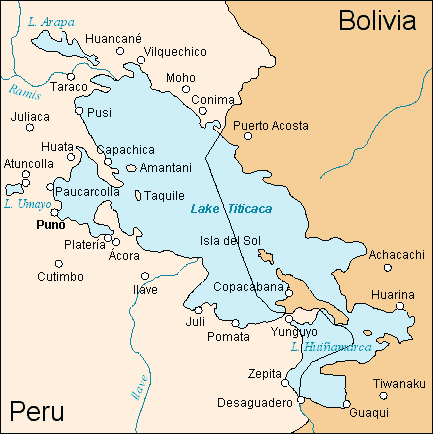
Random guess: the bold city on this map:
Lake_Titicaca_map

Another:

I’ve never been remotely close on any of the guesses I’ve made in the past (and haven’t entered, either). But I saw those buildings on a hill and the image stuck with me. Then I saw a documentary on Pablo Escobar a few hours later. I’m sure I’m wrong, but I can’t ignore the cosmic coincidence factor, so I’ll take a stab and say Medellin, Colombia.

Another gets on the right continent:

Heidelberg is my guess because of the lovely rolling green hills, the mix of what looks like old and new Western European housing, and, frankly, because I have a great affection for Heidelberg. As a 10 year old, my family of midwesterners, none of whom had been to Europe before, undertook a Clark Griswold-style adventure, prior to the fall of the iron curtain. One of the strongest memories I have from that trip was the “Student Jail” or Studentenkarzer, of Heidelberg, where naughty university students had been confined for a variety of offenses, including, according to the tour guide, setting the townspeople’s pigs loose in the street. Here’s hoping there’s some free-ranging pigs somewhere out of view.

Another:

The picture had an eastern bloc feel to it with those multiple flat-roofed apartment buildings.   But given the color patterns and subtropical look, I confined my search to mainly Romania and Bulgaria and near the Black Sea.  The closest similar-looking area I could find was about 5 km east of downtown Varna, Bulgaria.  I attached a picture which looks like the area depicted in the contest photo. Specifically, my guess is that the picture was taken from the Teacher Training building of Shumen University in Varna:

4774773

Another gets on the right track:

While the photo lacks any identifying landmarks, it does have a Mediterranean look thanks to the red tile roofs.  Dense oak forest could be near my home in California, but the specific landscape is not one with which I am familiar.  That leaves the actual Mediterranean and it seems like the dense forest is most prevalent in the northeast corner of Spain.  Searching for coastal cities with hilly but not rugged terrain and high rise buildings, I settled upon Lloret de Mar, Spain.  Since I can’t find the specific view I don’t think that is quite correct, but it’s as close as I’m going to get while still getting some work done.

Another:

The photo looks Mediterranean, with the reddish orange roofs and what looks like a mix of deciduous and conifer trees. It looks like there may be a bay at the top right corner. Modern building in the foreground with what look like dormitories in the back, as well as older buildings enmeshed in trees. So I am going to take a guess that it is Haifa, looking onto the Carmel forest.

Another:

Nothing much in the picture that can be Googled, but the traditional architecture and hill are reminiscent of Dubrovnik, Croatia, along with the modern building from which the photo was taken. Looks like the Adriatic in the background. Hope that proximity counts.

Proximity is definitely going to win this one:

Hi.  Lyon, France?  Just a hunch.

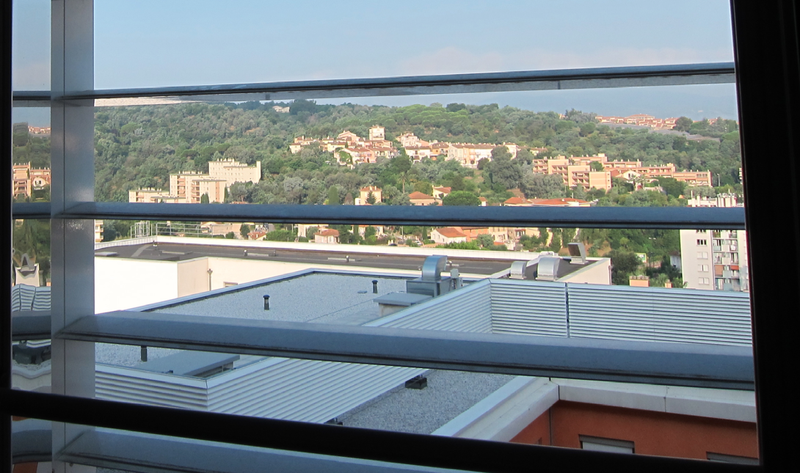
It’s Cannes, but Lyon is close enough for a win. (In fact, our winner was the only one to guess France.) We’ll get a window book out to you shortly. Easier one next week!

By the way, more details on the view:

We’re American. My husband had an emergency appendectomy, in France, this week. There are a lot of fascinating contrasts in the American and French medical systems, at least as we’ve experienced them.  (I had a baseball-sized brain tumor taken out a few IMG_0160 years ago, so we had some intense medical interactions).  The Centre Hospitalier de Cannes, in the La Croix de Gardes neighborhood, has committed, professional healers and the process is very focused on rest and sleep.  It’s much lower tech, and much more human.  And the quality, based on our anecdotal experience, seems high, at least for our issues.

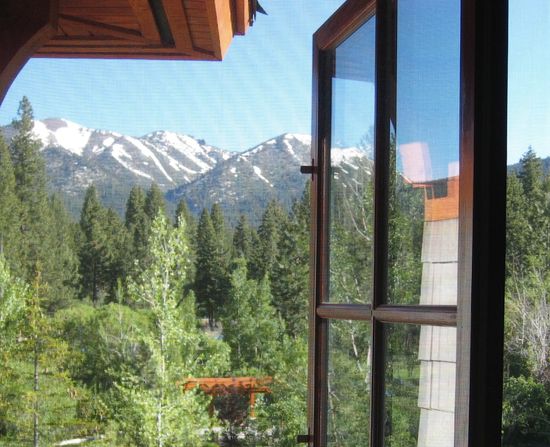
The view from the window is terrific.  I’m attaching photo with and without the IV pole in the way. It was taken by my husband, from the hospital bed.

(Archive)

Literati-In-Chief

Obamasbookclub
by Zoë Pollock

Ian Crouch heralds the latest nerd gossip: Obama's summer reading list (above). Instead of the expected biographic tomes, it's heavy on contemporary fiction and highlights the instinct for narrative that's been crucial to his political success. Obama seems like one of the rare political figures who seems as comfortable curled up with a good book as he is behind a podium.

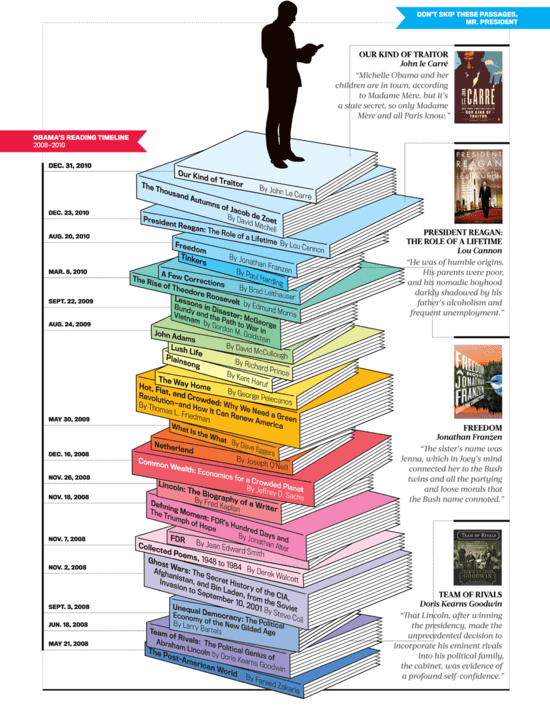
Ujala Sehgal rounds up the best over-analysis the internet has to offer about his heavy fiction choices, while Alyssa offers some alternative reading recommendations. Samuel P. Jacobs compiled what Obama's consumed since 2008. Full timeline after the jump:

Reading

The Costs Of Suing For Equality

by Patrick Appel

Dale Carpenter believes that the Prop 8 case thus far "been a setback for the cause of gay marriage as a matter of politics":

[T]he Perry litigation has sapped enthusiasm for a 2012 repeal of Prop. 8. Large donors, essential to any such effort, will not give because they expect that courts will hold Prop. 8 unconstitutional, bringing gay marriage back to the state and perhaps to the entire country. (And even if savvy donors don’t believe Perry will ultimately be successful in the courts, the existence of the litigation is a good excuse to hold off.) Why spend the money when courts may well take care of the problem? They have adopted a wait-and-see approach: we’ll see what happens and then consider whether to donate. Some of these donors have chosen to fund the litigation rather than a repeal campaign. Some are simply staying on the sidelines.

More commentary from SCOTUS Blog's marriage equality symposium is here.

Rebels Enter Bab-Al Azizya

By Zack Beauchamp

AJE's live feed (you can watch here) is reporting the rebels have breached Qaddafi's compound. Scott Lucas cautions against overexuberance:

James Bays is reporting that he believes the opposition fighters have entered the Bab al Aziziyah compound from two different locations, but he cautions that the compound is huge, the opposition fighters do not know it, Qaddafi's forces do know it well, and it is reportedly filled with tunnels and escape routes.

Naturally, there are conflicting reports about whether Qaddafi's inside. Al-Jazeera Arabic says civilians are now entering the compound.

Don’t Intervene In Somalia

by Zack Beauchamp

Ken Menkhaus describes al-Shabaab's implosion in the face of the famine:

The strain on al Shabab is likely to grow. Some of the organization's leaders operate in territory controlled by their own clans and face intense pressure from their people to allow food in. Tensions are strong between the most radical elements in the movement and these local commanders, who might defect from the movement to permit food aid. If this happens, key parts of southern Somalia may open up to aid agencies. Indeed, the key to ending the famine rests with these local al Shabab leaders, who are most likely to cooperate with aid agencies if allowed to do so discreetly. The United States and the UN should act accordingly, quietly working with dissident al Shabab leaders and protecting them from reprisal. The defection of al Shabab commanders would simultaneously strengthen humanitarian operations and weaken al Shabab. To further undermine and perhaps vanquish al Shabab, Ethiopia and Kenya have considered sending in Somali militia units that they have trained and equipped. But the United States should be wary of military operations by its regional allies at this time.

Foreign-inspired military operations in Somalia have a long history of triggering unintended consequences and, in this case, could rally Somalis behind al Shabab or encourage the organization to launch terrorist attacks outside Somali borders. If al Shabab remains intact and the famine worsens, however, the international community may face a painful choice between supporting armed humanitarian intervention and resigning itself to witnessing a major famine and offering aid only to those who manage to cross into Kenya.

You should go read the whole thing. Menkhaus' argument for humanitarian aid and diplomacy rather than intervention fits well with argument about global governance I was making yesterday. Though American military power gives us the ability to involve ourselves in issues outside our border without fear of conventional reprisal, said involvement by no means has to be military. In fact, global governance in the American order generally relies much more on non-military tools than the U.S. Army.

The Libertarian Escape Plan

SeaLand

by Zoë Pollock

Peter Thiel wants to build a colony on an island:

One potential model is something Friedman calls Appletopia: A corporation, such as Apple, "starts a country as a business. The more desirable the country, the more valuable the real estate," Friedman says. When I ask if this wouldn't amount to a shareholder dictatorship, he doesn't flinch. "The way most dictatorships work now, they're enforced on people who aren't allowed to leave." Appletopia, or any seasteading colony, would entail a more benevolent variety of dictatorship, similar to your cell-phone contract: You don't like it, you leave. Citizenship as free agency, you might say. Or as Ken Howery, one of Thiel's partners at the Founders Fund, puts it, "It's almost like there's a cartel of governments, and this is a way to force governments to compete in a free-market way."

Lauren Indvik notes that micronations are nothing we haven't seen before:

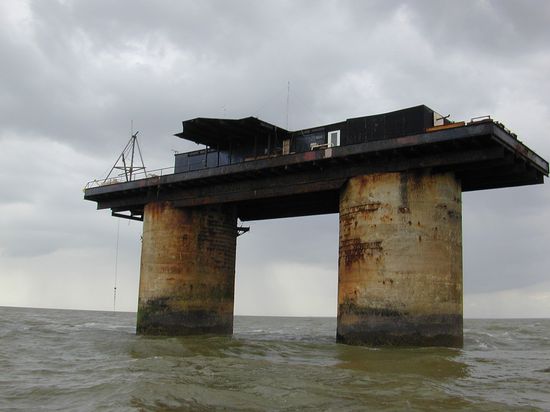
Among the better-known entities that have failed to be formally recognized by any other country is the Principality of Sealand, founded in 1967 off the coast of Suffolk, England. Sealand issues its own currency, postage stamps, passports and certificates of nobility. Its current population: 3.

Weigel says Thiel's pipe-dream is old news:

My theory is that the persistance of Ron Paul and other libertarians in the current political debate means that liberals are more interested than they have been before in making fun of libertarians. This desire outmatches the desire to find out the details of the thing being made fun of. The fact that this is the third annual Seasteading news cycle suggests that Seasteading isn't actually catching on yet.

(Photo of Sealand by Flickr user Octal)

Can Distrust Bear Fruit?

by Patrick Appel

After watching events unfold in Libya, Felix Salmon zooms out:

Most fundamentally, what I’m seeing as I look around the world is a massive decrease of trust in the institutions of government. Where those institutions are oppressive and totalitarian, the ability of popular uprisings to bring them down is a joyous and welcome sight. But on the other side of the coin, when I look at rioters in England, I see a huge middle finger being waved at basic norms of lawfulness and civilized society, and an enthusiastic embrace of “going on the rob” as some kind of hugely enjoyable participation sport. The glue holding society together is dissolving, whether it’s made of fear or whether it’s made of enlightened self-interest.

John Sides complicates this:

[W]hy is a loss of institutional legitimacy necessarily a crisis?  Some institutions and regimes are illegitimate, and if takes a bad economy to make them fall, then that’s hardly a bad thing.  I don’t think we can generalize about the inherent goodness or badness of legitimacy and illegitimacy or trust and distrust, without thinking about whether any particular institution deserves to be trusted.

The GOP Hates Taxes – Unless They’re On The Poor

by Zack Beauchamp

Fallows gets very angry about GOP super-committee co-chair Jeb Hensarling's desire to let the payroll tax cut expire:

Through the artificial debt-ceiling "crisis," through the Moonie-like spectacle in Iowa of candidates (including Mr. Sanity, Jon Huntsman) raising hands to promise never to accept any tax increase, the Republican field has been absolutist and inflexible about not letting any revenue increase, in any form, be part of dealing with debts and deficits. Except, it now turns out, when the taxes are those (a) that weigh most heavily on the people who are already struggling, and (b) would have the most obvious "job-killing" effect if they went up.

Scott Galupo has had similar thoughts.