The Tea Party And Defense

Matt Steinglass discovers an article by Tea Party leader Judson Phillips that defends military spending on the grounds that it "stimulates the economy." Matt's astonished response:

What's amazing here, obviously, is that Mr Phillips is justifying building aircraft carriers because government spending creates jobs and stimulates the economy. And he's right about that! But it seems that there are no other things the government spends money on, apart from defence, that Mr Phillips believes can stimulate the economy.

He appears to believe that while government spending on aircraft carriers leads to workers getting hired, spending their paychecks, and helping the recovery, government spending on highways, high-speed rail, education, and health care does not. Meanwhile, Mr Phillips also believes, as he argued in a Washington Post op-ed last week, that the government shouldn't borrow any more money, because that's leading us to economic ruin, like Greece. And he believes that the government shouldn't raise taxes, because that kills jobs. So where is the money supposed to come from? We're left with one possibility: Mr Phillips believes that we should build more aircraft carriers to stimulate the economy, and fund it by cutting other government spending programmes.
 

Words With No English Equivalent, Ctd

A reader writes:

These are Spanish words from my childhood with no direct English equivalent:

Lagaña – Eye crunchies.
Mocoso – Someone who has boogers.
Vavoso – Someone who slobbers.

Very entertaining to the 4-14 set.

Another:

One of your readers mentioned the German word "Fremdschämen" for "feeling shame or embarrassment on behalf of someone else." You might be interested to know that some linguists have tried to coin the English word "igry" to mean much the same thing.

It seems to have caught on as well as "fetch." Another:

The best Japanese word without an English equivalent: tsureshoben. It means to accompany another person after drinking to go out and pee in the street.

Another mixes romance and politics:

A true classic: Mamihlapinatapai.  It's listed in the Guinness Book of World Records as the Most Succinct Word.  Its approximate definition is "a look shared by two people with each wishing that the other will initiate something that both desire but which neither one wants to start".

Think of two people who mutually would like to be a couple, but dance around the subject because neither one is comfortable asking the other out on a date.  Or two politicians who both wish to implement a controversial policy, with each one wanting the other guy to stick out his neck first.

Another:

How about a new thread on the topic of British words for which there is no equivalent word in American English?  My favorite is "wanker", which initially referred to an onanist but has since become a general insult for someone considered to be pointless and useless.  It has a synonym in "tosser", but I find that word less jolly.

I'm also fond of the word "handbags" to describe a silly fight where the protagonists are unable or unwilling to seriously hurt each other. It is short for "a handbag fight", in reference to the way girls fight by hitting each other with their handbags.

Of course, it must not be confused with "handbagging".  A gift to the English language from the days of Margret Thatcher, it refers to dishing out or receiving a metaphorical battering in the world of politics.  Its entomology is tied to the fact that La Thatcher was rarely seen without a sleek and sturdy black bag on her arm. Persons on the receiving end of her abrasive style were said to have been "handbagged". The Iron Lady may be gone, but the word lives on – it has its own entry in the Oxford English Dictionary. 

“Something About Her Tells Me To Follow Her”

118969168

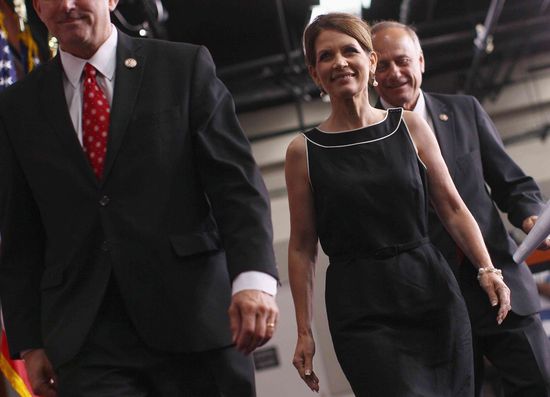
Lois Romano has a must-read on Michele Bachmann, whose rhetorical Tea Party purism doesn't jibe with her actual, you know, record or history:

She earned a federal salary as a lawyer for the IRS (an agency despised by the Tea Party), for example. Pressed on whether she took Americans to court to force them to pay back taxes, she answers carefully. “Our employer was the United States Department of Treasury. That’s who paid my salary,” she says …

Bachmann owned a stake in her father-in-law’s farm that received more than $250,000 in federal agriculture subsidies between 1995 and 2008. She says that money all stayed with her in-laws. In Congress, she tried to secure more than $3.7 million in federal earmarks for her district—the kind of pet projects she has blamed for excessive spending. And she railed against Obama’s $800 billion–plus Recovery Act as wasteful, then signed a half-dozen letters seeking stimulus funds for local projects. Her requests in 2009 echoed the arguments Republicans lampooned Obama for using. A bridge project could create nearly 3,000 jobs a year, Bachmann wrote, while a highway project would “promote economic prosperity.”

Hypocrisy? Remember Sarah Palin's furious lobbing for the bridge to nowhere and subsequent lies about it? I'd say it makes Bachmann the perfect red state candidate: addicted to federal funds but convinced that only others benefit from government. She is the perfect "Keep government out of my Medicare" candidate. And a great performer and debater.

(Photo: Rep. Louie Gohmert (R-TX), Republican presidential candidate and Rep. Michele Bachmann (R-MN), and Rep. Steve King (R-IA) leave a news conference at the U.S. Capitol July 13, 2011 in Washington, DC. By Win McNamee/Getty Images)

The GOP Owns The Economy

Benen thinks so:

Especially over the last couple of days, the underlying Republican pitch in response to economic anxiety and recession fears is, “See? It’s time to try things our way.”

What goes largely overlooked is the fact that we already are trying things their way. Whether Republicans want to admit it or not, the economy is advancing exactly as they want it to. The private sector is being left to its own devices; the public sector is shedding jobs and scrapping investments; and the only permitted topic of conversation is about debt reduction.

Still To Play For

OBAMAGOLFJewelSamad:Getty

The S&P downgrade was not a comment on America's economy; it was a comment on America's polity. The attempt by some on the far right (which is now, alas, synonymous with the right) to blame Obama is preposterous. Does anyone believe that if the GOP hadn't flirted with default, the markets would have been so spooked? The reference to both parties was politeness. We all know the reality.

And the reality is that the president has been very willing to put real compromise on the table:

Congressional Democrats, lobbyists for older Americans and advocates for the poor expressed alarm last month when Mr. Obama showed serious interest in proposals to reduce the cost-of-living adjustment for Social Security benefits, increase the eligibility age for Medicare and cut Medicaid payments to the states for treating poor people.

I know of no such compromise from Boehner or the GOP. Their absolutism on revenues is simply reckless and borderline insane at a moment like this. But there is hope. The Super-Committee should, in my view, expand its remit. The goal should not be another $1.2 trillion in debt reduction over the next decade but a full $3 trillion on top of the deal already made.

I support raising the retirement age, reducing the social security COLA, means-testing Medicare for the wealthy, beefing up IPAB in the healthcare reform, doubling the defense cuts now being proposed (sorry, Mr Panetta, but the Cold War is over and the defense budget should reflect that) and a tax reform designed to raise at least $1 trillion over the next decade. Rather than allow the Bush tax cuts to disappear, end the deductions, cripple the lobbyists who create them, and raise money while reducing rates. If the GOP cannot compromise even on that, then our political discourse is, indeed, over.

(Photo: Jewel Samad/Getty.)

Cool Ad Watch

Rebecca Cullers notes a first:

As part of the marketing for its new Picanto, the latest version of its smallest model, Kia came up with the world's first nail-art stop-motion animation film. That's right, it put together a micro-nail animation that celebrates the micro features of the car – with 1,200 bottles of nail polish, two hours of painting per nail, and 25 days and nights to complete all the work. Interesting and also weirdly Kia in its quirkiness, the little animation is sure to hit with the target market of city-dwelling ladies who like cute, zippy cars in candy colors.

Don’t Jail Them, Flog Them

It's a novel idea, and at first you think it's a joke. But in fact, he's deadly serious. And he has direct experience with crime as a former Baltimore cop and now professor at John Jay College of Criminal Justice in New York City.The main impulse of judicial flogging is to reduce the prison population in America which is, indeed, grotesque. Scott Horton interviews him and the whole interview is worth a read. Money quote:

The actual flogging would be done as it is in Singapore and Malaysia, where it involves tying a person down, spread-eagled, on a large structure, pulling down his or her pants, and flogging the bare behind with a rattan cane. Make no mistake: it’s painful and bloody. It’s not a gentle spanking. But the process is over in a few minutes. Then a doctor can tend to the wounds and the person can go home.

I think merely presenting the choice helps us question the purpose of prison, and suggests how destructive incarceration is for the individual and society. It’s worse than flogging.

The rationale?

Between 1970 and 1990 the total prison population in the U.S. rose by a million, and crime rose, too. Since then we’ve locked up another million, and crime has gone down. Is there something special about that second million? Were they the only ones who were “real criminals”? Did we simply get it wrong with the first 1.3 million we locked up? If so, can we let them out? …

We have more prisoners than soldiers, and more prison guards than U.S. Marines. We have more prisoners — by rate and number — than any other country in the history of the world: more than Stalin had at the height of the Soviet Gulag, and more than China has now. And China has a billion more people than we do! Something has gone terribly wrong.

Norm Geras gags at the idea of flogging, even if a consensual alternative to jail. I find it horrifying, but I see Moskos' point. And I do not see it as torture. It is not designed to get information or to break a person's will. It is punishment.

In my high school, caning was routine for misbehavior. The cane hung on the wall above the headmaster's desk. It made even a dressing down seem threatening. But it wasn't Asian style: and usually on a clothed bottom. One friend stuck a notebook in his underpants and didn't disguise it too well. So he got it raw. He asked not to sit down when he came back to class. Request denied.

Pundits: Foxes vs Hedgehogs

800px-European_hedgehog_(Erinaceus_europaeus)

Jonah Lehrer interviewed Philip Tetlock, the social scientist who disproved the authority of political pundits:

Some experts displayed a top-down style of reasoning: politics as a deductive art. They started with a big-idea premise about human nature, society, or economics and applied it to the specifics of the case. They tended to reach more confident conclusions about the future. And the positions they reached were easier to classify ideologically: that is the Keynesian prediction and that is the free-market fundamentalist prediction and that is the worst-case environmentalist prediction and that is the best case technology-driven growth prediction etc.

Other experts displayed a bottom-up style of reasoning: politics as a much messier inductive art.

They reached less confident conclusions and they are more likely to draw on a seemingly contradictory mix of ideas in reaching those conclusions (sometimes from the left, sometimes from the right). We called the big-idea experts “hedgehogs” (they know one big thing) and the more eclectic experts “foxes” (they know many, not so big things). …The most consistent predictor of consistently more accurate forecasts was “style of reasoning”: experts with the more eclectic, self-critical, and modest cognitive styles tended to outperform the big-idea people (foxes tended to outperform hedgehogs).

I try to be both myself, depending on the issue or event at hand. A Fox with spines?

(Photo: a European hedgehog from Soli-net. via Wiki.)

No Left Turn

Tom Vanderbilt summarizes urban planning efforts to update the intersection:

Left turns are the bane of traffic engineers. Their idea of utopia runs clockwise. (UPS' routing software Dorsett famously has drivers turn right whenever possible, to save money and time.) The left-turning vehicle presents not only the aforementioned safety hazard, but a coagulation in the smooth flow of traffic. It's either a car stopped in an active traffic lane, waiting to turn; or, even worse, it's cars in a dedicated left-turn lane that, when traffic is heavy enough, requires its own "dedicated signal phase," lengthening the delay for through traffic as well as cross traffic. And when traffic volumes really increase, as in the junction of two suburban arterials, multiple left-turn lanes are required, costing even more in space and money.

The diverging diamond interchange (above) engineers left turns out of existence but may not be able to keep up with higher and higher traffic volumes.

Chart Of The Day

Blog_union_density_income_inequality

Kevin Drum flags a new study on the impact of unions:

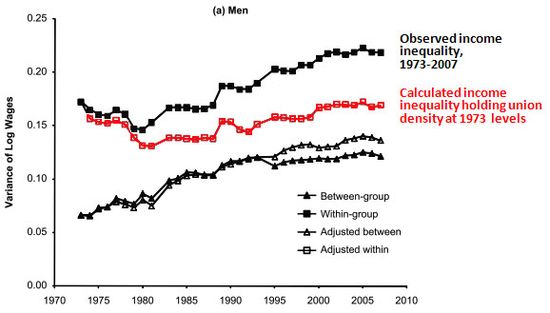
Among men, if you account only for the effect of individual membership in unions, it would be about a fifth lower, which agrees pretty well with previous estimates. But if you also account for the effect of unions on surrounding nonunion employers (who often raised wages to compete with union employers and to avert the threat of unionization in their own workplace), the effect is larger: Unionization at 1973 levels would decrease income inequality by a full third. You can see this in the chart below. For intragroup differences (which account for nearly the entire effect of unionization) the top line shows the actual rise of income inequality since 1973, while the red line is a prediction of what it would look like if union density were still at 1973 levels.