The Rickety Arguments Continue, Ctd

by Chris Bodenner

A reader goes against the grain:

A reader translates: "Doctor-driven medical studies are, like, just opinions, man."

Well, vile as I find Santorum, I have to agree with him on this one. The student who says something about the APA and 1974 is probably referring not to the American Psychological Association, but to the American Psychiatric Association. In 1974, the latter removed homosexuality from the Diagnostic and Statistical Manual (DSM), its formal list of mental disorders. The arguments within the association that led up to the removal were heated, and quite political.

The board announced that there was a scientific consensus that homosexuality was not an illness, and decided that homosexuality be removed from the DSM. Members who were upset by this move succeeded in forcing a vote of the entire membership. Ronald Bayer, in Homosexuality and American Psychiatry, notes:

Above all, those who continued to view homosexuality as a psychiatric disorder saw in the 37 percent vote against deletion a stunning refutation of the board's claim that its decision represented a scientific consensus.

Reading the Bayer book makes clear that homosexuality's status as a psychiatric disorder was no more scientific than its status as a non-disorder.

More historical background here. Update from a reader: 

I've been following your Rickety arguments thread, and I'm always amused by the way people rely on "science" to bolster claims, as if science were solid factual evidence and not a sophisticated method of inquiry and argument. But I am really writing just to remind readers, if you will post the link, that "This American Life" has done a superb job of telling the story of how 81 words were changed in the DSM. What I walked away with after listening to this story years ago was a deep sense that it's harder to stereotype and malign whole groups of people once you get to know them. Familiarity can breed compassion and lead to changes in policy. And as one would expect with TAL, it's a damn good story, and well-told.

Malkin Award Nominee

by Zack Beauchamp

"Why are left-wing activist groups so keen on registering the poor to vote? Because they know the poor can be counted on to vote themselves more benefits by electing redistributionist politicians.  Welfare recipients are particularly open to demagoguery and bribery. Registering them to vote is like handing out burglary tools to criminals.  It is profoundly antisocial and un-American to empower the nonproductive segments of the population to destroy the country — which is precisely why Barack Obama zealously supports registering welfare recipients to vote." – Matthew Vadum, American Thinker.

“Just Win, Baby”

by Maisie Allison

Matt Lewis rebukes the conservative movement's myopic approach to 2012: 

[W]inning is not an ideology…a conservative movement based solely on accomplishing a negative goal (removing a president from office) is unlikely to develop many positive/proactive ideas to implement once they have obtained power… There is, of course, nothing wrong with using an adversary as a motivation, but problems arise when accomplishing a negative act becomes the sole motivation. Ideas have consequences, and this one leads to long-term disaster (even if it brings short-term victory).

Should We Charge For Immigrant Visas? Ctd

by Chris Bodenner

A reader writes:

While I must agree with the reader quoting the Statue of Liberty, charging for a visa isn't exactly unique to America. Nor is the mountain of paperwork. 

I'm American, recently graduated from an American university, going to England for graduate school. I thought (very, very mistakenly) that the student visa process wouldn't be so bad. After hearing the horror stories of applying for American visas, it couldn't be worse going somewhere else, right? It's 11 days until my flight to the UK leaves, and I'm still waiting on my visa.

The basic application is $433. A rushed application ("premium") for student visas is an additional $100, plus can only be done in New York, Chicago, and L.A. The UK requires "maintenance funds" of what amounts to about $10,000 to be in a bank account, and they have been there for 30 days before you can even think about applying. This is on top of proving that tuition and university housing can be paid for. 

Then comes the certification of degree earned – or as I like to say, proof that I went to a real college. Since I'll be studying law, that had to be done through the Solicitor's Regulation Authority, which required a mailing of transcript and degree certificate, after paying for the application online. After getting that, I had to ask my university to apply for a number for me that showed I'd been unconditionally accepted and allowed me to start the visa process itself. 

The point is, while the American system sucks, so does every other country's. It wouldn't be so bad if this was a one-time thing, but I'll have to do this next year, apply for a work visa the year after that, and get to think about applying for citizenship two years after that. Delightful process, isn't it?

Another horror story from the US:

I am a legal 'alien' residing in the country for last 11 years and 8 months. I've been in the green card process since March 2002. My application to adjust my status as permanent resident was filed in mid 2005. As per law, I've been eligible for the green card since April of this year. A lot of applicants get their cases adjudicated in the first month when their priority dates become current. I am just waiting. I have contacted USCIS to process my case numerous times in last six months. I call customer service and they file a service request and block me from calling till they respond to it. USCIS sends me a letter telling me either that they are actively processing my case or my case is under pending service consideration. No success though.

Coming back to the cost, I have filed 7 H1Bs, 1 I-140, 1 I-485, 5 EADs, and 5 APs applications and roughly the same number for my spouse. The fees for me are paid by employer and I pay for my spouse. An H1B filing costs around $3000 including legal fees and an EAD (Work Authorization) or AP (Travel Authorization) costs around $650 each. I-485 costs around $5000 (USCIS fees, legal and medical examination fees).

So for a total of 37 applications, we have paid around $80K in last 11+ years. I am not done yet.

Should I pay more?

Andrew's 18-year struggle to get his green card came to an emotional end here.

Modern Prohibition

Marijuana_Price

by Patrick Appel

Timothy Egan applies prohibition-era politics to contemporary issues:

The coalition against drink was hardly a majority. The Anti-Saloon League played an outsized role at the margins, killing off moderates at the primary level, or in legislative deals, and forcing politicians to pledge to their cause.

Sound familiar? Today, virtually every Republican in national office, and a majority of those seeking the presidency, has taken a pledge to an unelected, single-issue advocate named Grover Norquist. His goal is to never allow a net tax increase — under any circumstances — and in the process reduce government to a size where he can “drown it in the bathtub,” in his well-known statement of mortal intentions.

Norquist is no where near as powerful as he pretends to be. Journalists like citing him because he's a personification of anti-tax ideology, and it's easier to write about people than it is to write about issues in the abstract. Anti-tax fervor would be ubiquitous in the GOP with or without him. But the point about prohibitionists being a minority is worth pointing out.

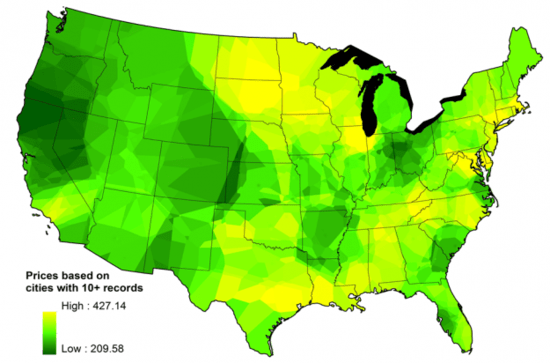
Map: Price of marijuana by county from Flowing Data by Floating Sheep.

Picking Someone Out Of A Lineup, Ctd

by Patrick Appel

A reader writes:

I know firsthand how unreliable eyewitness testimony can be. Quite some years ago, I was getting cash from the ATM across the street from my NYC apartment. As I was doing my transaction, I looked up, and a man was walking in who did not look like he belonged there. We were alone in the ATM. My instinct was to leave, but I said "now, don't be racist, just do your business and go." A moment later, the man walked over to me, pulled out a very large knife, and told me to withdraw $400 and give it to him. He told me his son needed an operation, and I would die before he let his son die. After a few false starts due to my shaking hands, I gave him the money, and he left, after warning me not to move until I counted to 100. I watched him walk away, and as soon as he was gone, I picked up the security phone in the bank.

Within a few brief minutes, bank security was there, and then a few minutes after, the police were there. Bank security told me there would be a video of the transaction, and that they were having it pulled, and then my money would be refunded. I gave a description to the policeman, a vague "African-American, average height, average build, wearing jeans and a hoodie." He put it out on his radio, and within a few minutes, he got a call back that some officers had stopped someone on the street meeting that description. They put me in a squad car to go see if this was the man who had had robbed me. This all happened very quickly.

I asked if the man they stopped had a knife and a wad of cash. He didn't, they said, but he was behaving "suspiciously." We drove to where the man was, and he was surrounded by about 10 police officers standing on the sidewalk. The officer in the car asked me if it was him. I said I wasn't sure, that he looked similar, but I didn't know. I asked if they couldn't just hold him until they saw the video from the bank. He didn't answer, but I knew the answer was no, not unless I identified him. So the officer in charge had them bring the man closer to the car, under a street lamp so I could get a better look. Two officers then really badgered me, having me look at him at different angles, in different light, etc. asking "Are you more sure, or less sure than you were before?" each time. They would tell me they didn't want to pressure me, but they were doing just that. I kept saying I wasn't sure, I didn't know, I couldn't really say, if only we could see the video. This went on for quite some time. The cops had loud conversations in my hearing "well, she can't identify him, we'll have to let him go, goddam it." I knew exactly what they were doing, and I knew what they needed me to do. After a long time, and a lot of agony, I said "okay, it's him." I truly wasn't sure, but "maybe" wasn't good enough, and I was sure they would be able to compare him to the video within a few hours, and if it wasn't him, they'd let him go.

Once I identified him, as tentatively as I had, the police officers treated it as if they had caught him in the act, as if my identification was 100% positive. It was as if all doubt had been erased. It was rather shocking, actually. We next went to the police station, and they parked me on a bench, and paraded this guy in front of me several times. I knew what was going on. I would soon become so familiar with his face that it would be very hard for me to separate out my recognition of the man who robbed me and the man who I saw in the police station. I am an attorney, not a criminal attorney, but I know enough criminal law, and I wrote a brief in law school about unreliability of eyewitness testimony, believe it or not.

I went away for the weekend, and I couldn't sleep a wink. Not because I had been held up at knife point, and my life threatened, but because I feared I had identified the wrong man. Of course, I had. The videotape showed that he was not the man. Fortunately, the man I identified was only held for a few brief hours, and released. Had there been no videotape, or if it was not clear, that man may have gone to jail for a crime he did not commit. I would not have repeated my identification if it turned out there was no video; I had decided that over that weekend, but I'm sure many people would have, because they would have felt pressure to do so, and would not have understood how tainted their identification had become.

The interesting coda to this is that several months later, I got a call from the police that they had arrested a man for armed robbery at ATM's, and they wanted me to come view a lineup. I was shocked. They would never be able to use my testimony, given that I had previously identified someone else, but I went anyway, to do my civic duty. I was determined this time that I would not identify anyone unless I was 100% certain. Shockingly, as soon as I saw the lineup, I was virtually certain I recognized the man who had robbed me, even after all these months, but because I wasn't 100% certain, and because I knew they'd never have me testify anyway, I said I didn't know. The police officer walked me outside, and I asked him why they'd bothered to have me come. He said they just wanted to close my case, they'd had about a dozen people already identify this guy. He also said that he thought that I recognized the guy in the lineup, he could tell by my face. He asked who I thought it was, and I told him, and he told me I was right, that was the guy.

There's something about a face. I should have known that if I wasn't sure about the first man they stopped, then it was NOT him. Under different circumstances, that first man could have gone to jail because he was walking while black in the wrong place at the wrong time.
A 9/11 Coloring Book

Coloring_Book

by Patrick Appel

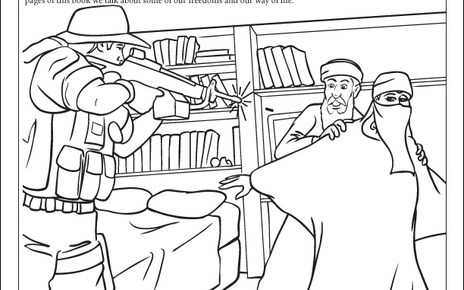
Elizabeth Minkel reviews the book, which gives me the willies:

The 9/11 book … has sold out its initial ten thousand print run. It remains to be seen how many were purchased for the novelty and how many will wind up in the hands of actual children, armed with Crayola 120 packs and ready to figure out exactly which crayon to use to color in the World Trade Center.

It should be noted that the above drawing is based on misinformation. The US government originally stated that Osama used a woman as a human shield before walking that statement back.

Wikileaks Wikileaked, Ctd

by Zack Beaucahmp

Joshua Foust worries about the consequences of Wikileaks' security breach:

The Zimbabwe cable Albon discusses was reviewed and vetted both by Wikileaks and  The  Guardian newspaper as a part of their "harm minimization" process. It was clearly inadequate. The latest leak, however, contains no such attempts at harm minimization. The new tranche available online contains no redactions, which places diplomatic sources, informants, methods, and communications even more directly at risk than any previous risk from accidental exposure. This latest leak is the purest distillation of Wikileaks' campaign to destroy the system of international diplomacy.

Greenwald, unsurprisingly, has a more sympathetic take. Oddly, Wikileaks is discussing a lawsuit against the Guardian with the U.S. State Department over its role in the leak.