Why Shouldn’t Women Serve In Combat? Ctd

A reader writes:

That letter from the "straight 46-year-old male" has to be a parody, right? It's just too on the nose.  The cataloging of his feminist street cred ("I'm as feminist as they come") that is then immediately undermined by the exaggeratedly offensive references to protecting precious "fertile wombs" and "cherishing" the helpless woman, seems too perfectly mindless to be real.  My guess is that this was written by a 20-year-old gender studies major looking for a laugh.

Another writes:

Yes, women are to be protected and cherished. That is why women routinely are killed, raped, mutilated, abused, burned out of their homes, left to starve, and otherwise become "collateral damage" in war. The idea that wars are fought because men are "protecting" their women is ludicrous. Wars are fought for territory, for resources (sometimes those "resources" are women), for ideology, for defense, and even, so the poets would have us believe, for more personal motives like revenge. There is no "deep psyche" reason for people to be appalled at the thought of women in combat. Women are already on the battlefield. They’ve always been on the battlefield in one way or another.

Another:

Regarding women serving in combat, I would put forward for example the WWII women snipers of the Soviet Union who numbered over 2,000 in strength. They proved themselves capable of the duty and several of them excelled at the task of killing the enemy. Like another reader put forward, we should determine what combat duty requires and then allow whomever can meet the demands, serve.

The Atlantic currently has a great photo essay of women engaged in World War II, including combat. For a fictional but realistic depiction of a female soldier taking down male enemies, watch the sniper scene from Full Metal Jacket (though fair warning: it's gut-wrenching). Another reader:

As a former combat-arms Marine officer, I don't have a problem with the idea of women in combat – provided they can fully hack it physically. Indeed, I've known some steely-eyed female Marines who could kick my butt from here to next Tuesday.

But it's not as simple as that. War is not a movie. In reality, it has always been a hellish Globe Theater tailor-made for cruel actors. They operate best in situations usually characterized as FUBAR, which are frequent. And sadly, war routinely invites the worst in men (see any war of your choosing since the Bronze Age). So I'm a bit surprised that your readers are dancing around the 800-pound gorilla in this debate: What happens when a female soldier or Marine is captured in battle?

To put it bluntly, some will almost surely be brutally raped. The greater the number of females in infantry-type units, the greater the odds some will be captured. The experience of Maj. Rhonda Cornum in the Persian Gulf War is just one example of why chivalry, if it ever actually existed, is long dead. Is the specter of sexual abuse not the core moral reason why some oppose employing women in combat? Are we as a society ready to cope with this special kind of collateral damage on a potentially larger scale?

If we (and the women we ask to serve in war) can live with this grisly reality, then, yes, open the combat arms to those brave females who can meet the requirements. But let all of us – tough, would-be G.I. Janes included – walk into this Brave New World with our eyes open. Know that ugly risks are involved.

Another:

Your reader concluded: "My generation grew up viewing the idea of women serving in the armed forces, as they might serve in any other profession, as natural and normal. But a woman on the battlefield somehow still seems to me like a crime against nature."

He’s half-right.  Until very recently, the American public has not had to deal with the idea of daughters, wives, girlfriends and sisters being maimed or killed in battle.  It is a crime against nature.

But the whole truth is that a battlefield is a crime against nature, as is war.  The fact that we as a society don’t seem to agree on this is a problem that keeps leading to more wars.  And if it takes opening up the battlefield to strong women to make the rest of us see the horror of war, and to fix the public mind on the idea that wars must be avoided, then those women in combatroles have already served a cause even greater than country or gender equality.  Their presence may lead to less reckless use of those armed forces.

In Defense Of Plastic Surgery

GT_PLASTIC_110913

Ole Martin Moen goes on a lonely quest:

Perhaps by paying for cosmetic surgery—and thus allocating resources to cosmetic medicine—we do something for which future generations will thank us. This could be the case if two premises hold true: The first premise is that transhumanists are right that real technological improvement comes when we start manipulating, not just our environments, but also our bodies. The second premise is that the cradle of such improvements is cosmetic improvement; that the most likely starting point of human enhancement is aesthetic enhancement.

Aesthetic enhancement has a long tradition, going back to early body painting, tattoos, and primitive jewelry, showing that we have a significant drive towards looking better. Today, that drive manifests itself in a formidable willingness to spend money on our looks. That drive and that money could make the most fascinating technologies of the future grow out of the cosmetic industry.

(Photo: Jahmar Bailey works on preparing a mannequin that sports extra large breasts for the display window of the Ocean 9ine store on April 26, 2010 in Miami Beach, Florida. A recent phenomenon in curvy mannequins is thought to be a reflection in the number of women who now have plastic surgery as well as catering to men's fondness for large boobs. By Joe Raedle/Getty Images.)

“Our Sense Of Fairness So Often Collapses At The Border”

Will Wilkinson ponders immigrant attitudes towards immigration. He notes that "immigrants depress the wages of established immigrants and their children more than any other group, yet immigrants and their kids are (not really surprisingly) more enthusiastically pro-immigration than any other group":

Immigration massively increases the well-being of immigrants while hurting American natives very little, if at all. Yet most Americans don't consider it unfair to give the rights and welfare of foreigners little or no weight in deliberation over national immigration policy. So I think it's right to say that American immigration policy reflects a sense among Americans that considerations of group interest are morally legitimate when the group is the group of Americans. Yet members of families that have benefited from immigration viscerally grasp the harm and indignity of having one's own rights and welfare systematically discounted due to a contingency of birth.

This seems so wrong not so much because it hurts one's own in-group, but that it does so on the basis of the morally spurious in-group partiality of most Americans. It's unfair to so drastically discount the rights and welfare of those who fall outside the national in-group. It should come as no surprise that, in a national survey, those best placed to feel the sting of this unfairness should oppose it most strongly.

Chart Of The Day

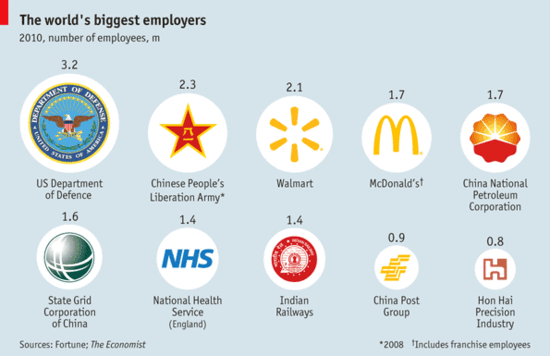
The world's biggest employers

The Economist illustrates a jobs conundrum:

One of the biggest headaches for policymakers in many rich countries has been how to create jobs during a period of fiscal austerity and anaemic growth. The private sector has been slow to generate jobs, and government-spending cuts usually end up cutting jobs. And governments employ a lot of people: in our chart of the ten biggest global employers, below, seven are government-run. America's defence department had 3.2m people on its payroll last year, equivalent to 1% of the country's population. China, the world's most populous nation and a big military spender, employs 2.3m people in its armed forces. 

Why Is Children’s Literature So Authoritarian? Ctd

A reader writes:

Oh for-the-love-of-Pete. Someone give this man a copy of The Hero with a Thousand Faces. Children's literature, as well as good children's TV, hews closely to the Hero myth. These stories teach our sons and daughters to be, without the presence of their parents, heroes in their own lives. They reveal the power of friendship, honor, justice, selflessness and sacrifice. They reveal greed, corruption, deception, desire for power and oppression of the weak as things to be fought against. Authoritarian background provides the starkest contrast to the choices of the individual. Methinks the nuance of parliamentary procedure can wait.

Another writes:

Jay Ulfelder should watch a Disney movie.

Disney heroes are almost always literal or virtual orphans who are rebelling against a corrupt, authoritarian power structure. If there are benevolent authorities, they are usually buffoons, powerless, or cannot perceive the threats that oppose the hero.

The game designer Robin Laws once pointed out that Disney's "Hunchback of Notre Dame" cartoon was a giant dagger in the back of the religious right, a story in which a corrupt authoritarian clergy must be brought down with the help of pagan gypsies. It taught millions of kids that the church is a vicious conspiracy to maintain power. Hmm…

Another:

It might better be said that the problem is bad children’s literature: didactic stories meant to teach lessons and inculcate obedience, blanket respect for authority, and simplistic definitions of good and bad. Alison Lurie’s Don’t Tell the Grownups: The Subversive Power of Children’s Literature offers some pushback. Good children’s stories – i.e., the kind kids actually enjoy rather than suffering through just to please adults – often deal in taboo, iconoclasm, and dark humor, with a deep vein of distrust for status quo adult values.

Several readers challenge Ulfelder's chief example supporting his case (spoiler alerts below):

I'll be brief because I'm sure I'm the hundredth to point it out, but Harry Potter is an epic argument against authoritarianism. There's a whole Wikipedia entry on its politics.

Another:

Look no further than the Harry Potter novels to see how governance is portrayed as difficult and messy, with no easy solutions. Fudge is a career politician who panics at the thought of the upheaval and terror brought by Voldemort's return. Consequently, he makes poor choices, even if he isn't portrayed as evil. Scrimgeour seems more fit to take on Voldemort, but he too struggles with making the right choices, perpetuating many of Fudge's policies (hushing up a mass breakout from Azkaban prison, continuing to hire wretched people like Dolores Umbridge).

Oddly enough, those examples could apply to our current president and his predecessor.

Another:

The Ministry of Magic in the series is just as much of an enemy as Voldemort.  At first ineffectual and bureaucratic (with a past history of McCarthyesque literal witch hunts), then transformed by fear into a police state, and finally overcome in a coup by Voldemort's supporters – every step of the way the apparatus of the magical government in the books demonstrates that "governance is a very hard and perpetual problem."  The absolute distrust of government running throughout the books is one of the many interesting things about the Harry Potter world, particularly when considered in light of the past 10 years.

Another:

The exception in the final Harry Potter book stands out.  That is, Harry breaks the wand that would grant him ultimate power.

The Daily Wrap

Today on the Dish, Andrew called the GOP out for cheering what the tragedy of the uninsured. Real conservatives moved towards moderation and compromise, while GOP elites freaked out about Perry's electability. Michael Scherer marveled at Perry's many campaign personalities over the years, Perry somewhat redeemed himself with an Yglesias award, and Ed Morrissey fact-checked Bachmann's anti-vaccine nonsense. Jamie Fuller compared Hillary and Obama to Romney and Perry, Palin pinged Perry and credited herself with calling the shots for the candidates and Levi entertained us with a new round of Sarah horror stories.

Conservatives will have to rethink their infatuation with Chile’s privatized social security system, Derek Thompson assessed productivity in the healthcare and education fields, and Seth Masket emphasized this election matters because the next president gets credit for saving the country. Members of Congress vote to please rich people because, for the most part, they are rich people, and fees may solve our revenue woes. The middle class felt the blow of a recession more than the rich, Jonah Goldberg exhibited some cognitive dissonance on exploitative rhetoric, and Eliezer Yudkowsky aired his libertarian frustrations.

Andrew echoed Erdogan and Bob Gates on how spoiled Israel is, we assessed the future fallout of a Palestinian declaration, and Michael Totten measured the hurdles Eygpt still faces for democracy. Church attendance boomed in China, and al-Qaeda may be done thanks to Obama's lethal persistence, while others disagreed. Flying while part-Arab is still a risk, Noah Millman recalled our wounded post-9/11 rationality, and approval of interracial marriage hit an all-time high, but Julian Sanchez wasn't buying it.

Andrew explored lower levels of testosterone after kids, and college is in for a transformation akin to journalism's. This is a truly great piece of 9/11 art, readers piled on the existence of Che shirts in Brooklyn, and one reader just couldn't handle the idea of women dying in combat. Jay Ulfelder challenged dictators in children's fiction, and Contagion sacrifices good story-telling for scientific accuracy. YouTube links live the longest online, and the future of home deliveries could involve 7-Eleven lockers.

Hathos alert here, map of the day here, MHB here, FOTD here, VFYW here, and contest winner #67 here.

–Z.P.

The UN And US Should Recognize A Palestinian State, Ctd

Eli Lake reports that "the Obama administration and its allies are waging a frantic, last-minute campaign to pressure Palestinian President Mahmoud Abbas to avoid unilaterally declaring statehood next week at the opening of the UN General Assembly." Noah Millman weighs the pros and cons of Palestine declaring statehood:

America will, undoubtedly, not even recognize a Palestinian state, which will make it exceptionally difficult for us to continue to try to be a broker between the two sides, but our non-recognition will stand out like a sore thumb once the bulk of the world has extended such recognition.

In the longer term, though, it’s the continuation of the conflict that creates problems for America. So whether a Palestinian declaration is bad in the long term depends on whether it makes it more or less likely for the conflict to finally be resolved. And that, in turn, depends on whether Abbas’s gamble pays off – whether he can midwife a Palestinian sovereignty that is actually functional and viewed as a modest success. If he can, then Israel’s conflict with the Palestinians would be “normalized” – it would be a conflict between two states rather than a conflict within a state. And the former type of conflicts are much more amenable to negotiated solutions than the latter.

Earlier thoughts on the subject here and here.

Al-Qaeda Is Done, Ctd

Petraeus and James Clapper aren't buying Gerges' argument:

David Petraeus says al-Qaida's recent losses of Osama bin Laden and others has opened "an important window of vulnerability" to exploit. In remarks Tuesday to a joint congressional intelligence committee hearing, Petraeus predicted al-Qaida leaders may even flee to Afghanistan or leave South Asia altogether to escape the CIA, which has quadrupled covert drone strikes against al-Qaida under the Obama administration. But Petraeus and Director of National Intelligence James Clapper both say al-Qaida's Yemeni offshoots and others are growing more daring, and dangerous — a sentiment seconded by senators and congressmen in their opening remarks.

Dimitry K. Simes and Paul J. Saunders urge that we not let our fear of terrorism sustain the national security state. Shadi Hamid wants to incorporate democracy promotion into our counterterror strategy:

In the long run, democracy promotion remains the best and most effective way to fight terrorism. That such a notion came to be associated with such an unpopular president made it easy to dismiss. The academic literature, however, appears to lend it support. Drawing on considerable empirical data, Alan Kruger — who is now, interestingly, President Barack Obama's pick to head the Council of Economic Advisers — found that "terrorists are more likely to come from countries that suppress political and civil rights." Reviewing the evidence, Steven Brooke and I made the argument for a causal link between lack of democracy and the incidence of terrorism in this 2010 Policy Review article.