Readers continue the thread in force:
One of my favorite films, Short Bus, is an unorthodox tribute to 9/11 and the New Yorkers left in its wake. Director John Cameron Mitchell generated a lot of buzz and controversy due to his integration of real sex into a feature-length film, but Short Bus was so much more about the emotional rawness of its characters seeking human connection. I don't have time to compose a more thoughtful tribute because I'm at work, so I'll just hand it over to Jim Emerson:
At Toys in Babeland, a sex shop in lower Manhattan, sales increased 30 percent in the wake of 9/11, according to the New York Observer. A year after 9/11, the number of babies born in New York hospitals was up 20 percent. These statistics form the background for John Cameron Mitchell's enchanting "Shortbus," the most unexpectedly honest and moving American feature film about 9/11 yet. And by far the funniest.
No, this is not a gripping docudrama, extrapolated from eyewitness accounts and official investigative findings, pumped full of Hollywood dramatic speculation and designed to elevate real-life heroism into the realm of pop-culture super-myth, like "United 93" and "World Trade Center." Instead, "Shortbus" takes place entirely in a fantasy post-9/11 New York City (played in the film by an ingenious handcrafted miniature), an interstitial dream in the chasm between that black day in September 2001 and the blackout of August 2003. In this ephemeral temporal-geographical metropolis, a lot of people engage in a lot of sex for a lot of reasons. And not to make you feel better about their valor, but simply because they're human beings who are still alive.
Another reader:
I know Bruce Springsteen's The Rising has already been mentioned as a great work of art that came out of 9/11, but I wanted to specifically mention his solo performance of "You're Missing" on SNL in October 2002. It still moves me to tears.
Another:
There is some debate about whether Wilco’s "Jesus, Etc." was written about 9/11. I have never seen that issue definitively resolved. The album on which it appears, Yankee Hotel Foxtrot, was released in 2002. If the song was written before 9/11, it makes it even more moving given what it captures. Even if you believe the pre-9/11 doubters, the song is truly beautiful and worth a listen.
There is also a popular meme that Radiohead's 2000 album Kid A predicted 9/11. Another:
Sleater-Kinney from their 2002 album One Beat has a few songs about 9/11, but "Far Away" is the only real 9/11 piece of art that has hit me. It just really hits home for me with the mix of fear and sadness that came over me in the immediate aftermath of 9/11.
Another:
Loudon Wainwright's astonishing "No Sure Way" is unlikely to be surpassed.
Another:
I'm surprised no one has mentioned Mary Chapin Carpenter's "Grand Central Station." Backstory here.
And another:
My favorite work of post-9/11 art is this lecture that McSweeneys reposts every year on the anniversary. It was given by a former literary agent 14 days after the attacks and almost perfectly captures what was uncapturable in those first few foggy days, when we thought nothing would ever be the same:
So if art cannot contain or describe this event, and if for now the suffering is too keen to be alleviated by parable… if stories are for the moment not as critically needed, as courage, as medicine, as blood, as bacon, they can at least revert to this social function. As time goes on, this will all pass away into memory, into a story with a beginning and a middle and finally an end. And that transition from the real into fable will bring its own kind of comfort and pain. Now, though, we may gather and distract one another, take comfort in our proximity, and know that we are, at this moment, safe.
Another:
On a lighter note … "America (f***k YEAH!!!)"
Another:
I believe this work was already in production before 9/11, but I really can't see how Bill Viola's "Going Forth By Day" as released in 2002 isn't massively informed by that event. I remember seeing it in NYC and just being overwhelmed on so many levels, because I found so much of it to be a direct reflection/meditation of that experience. Here are two reviews by Lisbet Krogslund Bertelsen and Felix Salmon.
Another:
Graydon Parrish's "The Cycle of Terror and Tragedy" should be part of the discussion (though the New York Times hated it).
Yet another:
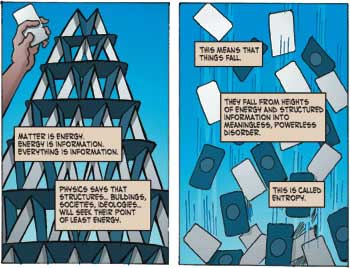
Shortly after 9/11, the comic book industry did a series of tribute anthologies, with the money raised going to relief charities for the victims of the attack. Alan Moore and Melinda Gebbie's contribution, a short story called This Is Information, ranges from the nature of entropy to the history of military interventions in Afghanistan to the eternal cycle of violence, but comes back to the simple image of one human hand holding another – falling through the air, or digging through rubble.
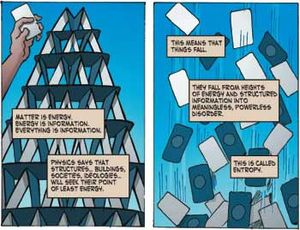 For all its surface intellectual cool, it pulses with grief and compassion underneath. The story places a then-raw disaster in a broader context and inverts a massive, unthinkable tragedy into a single, ordinary human act of hope and kindness. I still can't even think about the final lines and image of the story without getting a lump in my throat. Sadly, I can't find the piece anywhere online; the best I can dig up is this tiny excerpt.
Another:
I would nominate Omer Fast's "CNN Concatenated" as a great 9/11 work of art. You can see the first 10 minutes of it 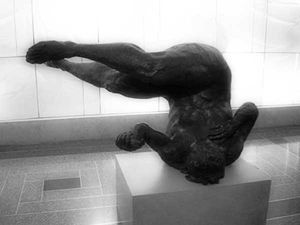 thought to be insensitive and disturbing. The piece was removed shortly after going on display because so many people found it upsetting. Fischl released a statement saying, "The sculpture was not meant to hurt anybody. It was a sincere expression of deepest sympathy for the vulnerability of the human condition. Both specifically towards the victims of Sept. 11 and towards humanity in general." I believe that Fischl was sincere, but I think that he was just incorrect when he later claimed people misunderstood the work because it was too bodily and people are uncomfortable seeing bodies. In my view, this was a really dense thing for Fischl to say. Instead I think Fischl bumped up against the limits of representational art as a means of coping with tragedy.
In a way, one of the reasons that there is not more great art about 9/11 is that art usually isn't up to the task. Even the best poets can't find the right words for an event like 9/11, or the plague, or the holocaust, or torture. There is a fundamental rip or void that art can only cover up, it cannot adequately represent or articulate it.
One more:
I think there is a misconception in this string that has to do with this being largely a political and philosophical blog. The people reading and responding are primarily interested in politics, not matters of aesthetics, and, I think, tend to view politics as the driving force for every other human endeavor. I assert that this is not the case, and that high quality in art has nothing to do with politics.
I remember the art critic Robert Hughes once pointed out that sometimes there are just low periods of art. In other words there are golden ages of art and then there are periods when not much memorable is produced. The quality of art production at any particular time and place has no relationship at all to the significance of political events. I think it is essentially a mystery of why some periods have outbursts of creative genius and others are fallow, but it is safe to say from a survey of art history that there isn't much consistent correlation with significant political events. There are plenty of significant historical events that have only bad or middling art associated with them – the Civil War for example. Whitman's worst poetry and a lot of really bad memorials were inspired by that war, but no great art (Gone With the Wind?).
Sometimes there are great flowerings of culture when an area is in political decline, or when it is relatively unimportant. Athens was a tiny, miserably poor city state compared to the Persian Empire, but it produced an astonishing amount of work of lasting value. The Russians were writing great novels and producing great music even when the Russian economy and general level of culture was an embarrassment compared to countries in Europe. The source of great art really is a mystery.
 The Dish