"If Social Security is going to be reformed, it’s going to be by politicians who appear visibly more interested in protecting it than ideologically transforming it. Perry did not appear that way last night," – Maggie Gallagher, NRO.
Month: September 2011
Quote For The Day
“Iran calling for Syria to dialogue rather than use force against its population is akin to Silvio Berlusconi telling Charlie Sheen not to womanize,” – Karim Sadjadpour of the Carnegie Endowment for International Peace.
Ahmadinejad's abandonment of Assad is really quite something, isn't it? Combined with the obviously biting sanctions and the viral disruption of nuclear research, the Obama administration has almost done as much to weaken Tehran as Bush and Cheney did to empower it.
“A Second Date”
David Brooks signs on to Obama's second, centrist stimulus. Like David, I'm not sure how much good this will do; but I am sure that doing nothing risks a real double-dip and untold human pain. Like Obama, I think this proposal must be linked to the super-committee's long term debt reduction plan – so we can retain confidence that we are not once again raiding the future to subsidize the present.
But what Obama has is what Cameron doesn't: a reserve currency that is still irreplaceable and that gives him some extra and unique lee-way to treat a stalled economy. That makes the perfect strategy just possible: short term stimulus, longterm austerity and reform.
I see a president fighting on for such an obvious sweet spot. I also see an opposition finally beginning to realize he has a point, and at last somewhat afraid of obstructing him. Their intransigence has publicly displayed their power and now given them accountability.
It's far too optimistic to think that the twists and turns of the last year might actually at some point twist out right. But if this bill can pass, with core elements intact, and if the super-committee doesn't fail, then we have a chance to do now what we shouldn't put off till after the election.
Know hope (which isn't the same thing as optimism).
Can We Save The USPS?
Testimony from the Postmaster General:

The Postal Service is near default [NYT]. Josh Barro argues that mail sent to rural locations should cost more. Wilkinson's dream policy:
My preference would be to lift the monopoly and shrink the USPS very gradually to, say, 20% of its present size (through a combination of buyouts, financed by the sale of USPS real estate, and a freeze on new hires) and transform it into a transparently tax-subsidized service (for households, not companies) that picks up and delivers mail once or twice a week for somewhat less than a private delivery service would charge. If you want to send a letter now, or want to send a piece of mail that gets where it's going fast, you can pony up and pay whatever DHL or FedEx or UPS or whomever is charging. Or you can wait for Wednesday, when that nice lady in the blue shorts looking forward to her very good pension comes by.
Earlier discussion of the USPS's problems here, here, here and here.
Headlines Of The Day
Drunk Swedish Moose Found Stuck in Tree
Libya Ferrets Out Gadhafi's Taint
Perry Hypocrisy Watch
In Wednesday's debate, the Texas governor attempted to distance his HPV vaccination mandate from Obamneycare. Will Saletan calls him out:
Perry said his vaccine order "allowed for an opt-out. I don't know what's more strong for parental rights than having that opt-out." But the opt-out procedure specified in the order is cumbersome. It says parents can "submit a request for a conscientious objection affidavit form via the Internet." And the opt-out clause doesn't distinguish Perry's mandate from Romney's or Obama's. The Massachusetts law exempts from its insurance mandate anyone who "files a sworn affidavit with his income tax return stating … that his sincerely held religious beliefs are the basis of his refusal to obtain and maintain creditable coverage." The federal law excuses anyone who obtains a religious exemption because "he is conscientiously opposed" to accepting health insurance benefits.
Perry may be right that good health and fiscal policy sometimes require mandates. He's entitled, as he puts it, to err on the side of saving lives. He's just not entitled to deride his opponents when they do the same thing.
Pareene points to another area:
Perry has spent this entire disastrous year berating the feds for not spending enough time, attention and — most important — money on helping his fire and drought-ridden state, at one point claiming the president had a personal vendetta against the state of Texas. (The U.S. Forest Service and National Interagency Fire Center are currently commanding firefighting efforts near Bastrop.)
Of course Rick Perry doesn't want to see Texas burn, so it is rational of him to ignore his rhetorical distaste for the federal government and demand that it help. And Texas could use the help, because Perry and the Republicans who control all three branches of Texas government have severely slashed the budget of the Texas Forest Service.
The 2012 Electoral Map
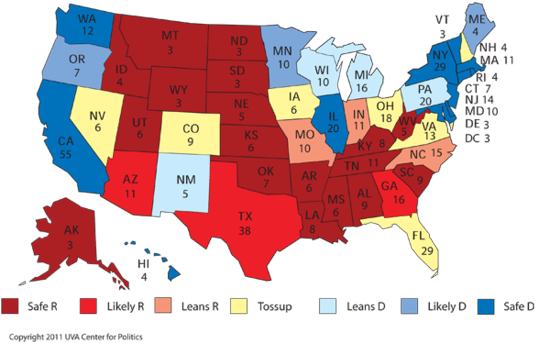
Larry Sabato offers a sneak peek:
So Republicans are a lock or lead in 24 states for 206 electoral votes, and Democrats have or lead in 19 states for 247 electoral votes. Seven super-swing states with 85 electors will determine which party gets to the 270 Electoral College majority: Colorado (9), Florida (29), Iowa (6), Nevada (6), New Hampshire (4), Ohio (18) and Virginia (13). Prior to Obama’s 2008 victories in each state, several of these toss-ups had generally or firmly leaned Republican for most elections since 1980.
Virginia, which hadn’t voted Democratic since 1964, was the biggest surprise, and its Obama majority was larger than that of Ohio, which has frequently been friendly to Democrats in modern times. Massive Hispanic participation turned Colorado and Nevada to Obama, and it helped him in Florida. New Hampshire was the only state lost by Al Gore that switched to John Kerry; its special New England character makes it especially volatile.
Iran’s Collapsing Foreign Policy
Meir Javendafar analyzes another blow to the Islamic Republic:
For Iran’s leaders, the margin of error for the economy is far smaller than for its foreign policy standing and influence. The recent news that China has scaled back its investment in Iran’s gas and oil sector should be particularly worrisome for Iran’s leaders — possibly worse even than events unfolding in Syria, because this directly impacts Iran’s economy, which gets majority of its income from its energy exports.
With majority of the world’s oil companies shunning Iran because of sanctions, China was one of the last countries which stood by Iran and its energy sector, which is in desperate need of investment and technological know-how. According to a study in a U.S. National Academy of Sciences publication in 2007, Iran could run out of oil for export by 2015. Lack of investment in the energy sector is one of the major reasons for this forecast.
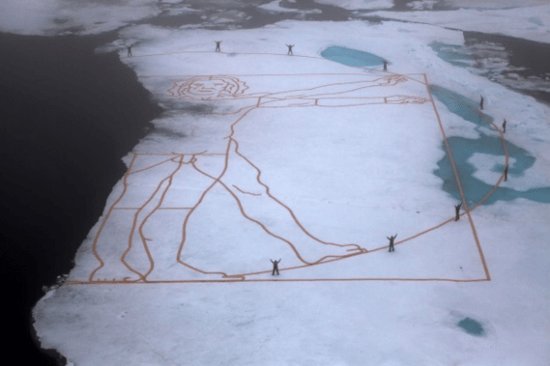
Cool Ad Watch
Narcissistic And Proud
How the conceited view their kind:
My results suggest that narcissists perceive narcissism (e.g., arrogance) as a personal strength. They do not think that their personality is socially desirable; instead, they see narcissism as a personality trait that brings an individual personal gain.
 The Dish