The Gay Gangs Of D.C.

Fighting back with sticks and stones:

"I just got tired of people beating on me and calling me faggie," Tayron Bennett, 21, told me recently. He'd helped to organize Check It while a student at Hine Junior High School. Other gay youths from his Trinidad neighborhood in Northeast soon joined, followed by gay youths from throughout the city. D.C. police estimate that Check It has a core membership of about 20 and counts between 50 and 100 others as "associates."

"At first, I tried fighting bullies one-on-one, but they don’t fight fair; they fight two and three on one," Bennett said. So the youths got together and "started carrying mace, knives, brass knuckles and stun guns, and if somebody messed with one of us then all of us would gang up on them."

Dan Savage cheers them on.

How The Greater Israel Lobby Won Again

The times they are a changin'. John Judis has written a piece I'd never thought I'd read at TNR. It's an elegant, factual, calm dismemberment of where the Obama administration has ended up on Israel-Palestine: on AIPAC's extendable leash, wagging its tail for a treat. On the pure principles of UN recognition of a Palestinian state, John shows exactly how American politics has been slowly but fatally corrupted by the Greater Israel lobby in recent years with respect to Middle East policy. One logical stiletto:

The United States, it is said, should not assist Palestinians in gaining membership at the UN because some Palestinians still don’t recognize the right of Israel to exist. But guess what? In 1947, there were Zionists identified with the Revisionist movement (parts of which later came together to create Likud) who denied the right of Palestinians to a state. They wanted all of Palestine and even Jordan for a Jewish state; and some of them were willing to use terror and assassination to achieve their ends. And there are still many Israelis who deny the right of Palestinians to a state. That didn’t preclude our helping Palestine’s Jews achieve statehood through the UN, and it shouldn’t impede our helping the Palestinians.

Precisely. More to the point, the Greater Israel lobby has actively damaged the interests of the United States on behalf of the illegal policies of a radical religious right government of a foreign country:

America’s standing in the world could only have been improved by being on the side of a Palestinian state. It would have removed an important talking point for Islamic radicals; it would have allied the United States with the reform forces of the Arab Spring, who, as has become clear in Egypt, are very critical of the continued Israeli occupation. American support could also have helped forestall the sort of explosive reaction among Arab publics that might follow rejection of the Palestinian bid in the Security Council. And backing Palestinian statehood would have put the United States in a position to work constructively with European and Middle Eastern countries, many of whom are hoping to see an end to the century-long standoff in Palestine and now Israel. Instead, Obama’s stand has made the United States an outlier in the region. We are identified not so much with Israel (which we have rightly defended against attack from other states), but with Israel’s occupation of the West Bank and with the expansionist ambitions of the Israeli rightwing.

The explanation for the humiliation of Obama at the UN, where he gave the kind of speech a junior congressman might give at an AIPAC break-out session, is pretty simple. Obama was checkmated. Netanyahu and the GOP recognized immediately that the Cairo speech could have opened up a whole new chapter in America's relationship with the Arab and further Muslim world. And so they, in active collaboration, did all they could to stop it in its tracks. They succeeded in handing Obama the clearest defeat of his first term.

The Obama goal was simple: win back global soft power in the war against Jihadist terrorism by demonstrating even-handedness again with the Israelis and Palestinians; use hard power much more effectively by lethally targeting al Qaeda in Pakistan and Afghanistan. The latter has been a big success. The former a major failure – fundamentally caused, as Judis beautifully explains, by Netanyahu's adamant resistance to any serious attempt at a two-state solution on 1967 lines with mutually agreed land swaps, the only formula with any chance of success.

Many of us who supported Obama partly on his potential to transform America's Muslim relations, especially in the wake of the extraordinary Arab Spring, have been crushed and angered. But the anger has by now led to total resignation. I mean: what, in the end, was Obama supposed to do? Many of the chieftains in his own own party – Reid, Hoyer, et al. – are more loyal to the Israeli prime minister and their core donors than to their own president. The GOP is even worse: actively going to Israel and colluding with the Likud against the US administration to enable more and more illegal settlements on the West Bank. AIPAC's roll-call at its last conference revealed a veto-proof majority of Congress. Veto-proof. I doubt that was a message designed to be buried.

So any genuine attempt to put any serious pressure on Netanyahu would be immediately undercut by the Hill. So would have recognizing the Palestinian state at the UN. If Obama had followed through, the Congress would have responded by cutting off aid to the Palestinians, backing Israeli annexation of parts of the West Bank, and would reveal triumphantly that even a president who has done as much for Israel as Obama (bunker-busting bomb sales, rescuing embassy staff in Cairo spring immediately to mind) cannot break out of the constraints any president is under when tackling this subject.

In that sense, I believe the pro-Greater Israel skeptics of the sincerity of Obama's UN speech are largely right. Obama simply has run out of options. So he has cut his losses and capitulated – what any serious leader does when he recognizes the forces against him are so massive there's no hope but to wait for a recapitalization after another election victory. Meanwhile, Netanyahu remains in Israel an extension of the GOP at home – and more secure than ever because the GOP has adopted wholesale the Christianist support for Greater Israel on theological grounds. What is at stake is nothing less than America's global credibility as a power able to act in its own interests, outside the demands of religious fundamentalists and Democratic donors. That has now been revealed, when it comes to Israel, as essentially impossible.

We had a window. It's important to remember who shut it, and tried to lock it tight.
Where’s Perry’s Platform?

He doesn't have one:

When Perry is under fire over some aspect of his Texas record, he hasn’t pivoted to signature plans for jobs or foreign policy. A spin through Perry’s website underscores the problem. Under “Jobs,” we find five paragraphs of conservative boilerplate. The most detailed sentence refers to “low taxes, reasonable regulations, a predictable civil litigation system and an educated workforce.”

Ed Morrissey frowns:

Perry’s competition have already laid out specifics on economic policy, especially his toughest foe, Mitt Romney, whose plan is detailed enough to be a 160-page book.  Herman Cain has his 9-9-9 plan, and even Jon Huntsman …. has an economic plan that the Wall Street Journal takes seriously enough to review and praise. Not having anything beyond a few boilerplate conservative concepts doesn’t give voters a reason to positively support Perry, and being this far behind the others on stage puts him in a weak position to answer policy questions on the most important issue in the upcoming elections.

“I Would Not Discount Mr. Cain’s Chances Entirely”

116764899

The 999 pizza man is now in a three-way race with a sinking Perry and water-treading Romney:

Cain has benefited not only from his debate performances, but also significant media attention after winning the Florida Republican Party’s straw poll on Saturday. Perry now garners 19 percent, a drop of 10 percentage points from a month ago. That puts Romney back in the top spot with the support of 23 percent. Last month Romney was at 22 percent.

Disillusioned Perry voters are not going to Willard:

Mr. Romney has emerged — or re-emerged — as the favorite; I’d give him roughly even odds of winning the nomination. But it’s unlikely to be a smooth and linear path, and the alternate hypothesis that Republican voters are determined to pick someone more conservative than him has some support in this data.

It cannot be easy for Romney to know that if he gets the nomination, it really will be because the GOP voters really couldn't find any other viable national candidate. In that dynamic, he reminds of John Kerry in 2004.

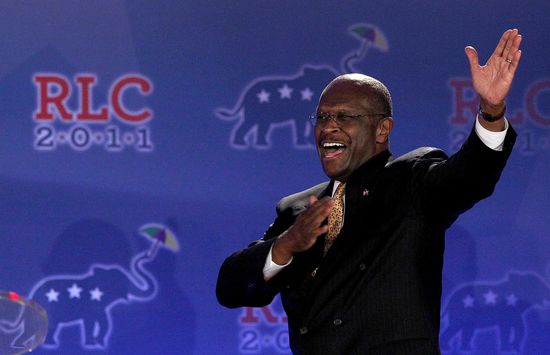
(Photo: Former Godfather's Pizza CEO and Republican candidate for president Herman Cain speaks during the 2011 Republican Leadership Conference on June 17, 2011 in New Orleans, Louisiana. The 2011 Republican Leadership Conference runs through tomorrow and will feature keynote addresses from most of the major Republican candidates for president as well as numerous Republican leaders from across the country. By Justin Sullivan/Getty Images.)

When Must Palin Decide?

Soon:

The filing deadline for the Utah primary, Oct. 15, is fast approaching. While a potential Christie campaign would most likely not suffer from missing this contest, his staff will have to be mindful of the next deadline: Florida. Failing to file by the Oct. 31 deadline in the Sunshine State would almost certainly derail any chance that Christie would have at grabbing the Republican nomination.

Of course, she could always go the third-party route:

Could Palin launch an independent bid for the presidency? Why not? What bridges would she be burning with Republicans that she hasn’t burned already? And if she did go that route, she certainly wouldn’t have problems raising a fair amount of money, and she would be able to mobilize enough volunteers to get her name on the ballot in quite a few states.

Quote For The Day

"Huntsman has been my biggest disappointment so far. I went up to watch him campaign in Exeter, N.H., a few weeks ago, and I’ve watched him debate. He has no theme, no narrative. His campaign seems to be a patchwork of positions that he rotates through. He doesn’t tie his policy vision to his personal story and abilities. He needs some emotional and intellectual coherence and a single energizing theme. I hope he finds it," – David Brooks.

Grids vs Cul-de-sacs, Ctd

Kevin Smith presents a third option, seen above. A reader writes:

I'll concur with the dissenters.  I'm on the grid in a dense part of Seattle.  We have a narrow street that everyone parks on, so it's one way.  That means that you have to carefully navigate and frequently pull over to let other cars pass. We've got chicanes throughout the grid, which slows traffic further.  Balls fly out in front of my car on a regular basis, but I'm usually already stopped. I'm going slow enough that I can see the kids playing ball and prepare for the inevitable.  It's a miracle if I hit 20 mph.  It means everyone in my neighborhood is out of town on vacation or something.  I grew up on a cul-de-sac and was always going at least 30.

Examples of a chicanes here and roundabouts – also common in Seattle neighborhoods – here. Another writes:

I've now lived in a dense grid system, a small town grid system and suburban cul-de-sacs with children, and we've found the grid systems to be much more fun and freeing for our childern.

In a suburban cul-de-sac, children end up needing car rides to go anywhere, they can't go to the grocery or library by themselves even when they are less than a mile away from these places. Cul-de-sacs result in access to conveniences being farther away by road, inaccessible by sidewalk, and the roads that those conveniences are on being more heavily traveled by higher speed cars.

In a grid system, there is almost always a low-traffic path to things like a convenience store or grocery or school that kids can ride their bikes on. This allows kids to learn to be more independent, to explore, and to separate themselves from their families. When my sons first when to the grocery by themselves on their bikes, it was a big deal, and they were obviously proud of themselves. I expect that many suburban kids don't get that experience until they or their friends drive.

Or as one reader puts it:

Moving to a cul-de-sac for "safety" is a bit like installing all those "baby-proofing" implements for your house.  As my friend David put it, "don't baby-proof the house; house-proof the baby!"  

A previous contributor writes back:

The strong feelings that this topic generates are in part attempts to justify one’s own decisions. While my earlier email extolled the virtues of cul-de-sacs, I choose to live in the city because there’s so much beyond cul-de-sacs that I want to have available. Ultimately both arrangements have their pluses and minuses.

That said, what one poster said about the tendency for suburban kids to get run over in their own driveways is just pap. Some people do stupid, unaware stuff like back up without carefully looking first. Stupidity happens anywhere. Somehow linking it to suburbia is weak.

The reader follows up:

Thirty years or so ago, Berkeley, California installed a system of barricades specifically to cut off secondary streets from being used as primary conduits. At the time most people I know were livid. Since then, we’ve come to accept them, and secondary streets have become both safer and quieter. What does it say that arguably the most progressive city in the country sees fit to interrupt their grid system? Perhaps the answer is that neither the grid nor the cul-de-sac alone is optimal.