A reader writes:
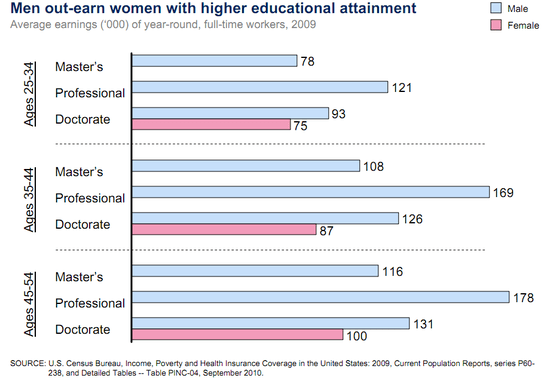
I need to put a damper on Taylor Marvin's eagerness to be treated to a meal. While it's true that women are earning more advanced degrees, they aren't earning the salaries that go along with them for men. It goes without saying that PhD women earn less than PhD men. But it may be more surprising that overall, women with PhD's earn less than men with master's degrees; among those between 35 and 54, the gap is in the neighborhood of 20 grand. (Yes, that's comparing women with PhD's to men with master's; if we were to compare with men holding other professional degrees – i.e., law, medicine – the gap quadruples to about $80,000.) It may be premature to look for changes in dating habits.
One of the reasons behind the surge in women's education is our awareness that we have to run faster just to keep up. We know we need to be more qualified than men to be competitive with them. And just as soon as our achievements translate into dollars and cents – all of them – I'm sure we'll be happy to pay the tab.
(I'm attaching a handy chart I made to illustrate.)
Another provides more data:
Don't worry, women's salaries aren't increasing relative to men any time soon. As a full-time, tenure track professor, who makes probably 1/4-1/8 of the salary of most full-time doctors, lawyers or bankers I know, I was very surprised by this piece and had to check the source. There are two major problems with judging the earning potential of women with doctorates using this data:
1. The earnings measured in these charts are based on "full-time, year-round" workers. Unfortunately, the reality for most people who get doctorates these days is that they never attain a "full-time, year-round" job. I am very grateful to be one of the lucky ones, but I have had to watch with dismay as so many of my co-graduates have failed to get tenure-track jobs. Instead the vast majority of PhDs, especially in the humanities and social sciences, put together 3-4 part time jobs to make ends meet – teaching a few courses as an adjunct instructor, doing some adult education, organizing some curriculum. These part-time adjuncts usually just manage to pay the bills, and seldom have health insurance or benefits.
2. The earnings measured are from 1997-1999. As the Chronicle of Higher Education has repeatedly reported, the casualization of labor in Higher Education (that is, use of adjunct instructors or grad students to teach courses instead of full-time professors) has exploded over the last decade. The recession of 2008 has only made matters that much worse, as state-funded universities are facing huge budget cuts and any increase in student enrolment has been met with apportioning more work to existing employees and increased exploitation of adjuncts and grad students. The number of people in PhD programs has not gone down, but the number of job ads has been drastically reduced, resulting this year in about 1 job per at least 100 applicants.
Getting a PhD is often a labor of love, spending 5-8 years as a student teaching, researching and writing with no guaranteed career trajectory once the degree is granted. Even those of us lucky enough to get full-time jobs earn far less than our friends who spent considerably less time in medical and law schools or MBA programs. So as a woman with a doctorate in the humanities but pretty average salary, I say: you can still pick up the tab for dinner, but brush up on your film theory and history of cinema if you want to discuss the movie.

