Gregory Djerejian weighs in:
While I will readily confess I find it odd as something of a Burkean that I am sympathetic to these protestors, they are not looking to trot out the guillotines, in the main (though I did spot a "Behead the Fed" sign!), but rather, they have smelled the radicalism of the body blows dealt to a representative democratic system presented by almost unfettered oligarch-like behavior among too many elites wholly disconnected from, yes, the 99% they speak of. They are acting to secure conservative aims of re-balancing a society that is becoming dangerously unmoored and increasingly bent asunder. They want accountability and dignity and prospects. Their leaders have failed them. So they have taken to the street to lead themselves.
It will not be easy in the months ahead (the encroachments of winter alone will prove a big test), but they have started something that has real potential, and should be lauded for it, and indeed urged to carry on. If so, they may accomplish something, even possibly something historic. In this goal, in my view, they should not immediately fall prey to pressure that they must issue some long laundry list of ‘demands’ that might risk ideologically ring-fencing them some and/or stealing the spontaneity of their movement, while resisting too close associations with old-line standard-bearers of the left like the unions. They have created something quite new on the American political scene, and should stoke it during these early days in a manner strictly of their choosing.
But maybe posters like this require, er, a little finessing:
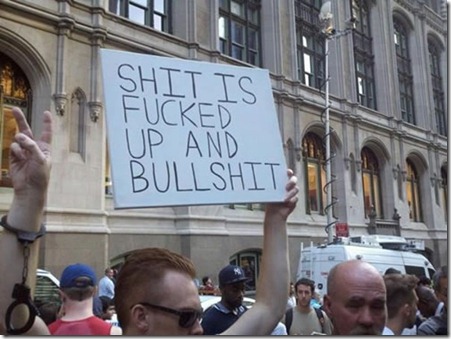
Yeah, we get the point, but are you aware you look like a scene from South Park? Douglas Rushkoff thinks the haters don't understand the core of the protests:
The members of Occupy Wall Street may be as unwieldy, paradoxical, and inconsistent as those of us living in the real world. But that is precisely why their new approach to protest is more applicable, sustainable and actionable than what passes for politics today. They are suggesting that the fiscal operating system on which we are attempting to run our economy is no longer appropriate to the task. They mean to show that there is an inappropriate and correctable disconnect between the abundance America produces and the scarcity its markets manufacture. And in the process, they are pointing the way toward something entirely different than the zero-sum game of artificial scarcity favoring top-down investors and media makers alike.
Melissa Bailey looks at how Occupy Wall Street is handling an influx of donations. As I've said, I'm as surprised as Greg by how sympathetic I find myself. But, on reflection, I've arrived at the conclusion these past few years that the kind of fantastic income and wealth inequalities in this country (and the trends that keep reinforcing them) are a threat to our political and social order. The massive concentration of wealth at the top is undermining some core assumptions about common citizenship, even within a free market economy, especially since much of the wealth seems acquired by accounting chicanery, crony capitalism and a K-Street fix. As such, conservatives should be worrying about inequality as much as liberals. So far, this is largely a peaceful, groovy, inchoate protest against the right target: the concentration of wealth in the financial sector and its immunity from any kind of social or political accountability for its role in the unending recession in people's incomes. I see nothing more culturally out there in these protests that were not in the Tea Party protests – from the other side. One man's nose-ringed hippie is another woman's costumed Tea Partier.
This is not socialism. It's pointing out how capitalism, unchecked by government, can kill itself. But if this issue is left unresolved or defended in the brain-dead fashion of many in the GOP, it will soon become so. And that's why I remain bullish about Obama despite the collapse of confidence after the debt ceiling fiasco and the Grand Bargain failure. His substantive position – that the very wealthy should play their part in tackling the debt, which means more revenues – is overwhemingly popular. If the election is between holding those people accountable or letting them off scott-free, Obama wins.

