Everybody Bikes

Who_Bikes

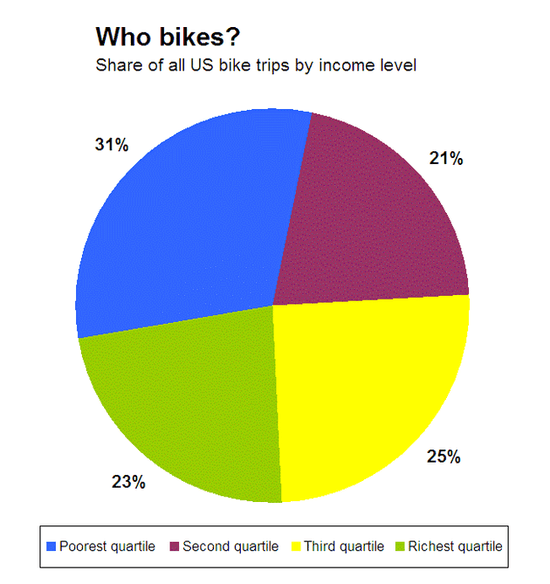
It's not just for hipsters and yuppies:

It’s certainly true that many of the bikers pedaling around the hipper city precincts appear to be of the bourgeois-bohemian persuasion. But take a look across the country and bicyclists are a diverse lot, including immigrants who lack the documentation to get a driver’s license and people who are too poor to own a car. These are disproportionately minorities. According to a 2006 report by the Brookings Institution and the University of California, Berkeley, 19 percent of blacks live in households without a car, compared with 13.7 percent of Hispanics and 4.6 percent of whites.

(Chart by Grist)

Up From Libertarianism

Jim Henley documents his own ideological reinvention:

I think my real *flip* was the Bush Administration's social-security privatization proposal in 2005-6, and the enthusiastic advocacy for it by libertarians like my, well, young friend Will Wilkinson. As long as privatized social security was abstract, I was all for it. But when it became, seemingly, a real possibility, I looked at the law, and I looked at the Henley-family finances, and I knew fear. Real "maybe I won’t sleep; maybe I’ll just stare at the ceiling all night" terror. Somewhere in there, I recovered enough other-directedness to recall that we are very far from the worst-off household I know. And I realized that my stated beliefs were a sham. A luxury. I leapt, at least in my secret heart, into one of the available cups.

Why Not Pay Teachers $125,000?

The film American Teacher makes the case for higher salaries. Dana Goldstein is disappointed by the film's simplicity:

[T]here is little doubt the quality of the teacher corps would improve if the job paid a six-figure salary. I love that idea! But any such increase in teacher pay would require either that we drastically raise taxes or rearrange spending priorities—exceedingly unlikely—or that we cut other major expenses in school budgets. Should class sizes be much larger? Should sports programs be canceled? Will administrators agree to take a pay cut?

American Teacher doesn’t raise these questions, but as any longtime observer of the education wars will tell you, meaningful school reform requires hard choices—lots of them—not silver bullets. If it’s possible for a two-hour movie to present these choices in all their complexity, it hasn’t happened yet.

Paying For Solar Service

new method of doing so:

"I would never pay $6,000 up front for a phone that gave me free calls for 5 years or 10 years or 20 years," [Paul Needham] says. "I wouldn’t do it, even if I thought I’d be better off." But that’s what solar companies essentially ask customers to do: pay up front for electricity years into the future. For very poor people with irregular incomes, that doesn’t make sense. Simpa Networks, the company that Needham heads, is working towards offering an alternative. Customers put down a deposit for the solar panels, then pay for incremental units of electricity, the same way they might put minutes on their phone.

Patenting PB&J

178708620_02e23123bd_b

Peter Smith recounts the ultimately failed attempt by Smucker's Uncrustables:

In order to secure a patent, inventions are expected to meet standards for novelty, usefulness, and "non-obviousness." That last bit is probably the biggest source for patent disputes. Patent No. 6,004,596’s usefulness was not in question. But a peanut butter and jelly sandwich is both mundane and obvious, even if you’ve cut off the crust, crimped the edges, and frozen it whole. Still, a patent examiner named Lien Tran approved the patent on the grounds that the invention was not just a sandwich: It was a sandwich within a sandwich. By surrounding the jelly filling on both sides with peanut butter so the bread didn’t get soggy, Tran determined, the inventors were on to something new. …

Smucker's continued to assert that its sandwich-making process was unique and worthy of protection, but as it turns out, the crimped edges of Uncrustables actually look a lot like ravioli. Upon re-examination, the patent office even noted that sandwiching jelly between two layers of peanut butter was not novel—it unearthed a citation in The Wichita Eagle from 1994, explaining the very method as a back-to-school tip for keeping sandwiches free from sogginess. A court ultimately rejected the patent in 2005. The story of the patented PB&Js is a convenient parable for the vast overreach and rampant abuse of intellectual property in the United States.

(Photo by Flickr user spike55151)

Should We Abolish Employee Credit Checks?

Barbara Kiviat weighs the arguments:

A decade ago, about a third of employers ran credit checks on job applicants; today, some 60% do. HR types (and, of course, the Big Three credit bureaus) argue that credit checks help firms find reliable employees who are unlikely to steal from company coffers. Civil liberties types argue that pre-employment credit checks have a disparate impact on groups that tend to have lower credit scores, like minorities. The Great Recession is what makes this back-and-forth particularly interesting. Losing a job is one of the fastest ways to wreck your credit. Now, it seems, that same bad credit may hinder you from regaining a steady paycheck and mending your finances. Quite the vicious cycle.

She concludes that "there isn’t any evidence that credit is an indicator of how reliable a worker will be, or the likelihood that he will embezzle or otherwise steal," which is why Connecticut, Maryland, Illinois, Washington and Hawaii have banned such credit checks.

Start Paying For Dinner, Ladies, Ctd

Screen shot 2011-10-02 at 11.23.14 PM

A reader writes:

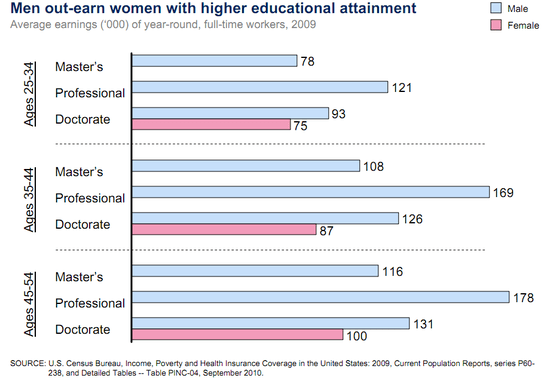
I need to put a damper on Taylor Marvin's eagerness to be treated to a meal.  While it's true that women are earning more advanced degrees, they aren't earning the salaries that go along with them for men. It goes without saying that PhD women earn less than PhD men.  But it may be more surprising that overall, women with PhD's earn less than men with master's degrees; among those between 35 and 54, the gap is in the neighborhood of 20 grand.  (Yes, that's comparing women with PhD's to men with master's; if we were to compare with men holding other professional degrees – i.e., law, medicine – the gap quadruples to about $80,000.)  It may be premature to look for changes in dating habits.  

One of the reasons behind the surge in women's education is our awareness that we have to run faster just to keep up.  We know we need to be more qualified than men to be competitive with them.  And just as soon as our achievements translate into dollars and cents – all of them – I'm sure we'll be happy to pay the tab.  

(I'm attaching a handy chart I made to illustrate.)

Another provides more data:

Don't worry, women's salaries aren't increasing relative to men any time soon.  As a full-time, tenure track professor, who makes probably 1/4-1/8 of the salary of most full-time doctors, lawyers or bankers I know, I was very surprised by this piece and had to check the source. There are two major problems with judging the earning potential of women with doctorates using this data:

1. The earnings measured in these charts are based on "full-time, year-round" workers. Unfortunately, the reality for most people who get doctorates these days is that they never attain a "full-time, year-round" job. I am very grateful to be one of the lucky ones, but I have had to watch with dismay as so many of my co-graduates have failed to get tenure-track jobs. Instead the vast majority of PhDs, especially in the humanities and social sciences, put together 3-4 part time jobs to make ends meet – teaching a few courses as an adjunct instructor, doing some adult education, organizing some curriculum. These part-time adjuncts usually just manage to pay the bills, and seldom have health insurance or benefits. 

2. The earnings measured are from 1997-1999. As the Chronicle of Higher Education has repeatedly reported, the casualization of labor in Higher Education (that is, use of adjunct instructors or grad students to teach courses instead of full-time professors) has exploded over the last decade. The recession of 2008 has only made matters that much worse, as state-funded universities are facing huge budget cuts and any increase in student enrolment has been met with apportioning more work to existing employees and increased exploitation of adjuncts and grad students. The number of people in PhD programs has not gone down, but the number of job ads has been drastically reduced, resulting this year in about 1 job per at least 100 applicants. 

Getting a PhD is often a labor of love, spending 5-8 years as a student teaching, researching and writing with no guaranteed career trajectory once the degree is granted. Even those of us lucky enough to get full-time jobs earn far less than our friends who spent considerably less time in medical and law schools or MBA programs. So as a woman with a doctorate in the humanities but pretty average salary, I say: you can still pick up the tab for dinner, but brush up on your film theory and history of cinema if you want to discuss the movie.
What The Victim Wants

Apropos of our discussion of the death penalty, many families of the victims, or the victims themselves, have come out against the death penalty for their attackers. In the days after 9/11, Mark Stroman shot Rais Bhuiyan in the face because Bhuiyan was an immigrant. Ten years later, Bhuiyan wanted to tell him why he forgave him:

In November 2009, [Bhuiyan] took a trip to Mecca with his mother. It was a Hajj, a pilgrimage. They stayed for a month, praying almost all day every day, purifying. In the quiet time, he sat and thought about his life, the chance encounter all those years ago, and the man who had taken his eye. Rais Bhuiyan felt his heart soften; he felt the pouring forth of something warm, something invigorating. He felt something leaving his body. He felt forgiveness. What had been pure fear, pent up for years, was now compassion. He didn’t hate Mark Stroman. He pitied him. Thinking of this man sitting in a prison cell, counting down the days he has left on this planet, he wondered if he could help him in some way. He remembered what the prosecutor had told him, and he didn’t want to break the law, but Bhuiyan wanted to talk with the man. He wanted to tell the monster haunting his dreams that he had forgiven him.

Texas refused Bhuiyan's request to meet with Stroman or stay his death penalty sentence. They executed him on July 20th. This week's discussions of the death penalty and redemption here and here.

Filming The Forever War

Michael Kamber reviews Hell And Back Again, a documentary by Danfung Dennis:

The Marines fight day after day against an unseen enemy, seemingly making little headway. They deliver good-will speeches to local leaders who stare blankly, then ask, “If you really want to help us, why don’t you leave?”  … It is hard to see the film and not make comparisons to Restrepo, the other masterpiece of the Afghan war. Restrepo, too, shows the war’s devastating effect on soldiers’ lives, yet it is suffused with warmth and love. Mr. Dennis spent a year with Sgt. Harris and his wife, and certainly he could have chosen to tell many stories with his footage.  The one he settled upon in “Hell and Back Again” gives the viewer nothing back; one leaves empty, frustrated at the wait for redemption that never comes.  This hard, cold film feels much like the distant war that has gone on for 10 years with little payoff.