Face Of The Day

130444241

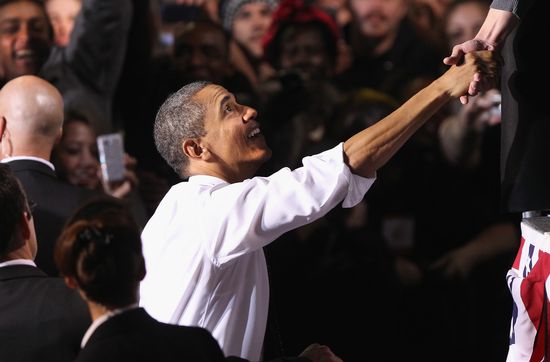
U.S. President Barack Obama greets a supporter after speaking at the University of Colorado-Denver campus on October 26, 2011. The President launched a new plan to lower the cost of paying back student loans. The plan, to be implemented by executive order, will allow former university students to cap their loan payments at 10 percent of their discretionary income starting in 2012. It would also forgive the balance of student loans after 20 years of payments. By John Moore/Getty Images.

The Arab Spring Isn’t America’s Lap Dog

Greg Scoblete explains:

It's going to almost impossible in the short-run to have a strategic relationship with many democratic countries in the Middle East of the kind that would satisfy the demands of sustaining U.S. hegemony in the region. The curious dynamic of the Arab Spring in the U.S. is that many of those who would champion U.S. hegemony in the region are also cheering on the revolutions. It seems increasingly clear that, in the short-run at least, the U.S. is not going to have both.

Cool Ad Watch

Copyranter isn't always a cynic:

Finally, an anti-drunk driving spot that gets the tone right. Only once before have I seen [one] that didn't make me shake my head and sigh (this entertaining short film via Denmark). Usually, the commercials are either pathetically preachy or "shocking." But this one, via the New Zealand Transport Agency, talks to kids, not at them.

America Rising?

Ambrose Evans-Pritchard is bullish about the future of American power:

The American phoenix is slowly rising again. Within five years or so, the US will be well on its way to self-sufficiency in fuel and energy. Manufacturing will have closed the labour gap with China in a clutch of key industries. The current account might even be in surplus. Assumptions that the Great Republic must inevitably spiral into economic and strategic decline – so like the chatter of the late 1980s, when Japan was in vogue – will seem wildly off the mark by then.

Sam Roggeveen pushes back:

I sincerely hope this is right, though even if it is, I doubt it makes much difference to the larger phenomenon. The slow shift of global power away from the US really hangs on the rise of developing countries, not America's fall.

Americans And Inequality

Top_One_Percent

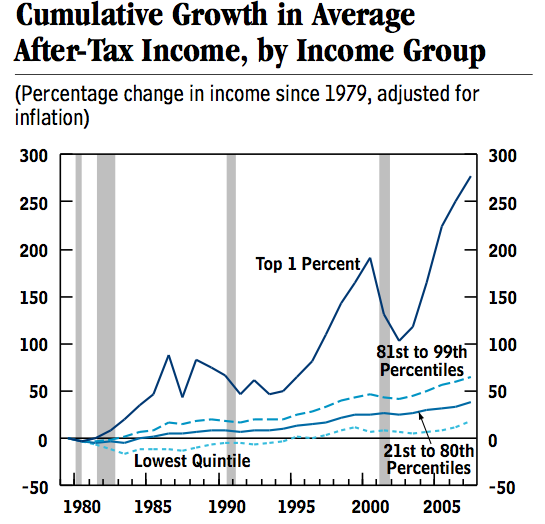
David Brooks assured us yesterday that Americans are moving away from – not towards – redistributionism. But here's a poll question from his own paper today

Do you feel that the distribution of money and wealth in this country is fair, or do you feel that momey and wealth should be more evenly distributed among more people?

66 percent back more even distribution of wealth, compared with only 26 who don't. I do not believe this is some great ideological move leftwards. I think it's a pragmatic worry about what is happening to American society and culture, and about how we reduce our debt of those with the most money continue to get away with paying historically low levels of tax. The data are increasingly indisputable, as Jeff Weintraub elaborates on here.

On the question of whose policies favor the middle class, 23 percent say that of the Obama administration, compared with only 9 percent saying it of the GOP. A staggering 69 percent say that GOP policies favor the rich, not a great position for a party in these times. And a reminder of why Romney is trying hard to avoid some of the policies more egregiously indifferent to inequality, like those of Perry and Cain. He's not stupid. Just shameless.

Something is happening in America, and I feel it within myself. A moderate and calm embrace of reducing inequality is not the electoral killer many assume it is. Times have changed. And Obama's more populist pitch has some serious data behind it.
How Do We Fix Medicare?

After pointing out that "a third of all Medicare spending goes for unnecessary surgeries, redundant testing, and other forms of overtreatment," Phillip Longman proposes cutting waste by simply eliminating Medicare payments to fee-for-service providers:

Going forward, Medicare should instead contract exclusively with health care providers like the Mayo Clinic, Kaiser Permanente, the Cleveland Clinic, Intermountain Health Care, the Geisinger Health System, or even the Veterans Health Administration. All these are nonprofit, mission-driven, managed care organizations widely heralded by health care experts for their combination of cost-effectiveness and high quality, including cutting-edge use of electronic medical records, adherence to protocols of care based on science, and avoidance of medical errors.

Because doctors working at these institutions are not compensated on a fee-for-service basis, they are neither rewarded for performing unnecessary tests and surgeries nor penalized financially for keeping their patients well. And unlike for-profit HMOs, these institutions are not pressured by shareholders to maximize earnings through withholding appropriate care.

Timothy Noah endorses the plan.

App Of The Day

Getting arrested

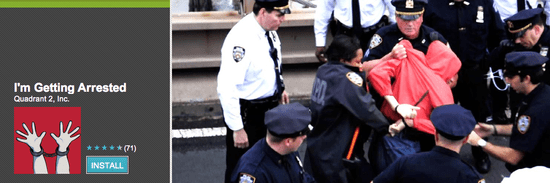
From Android, called "I'm Getting Arrested," inspired by OWS: 

Users craft a text message in advance and program a list of recipients. Then, as cops get the bracelets out, they can hit one button and tell everyone on their list that they're in danger of being pinched. As of Monday morning, 9,000 people had already installed the app.

From CNET's review:

As you can imagine, I’m Getting Arrested can be used for more than just incidents of wrongful detainment. It’s actually a great shortcut for sending any kind of message in a hurry. It can also be used for messages that you send regularly. For instance, do you send the same text to your carpool partner every day? Well, with I’m Getting Arrested, you can just program it in, and long-press the bull’s-eye instead of typing out your message every time.

Don’t Be Evil, Google, Ctd

Apparently, Google shutting down Reader sharing isn't just angering bloggers – it's also helping disable the Green Movement:

Google Reader, which thanks to its social features (which are going to be removed), is much more than a simple RSS reader for Iranian users. Google Reader is not in a separated domain (like any other Google product) and thanks to https protocol, it is hard to filter by government (To filter google reader the whole google.com domain should be filtered). In a country which all social website like twitter, facebook, friendfeed, and video or image sharing websites like youtube, tumblr, flickr, picassa and many more are banned, Google reader acts like a social websites and in lack of any independent news website (it should be mentioned that all international news channels like BBC, CNN, VOA, and all other non-governmental news website are banned,) Google Reader acts like a news spreading website. Easy access to Google reader made it suitable for Iranian community and through all these years, specially after June 2009 election, developed an strong community for spreading the news.

Sarah Perez expands on the point and flags a petition to save Reader sharing. 

So Far, So Good, In Tunisia

Ballots are still being counted, but Jason Brownlee is optimistic:

There is no past Middle East election quite like what Tunisia has produced. Whereas Algeria in 1991 and the Palestinian Authority (PA) in 2006 are natural points of reference, both cases were marred by the dominance of extra-electoral powers. A more instructive example can be found just outside the Arab World, in Turkey 2002, when the AKP won 34% of the national vote. Thanks to Tunisia’s current rules for allocating seats, Ennahda’s slightly stronger performance will translate into a smaller share in the assembly and, if current trends hold, a multi-party government. In short, the Tunisian 2011 National Constituent Assembly elections compare favorably with the region’s largest democracy and evince few parallels with Algeria and the PA. 

I find it inspiring. And on one parochial note: there's no hint here that Islamism means terrorism. It doesn't. It means a religiously dominated democracy, just as the Christianists want in America. Joshua Goldstein likewise reads the Tunisian election as a triumph of moderate Turkish Islamism:

The model [in Tunisia] is not the Palestinian Islamic armed faction Hamas, which rules the Gaza Strip, and not the Islamic Republic of Iran. It is no relation to the Islamist militancy of the fading al Qaeda. Rather, the model of the day is Turkey’s Justice and Development Party. It emerged from an underground Islamist force under a military government; it attended to daily needs of poor people in slums (garbage, electricity, jobs); it rode to power on the charisma of its leader Recep Tayyip Erdogan, who became mayor of Istanbul, then prime minister of Turkey. Erdogan has battled back the fiercely secular Turkish military, firmly establishing democratic civilian control after decades of military interference in politics. He is pro-business and pro-Europe. And his brand of Islamist politics is taking root far beyond Turkey’s borders.

Steven Cook looks at Turkey's equally significant role in the region's international politics. Ali Sarihan advocates democracy assistance from international organizations (rather than states) for the new democracies.