What Can We Know About Consciousness? Ctd

Sam Harris expands on his earlier thoughts:

The fact that the universe is illuminated where you stand—that your thoughts and moods and sensations have a qualitative character—is a mystery, exceeded only by the mystery that there should be something rather than nothing in this universe. How is it that unconscious events can give rise to consciousness? Not only do we have no idea, but it seems impossible to imagine what sort of idea could fit in the space provided. Therefore, although science may ultimately show us how to truly maximize human well-being, it may still fail to dispel the fundamental mystery of our mental life.

Perry’s Tax Plan: Is This A Joke?

Perry outlines his plan in a WSJ op-ed. He's proposing an optional 20 percent flat tax. Kevin Drum imagines Perry's brainstorming session:

[Y]ou sort of have to admire Perry's gimmick of allowing everyone to choose between his plan and the existing income tax. You can almost imagine the conversation: one of his advisors points out that no matter how careful you are, someone will pay more under the new plan. Probably people with low incomes, and you just know the librul media will have a field day with that. "It's regressive! Rick Perry hates the poor!" It'll be a nightmare.

But Perry has a brainstorm! Give everyone a choice! This means that not one single person will pay more under his plan, because they can always choose the old system if they want. This means keeping all 60,000 pages (or whatever) of the old tax code, of course, so nothing really gets simplified.

Reihan calls the plan an "embarrassment." The spending side of his plan is equally gimmicky

Rick Perry’s plan is to implement a ten percent reduction in spending, even though the share of elderly people in the population is rising, without so much as gesturing at which programs will be curtailed as a result. 

Bartlett finds all the GOP talk of tax reform as really subservient to tax cuts. I note that Perry exempts the mortgage deduction, the charitable deduction, and state and local taxes deduction from abolition. Not exactly a profile in flat tax courage.

Are Small Businesses Overrated? Ctd

James Surowiecki explains why our fetishization of small business is misguided:

The developed countries with the highest percentage of workers employed by small businesses include Greece, Portugal, Spain, and Italy—that is, the four countries whose economic woes are wreaking such havoc on financial markets. Meanwhile, the countries with the lowest percentage of workers employed by small businesses are Germany, Sweden, Denmark, and the U.S.—some of the strongest economies in the world. This correlation is not a coincidence. It reflects a simple reality: small businesses are, on the whole, less productive than big businesses, and though they do create most jobs, they also destroy most jobs, since, while starting a business is easy, keeping it going is hard. 

Felix Salmon nods.

The Occupied Library

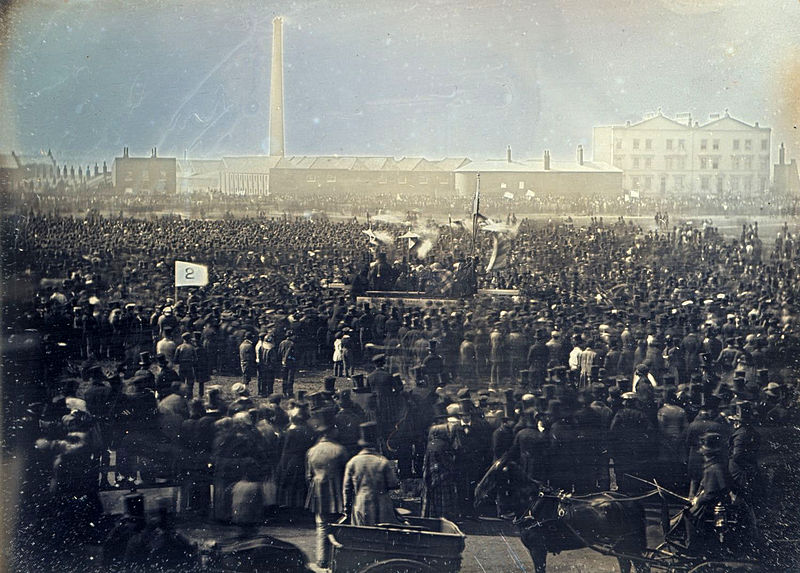
800px-Chartist_meeting_Kennington_Common-1

Today's occupy protests aren't the first:

In the middle of the nineteenth century, England’s Chartist movement—its energies strikingly similar to those of the Occupy movement, its intent similarly misunderstood by the powerful—established reading rooms throughout Britain. This was an era when public libraries were not widespread; most lending libraries charged subscription fees. The free Chartist libraries were enormously popular—and for the elite, enormously unsettling.

A commentator in Blackwood’s magazine argued that “Whenever the lower order of any state have obtained a smattering of knowledge they have generally used it to produce national ruin.” Utilitarian reformers sought public funding for libraries where, they argued the intellectual appetites of working class-readers could safely be turned to productive ends.

(Photo: "Occupy Kennington Common: London's Great Chartist Meeting, 1848")

Is Grooveshark Just As Bad As The Music Industry?

One band's attempt to remove their music from the music-sharing site hasn't gone well. Tom Hawking's conclusion:

Running rough-shod over musicians’ rights in the name of profit is something that record companies have been doing for years, and part of the justification of the whole liberation of music from such companies’ grasp is that it ultimately gives artists more avenues for the distribution of their music. If all it means is that they’re going to get screwed over by a whole new bunch of besuited profiteers… well, that’s awfully depressing, isn’t it?

Even though a Swedish study pointed to reduced music piracy levels after streaming sites like Spotify debuted, it may not be enough to buoy the industry:

[T]he payouts received by labels and artists from Spotify and similar services is tiny compared to what they make off of digital downloads and album sales. A handful of small indie labels have pulled their catalog from these services out of concern that the streaming model is not economically viable for them.

The Hirsute Devout

4209910250_afcc5eee42_o

Many characterize the religious beard as a testament to masculinity: 

As with other bearded religions, the Amish appear to wear their beards as a sign of manhood, and the recent attacks are consistent with the ancient Judeo-Christian tradition of forcibly shaving an enemy to emasculate him. The Ammonites humiliated the emissaries of King David by shaving their beards. In the Book of Judges, Samson loses his strength when his hair is cut. (Samson lost all of his head hair, not just his beard.)

(Photo by Jamie Mitchell)