Just your average beagle:
Month: October 2011
Must The Story Of The Fall Be True? Ctd
Jerry Coyne has written two responses (here and here) to my arguments. His most substantive point:
Wright certainly does not show that humans have become morally better over the last 200,000 years. He gives no data on that point, asserting only that scripture has become more moral since the early days of polytheism. But even if Wright is correct (and I don’t think he is), that says nothing about whether such putative moral improvement has anything to do with validating the Christian myth. In fact, if we’ve become progressively better over time, then why do we think there was a “Fall”? And even if there was a Fall, why does that give evidence for Sullivan’s belief in God, Jesus, and the Resurrection? All Sullivan is doing here is confecting a post facto story to justify his Catholic beliefs. But the story is unconvincing. He has not come close to answering my main question: how does he know that certain parts of the Bible—like Adam and Eve and the Fall—are to be taken metaphorically, while others—like the existence of God, Jesus, the Resurrection, and the expiation of sin “through the universal embrace of a loving God”—are true.
Bob's entire thesis was that religion can evolve and has obviously evolved over time. And I think that's indisputable. For the other point about declining violence and ameliorating morality, I recommend Steven Pinker's latest which I'm in the midst of right now. Coyne links to a post by Jason Rosenhouse:
Sullivan is joking, surely. The parts of the story we are arguing about; the reality of Adam and Eve, their status as the first people, their actual sin and its consequences for humanity, and the transmission of that sin by descent; have been taken literally by Christian authorities for centuries. For heaven's sake, most of the religious opposition to Darwin, especially from the Catholic Church, was based on Genesis 2 and not on Genesis 1. That Darwin's vision of natural history conflicted with the Biblical account of Adam and Eve was considered a grave problem.
But the Catholic church has come to embrace evolution, and even ecumenism, suggesting again that doctrine, as Newman insisted, can develop as our minds and culture evolve. As to Coyne's challenge to present a criterion of what is real in the Bible and what is true, I'd argue that empirical claims –  like, say, a census around the time of Christ's birth, or the rule of Pontius Pilate in Palestine at the time – can be tested empirically. But the Gospels themselves have factually contradictory Nativity and Crucifixion stories, especially in their mythological details (the Magi, the shepherds, the various sayings attributed to Jesus on the Cross, each of which suggests radically different interpretations), and so scream that these are ways to express something inexpressible – God's entrance into human history as a human being.
If you are treating these texts as if they were just published as news stories in the New York Times, you are missing the forest for the trees. You are just guilty of a category error – or rather of forcing all experience into the category of science.
The rub is the miracles, as Hume noted. Here we have clear empirical accounts of things that we cannot account for in nature, indeed stories that are told precisely because they defy the laws of nature. And when the real and the true seem to conflict, I think we need to rely on the true, and leave the real to one side. The point of curing a blind man is the lesson of faith: "I once was blind and now I see." I remain agnostic about the miracles as real; I have no doubt that they were true, that those who experienced Jesus' touch and message were transformed in ways perhaps only expressible in terms of physical miracles. That goes for Lazarus as well. When we are talking about coming back from the dead, we are entering non-real truths. And the most profound unreal truth is, of course, the Resurrection.
One way of looking at this is to see pluralism in our experience. Some things, most things, we experience as real, like a Happy Meal or a bike accident (yes, I wiped out badly on Sunday). Other things we experience as true – a profound musical epiphany, or spiritual calm, or unexpected joy. A reader elaborates on my last post on biblical literalism:
There is a difference between truth and fact, and fundamentalism and fanaticism stems from a confusion between the two. Evolution is a fact. The story of the Fall is true. Interestingly, the Fall is treated very differently by Muslims, Jews, and Christians, who each have their own truth about the Fall. Religious truths can differ from poetical truths, but both truths resonate in the person who contemplates the truth in question. The legends of Hamlet, Luke Skywalker, and Humphrey Chimpden Earwicker are true, even though none of them are factual (although the existence of Amleth of Denmark was most likely a fact, if Saxo Grammaticus is to be believed). Forcing the Fall to be factual is crazy, and makes for craziness. When believers try to force fact to succumb to truth, or force truth to succumb to fact, they can leave a trail of blood in their wake.
The sign of a civilized person is to allow others to have different truths than themselves, and to respect the truths of others, even when they differ from their own, especially when that respect is reciprocated.
Ignorance is ignorance of fact. A Pashtun soldier who does not know how to count to ten is ignorant. Superstition is ignorance of truth. People who think their Creator created their daughters with flawed genitalia that require clitorectomies or worse in order to be presentable are superstitious. Fanaticism is confusing the two and insisting that others do as well. David Barton is a fanatic, as was Lenin. Notice that the fundamentalist and the militant Atheist both confuse truth with fact, the fundamentalist by insisting that truth overwhelm fact, and the militant Atheist by insisting that fact overwhelm truth. Neither, usually, have solid epistemological grasp of truth or fact.
Because their epistemology is too crude, in my opinion.
Hathos Alert
Fake and yet still creepy:
Grading Romney On Foreign Policy
Dan Drezner gives Romney's foreign policy "white paper" a solid B:
You've also demonstrated an appropriate awareness that American power rests on more than a strong military. When you note that a Romney administration would "apply the full spectrum of hard and soft power to influence events before they erupt into conflict (p. 8)," I caught myself nodding along. Some of the details are intriguing as well. I need to look more into these "Reagan economic zones" that you mention a lot, but applying them to Latin America and the Pacific Rim make a great deal of strategic and economic sense. I'm not fully persuaded that your notion of creating regional envoys to organize all "soft power resources" is all that different from the foreign policy czars or special envoys of administrations past, but this kind of argument fits well with your management background. That said, there are some logical flaws and major gaps in this draft that will have to be corrected if you want to earn a better grade.
James Joyner's exhaustive reading found it – much like Romney himself – pretty milquetoast.
The Inevitable Tahrir/Wall Street Comparison, Ctd
Sohrab Ahmari seethes at the conflation of the two:
"This was absolutely inspired by Tahrir Square, by the Arab Spring movement," a protestor told New York Times editorialist Nicholas Kristof — who gushingly approved the comparison in his column. Next came David Swanson, an organizer with Occupy Washington, D.C., who took to Press TV, the state-run organ of the Islamist regime in Iran, to denounce Congress and President Obama, and mark the dawn of an American Spring.
"Well, you have a president [Barack Obama] who is not just continuing these wars and expanding on abuses of civil rights but is introducing job killing corporate trade agreements," Swanson told PressTV’s anchor, ranting incoherently. "You have a Congress that now has a caucus to represent the interests of unmanned drones and people feel shut out, 99 percent of us feel shut out and we planned this occupation to begin on Thursday in Washington D.C. months ago inspired by the Arab Spring to mark the ten-year anniversary of invading Afghanistan." That the outlet he was addressing represents a brutal theocracy with the blood of thousands of dissidents on its hands seemed to have eluded Mr. Swanson.
Ahmari's bottom line:
[T]o make the comparison is to denigrate the courage of brave young Arab dissidents who took on ruthless dictatorial regimes entrenched for decades.
(Hat tip: Kirchick)
Could Anyone Have Fixed The Economy?
Over the weekend, Ezra Klein argued, at length, that Obama handled the economic crisis about as well as possible. Drum summarizes:
Despite everything, Team Obama actually did pretty well. Maybe 70-80% as well as anyone could have done. Housing was their single biggest area of failure, but even there, taxpayer and congressional resistance to bailing out "reckless" borrowers constrained them more than critics usually admit. Our failure to adequately address the Great Recession wasn't really rooted in the Obama administration, it was rooted in the fact that virtually no one, faced with an economic crisis, ever has the guts to truly unleash the proper amount of firepower. It's a very human problem, but for now anyway, humans are all we have. So a human response was what we got.
Chait's counterfactual:
But what if we had a Republican president? Perhaps a President McCain might have designed a less sweeping and less effective stimulus than President Obama did. But Republicans would have gone along — after all, they did under Bush, and this time the justification was far stronger. It’s also likely that Democrats would have gone along, because they have shown themselves to be happy to support stimulus under Republican presidents. It also seems likely that, as the crisis deepened, President McCain would have fought for more stimulus measures, and these measures would not have been dead on arrival because there would not have been a right-wing backlash against the first one.
Cain Leads In Iowa
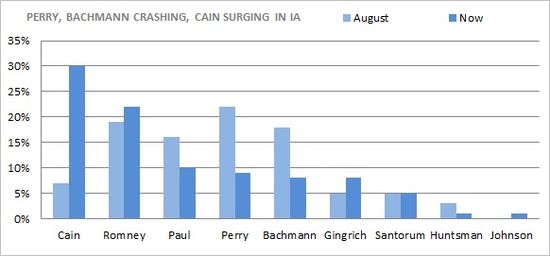
He's beating Romney 30 percent to 22:
Better news for Cain even than his lead is that his supporters are much more solidly committed than Romney's. 50% of them say they will definitely vote for him compared to only 34% who say the same for his co-front runner. When you look at the race just among voters who say they are firmly committed Cain's lead expands to 19 points at 38% to 19% for Romney, 13% for Paul, and 12% for Perry.
The View From Your Window

Colorado Springs, Colorado, 1.59 pm
What The One Percent Own
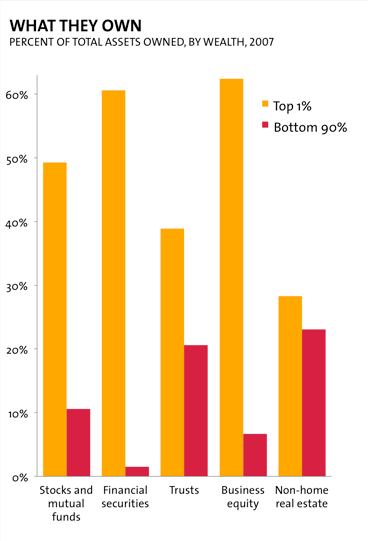
And that's 2007 – not now. Somewhere Al Gore is smiling. Even his social security lockbox has enjoyed a revival.
Can Neutering Your Dog Make It Depressed?
Quite possibly. It would bum me out if it happened to me. And this is one of the more surprising and brilliant passages in JR Ackerley's inspired "My Dog Tulip." He actually sees his German shepherd as having sexual needs. Hilarity ensues, as they say, when he tries to fulfill them.
 The Dish