Gotta question? askandrew@thedailybeast.com
Self-explanatory, really.
Glenn Beck rolls out his all-American charity/clothing line:
Via Alyssa Rosenberg, who comments:
The clothes are basically J. Crew-meets-Ed Hardy-by-way-of-Etsy. There are lots of polo shirts and fleeces (interestingly, no women’s apparel) with radiant hearts, snakes, and skulls-and-crossbones declaring “Death to Tyranny.” As popping-your-collar-and-getting-annoyed-about-government gear goes, it’s fine, though unlikely to ignite a fashion revolution, particularly when the polos start at $65 and the fleeces at $85 (you can get a t-shirt for as little as $25). And I’m not wildly optimistic that 1791?s going to spark a revolution in American-made textiles, though the idea of Glenn Beck in period clothing hectoring Lowell Mill Girls seems strangely apt.
The Dish team will be doing our usual routine on a debate night tonight. I'll be live-blogging and we'll be rounding up the most succinct and comprehensive reactions from around the web. See you then. I'm actually not dreading this one. It'll be fun to see Cain as the front-runner.
It was a glorious October weekend, and a friend sent along this priceless combination of Keats' "Ode To Autumn" with Ralph Richardson, one of the greater 20th century English actors. The recitation begins around 2:40. But the whole clip is beguiling – indeed, the entire interview.
Jay Ulfelder tries to explain recent concessions by the highly authoritarian government:
Dictators are most likely to undertake political liberalization either when citizens already pose a credible and formidable threat (liberalization by concession), or when citizens appear to pose only a weak threat (liberalization by imposition). Viewed through this wider lens, recent events in Burma make a little more sense. Like Gorbachev’s initially timid steps toward openness (glasnost) in support of economic restructuring (perestroika), the Burmese government’s recent reforms seem to identify that country as a budding case of liberalization by imposition. After the collapse of the USSR, dictators may have become more inclined to err on the side of caution and forego the potential gains from reduced economic friction. More recently, though, the Chinese government’s success (so far) in managing these trade-offs in its favor seems to have re-opened the door to liberalization from above.
"I tend to think that in a town where 'our blacks' is an actual phrase, integration will tend to go slow," – Ta-Nehisi Coates, on a story [NYT] about Rick Perry's home county.
Bob Sullivan exposes the government's "accounting tricks" that make the USPS seem unprofitable:
There's a long and a short story to the tragic tale of Postal Service financial trouble. I'll start with the short one. Right now, the Postal Service is being forced to pre-pay health benefits for the next 75 years during a 10-year stretch. In the past four years, those prepayments have totaled $21 billion. The agency's deficit during that time is about $20 billion. Remove these crazy pre-payments — a requirement that no other government agency endures and no private industry would even consider — and the Postal Service would be in the black.
Previous coverage of postal woes here.
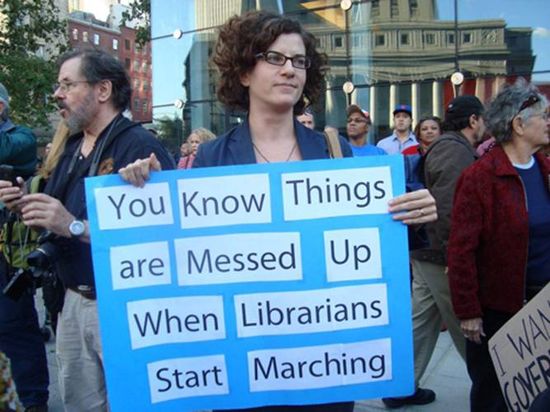
A reader writes:
I was interested, and glad, to see this sentence in Gregory Djerejian analysis of the Occupy movement: "They are acting to secure conservative aims of re-balancing a society that is becoming dangerously unmoored and increasingly bent asunder." Why? Because it reasonably identifies a truth about today's Conservative/Liberal political environment – that many on the Liberal side of the political equation are often quite philosophically conservative. And that today's "conservatives" are anything but.
As a long time resident of that liberal political hotbed Madison, Wisconsin, I've often said that it is in fact one of the more conservative places you'll find.
Why? Because even most of the more radical lefties living here (and there are far fewer than some would like others to believe) are living essentially conservative lives; they want a safe place to raise their kids, value their monogamous relationships (gay or straight), support law and order, have decent middle-class jobs, and want their world to be primarily stable and fairly predictable. They surround themselves with generally like-minded neighbors, talk to them over their fences (or across their hoes at the community gardens), and politely wait for their children in the pick up zone of their schools.
Do they vote Democrat or even Green? Sure. But at their core, they want what traditional philosophical conservatives seem to want: community, neighborliness,
predictability. When hundreds of thousands of them marched daily around our Capitol last spring in response to the new "conservative" governor's radical policy changes, it was because they felt the changes were moving too fast and the rules weren't being respected. The foundations of their lives – built generally on following the rules, respecting their contracts and following what seemed to be reasonable and stable career paths – were being shaken too vigorously and unfairly. You don't have to agree with their take on the situation to agree that the core of their complaint was about as traditionally conservative as you can get. I say this as a fairly classic liberal who embraces change and thinks throwing a wrench into the works – personally and societally – is rarely a bad thing.
I think this is a vital phenomena to understand, especially given the way the Republican right in the USA has taken to painting anyone who opposes them as radical Leninists who want to destroy the conservative fabric of the country. Somehow, I fail – and I think many others do and/or will – to see how demanding to take part in a traditional American middle-class life does that. I fail to see it because it doesn't. The only things really threatening that fabric, ironically, are the radical Corporatists and Christianists who dominate today's Republican party.
(Photo of a Wall Street occupier via Ouno Design. Map of similar sit-ins by Mother Jones.)
Are scarier than Sarah's fever dream:
American militants like Anwar al-Awlaki are placed on a kill or capture list by a secretive panel of senior government officials, which then informs the president of its decisions, according to officials. There is no public record of the operations or decisions of the panel, which is a subset of the White House's National Security Council, several current and former officials said. Neither is there any law establishing its existence or setting out the rules by which it is supposed to operate. The panel was behind the decision to add Awlaki, a U.S.-born militant preacher with alleged al Qaeda connections, to the target list.
Ackerman is appalled that Marty Lederman, a strong critic of Bush's expansion of executive power, apparently co-authored a legal memo justifying the execution of al-Awlaki:
I seriously question how this memo reflects anything but the ratification of a forgone conclusion. Its arguments, as reported [NYT] by Charlie (the best reporter working on national security law), are flimsy, even to my non-lawyer mind. I suspected such a forgone conclusion when it came to the torture memos penned by Yoo, Bybee, Addington, Gonzales, Haynes, etc. I would be guilty of hypocrisy and cowardice if I did not extend those suspicions to someone I actually like as a human being, and whose politics are far similar to my own.
My views on this remain the same. I do believe, however, that the executive branch should provide much more transparency here. If a US citizen is to be targeted in rare instances when they cannot be captured, then the reasons for doing so need to be explained, not assumed.
 The Dish