I'm sick of the Steve Jobs eulogising by anyone who did so much as shake his hand (one article I've seen was by a man who was once so blessed as a teenager), or received a couple of phone calls (Aaron Sorkin), not to mention by all those people who never met him. And for those who declare that he changed the world, they misunderstand. What they mean is that he changed their lives. And if that is true, then frankly they need to get a life. (And no, there isn't an app for that.) Jobs was a master marketer of overpriced, although good quality, consumer products. That is not the same thing as changing the world, and it is quite ridiculous that people think it is.
His whole marketing strategy was to present each iProduct as a cultural event, as opposed to just a bit of obstinate hardware that would be out of date in six months. The amazing thing about Jobs and Apple is that they contrived this strategy so successfully.
And to those who talk of the quality of Apple products, let me remind them, we pay for that quality. What would have been truly innovative is if the quality was as high while the price was as low as the competition. That would have changed the world, as it would have spurred other companies to design higher quality products for decent prices. For someone who made a great play of it not being about the money, he seemed to be quite happy with charging the earth.
The apotheosis of Jobs has all the hallmarks of a blogosphere feedback-led feeding frenzy. His legacy is making computer equipment desirable, so desirable that the consumer will pay a premium. This is largely no different from Armani vs high street clothing companies. And, like Armani, and unlike Ford, it remains prohibitively expensive to the majority.
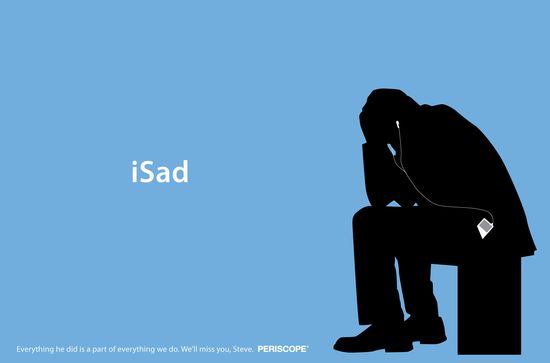
(Above image is from Copyranter's compilation of the ten worst tribute ads to Steve Jobs.)
Is there anything the government can do to bring unemployment down? Or is it now too late? If we are indeed in the early months of a double-dip recession, than I think it is too late: unemployment is more likely to go up than it is down from here. And even if the economy’s still managing to eke out modest growth, I don’t see much hope that the unemployment rate will come down to a remotely acceptable level any time soon. Realistically, America’s unemployed are here to stay. And we’re only just beginning to understand how that’s going to affect the political economy of the nation.
"I think what [Obama is] doing is articulating actually a pretty sensible center-ground position. I mean, look, I’ve been through all this, and I find a lot of this liberal critique of him just absurd. … This “what does he stand for?” idea. What he stands for is absolutely clear. He’s trying to lead America out of a very difficult economic situation, which every developed country in the world shares, by the way, and he’s trying to do it on the basis that’s fair," – Tony Blair, cutting to the chase.
While I will readily confess I find it odd as something of a Burkean that I am sympathetic to these protestors, they are not looking to trot out the guillotines, in the main (though I did spot a "Behead the Fed" sign!), but rather, they have smelled the radicalism of the body blows dealt to a representative democratic system presented by almost unfettered oligarch-like behavior among too many elites wholly disconnected from, yes, the 99% they speak of. They are acting to secure conservative aims of re-balancing a society that is becoming dangerously unmoored and increasingly bent asunder. They want accountability and dignity and prospects. Their leaders have failed them. So they have taken to the street to lead themselves.
It will not be easy in the months ahead (the encroachments of winter alone will prove a big test), but they have started something that has real potential, and should be lauded for it, and indeed urged to carry on. If so, they may accomplish something, even possibly something historic. In this goal, in my view, they should not immediately fall prey to pressure that they must issue some long laundry list of ‘demands’ that might risk ideologically ring-fencing them some and/or stealing the spontaneity of their movement, while resisting too close associations with old-line standard-bearers of the left like the unions. They have created something quite new on the American political scene, and should stoke it during these early days in a manner strictly of their choosing.
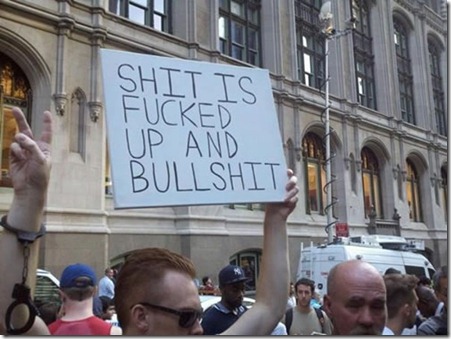
But maybe posters like this require, er, a little finessing:
Yeah, we get the point, but are you aware you look like a scene from South Park? Douglas Rushkoff thinks the haters don't understand the core of the protests:
The members of Occupy Wall Street may be as unwieldy, paradoxical, and inconsistent as those of us living in the real world. But that is precisely why their new approach to protest is more applicable, sustainable and actionable than what passes for politics today. They are suggesting that the fiscal operating system on which we are attempting to run our economy is no longer appropriate to the task. They mean to show that there is an inappropriate and correctable disconnect between the abundance America produces and the scarcity its markets manufacture. And in the process, they are pointing the way toward something entirely different than the zero-sum game of artificial scarcity favoring top-down investors and media makers alike.
Melissa Bailey looks at how Occupy Wall Street is handling an influx of donations. As I've said, I'm as surprised as Greg by how sympathetic I find myself. But, on reflection, I've arrived at the conclusion these past few years that the kind of fantastic income and wealth inequalities in this country (and the trends that keep reinforcing them) are a threat to our political and social order. The massive concentration of wealth at the top is undermining some core assumptions about common citizenship, even within a free market economy, especially since much of the wealth seems acquired by accounting chicanery, crony capitalism and a K-Street fix. As such, conservatives should be worrying about inequality as much as liberals. So far, this is largely a peaceful, groovy, inchoate protest against the right target: the concentration of wealth in the financial sector and its immunity from any kind of social or political accountability for its role in the unending recession in people's incomes. I see nothing more culturally out there in these protests that were not in the Tea Party protests – from the other side. One man's nose-ringed hippie is another woman's costumed Tea Partier.
This is not socialism. It's pointing out how capitalism, unchecked by government, can kill itself. But if this issue is left unresolved or defended in the brain-dead fashion of many in the GOP, it will soon become so. And that's why I remain bullish about Obama despite the collapse of confidence after the debt ceiling fiasco and the Grand Bargain failure. His substantive position – that the very wealthy should play their part in tackling the debt, which means more revenues – is overwhemingly popular. If the election is between holding those people accountable or letting them off scott-free, Obama wins.
"Today it seems language is completely packaged on a level of thought-utterance. Recovering the dignity and nature of authentic speaking, or dare I say 'organic' voice, is a move toward smashing historical determination. From the inside-out language seems ripped apart from being; conversely, from the outside-in death is inhaled through endless objects of commoditized life. Aisle after aisle of produced thinking we ceaselessly inhabit a neo-bourgeois ideology of moderation. Profane thinkers of the day have yet to turn to novel tactics that are sustaining fronts of resistance. How does one address something that we cannot even see?" – A. Staley Groves, Berfrois.
Scott Lucas has the details of the Christian march in Egypt's capital, where 24 died:
The protesters were angry at the latest attack on the Coptic Church in the village of Merinab in Aswan when Muslim villagers attempted to block renovations underway at a Christian church in the majority Muslim village, charging that the building was a "guesthouse" that cannot be turned into a church. The protesters also demanded that the governor of Aswan be removed for justifying the attack on the church and saying that a permit was not issued. The protesters were also furious at the increasing attacks against Copts in recent months and the army’s lack of protection.
Just as quickly as the Copts reached their destination, a massive rock fight erupted between protesters and hundreds of "thugs" across from the television building. It was not immediately clear whether the thugs — an increasingly common catch-all for anyone instigating violence — were average citizens or plainclothes security officials. Several eyewitnesses reported that the thugs initiated the attack against Christian protesters. Egypt’s government, on the other hand, blamed the Copts for the violence.
Egypt's own Health Ministry reports 272 people were wounded:
Muslim and Christian activists said much of the anger from Sunday's violence was focused on the army, which has also come under fire from across the political spectrum for failing to give a clear timetable for handing power to civilians. "Why didn't they do this with the Salafists or the Muslim Brotherhood when they organize protests? This is not my country any more," said Alfred Younan, a Copt speaking near Cairo's Coptic Christian hospital where many of the dead were taken. The violence casts a shadow over Egypt's first parliamentary poll since Mubarak fell. Voting starts on November 28.
David Goldman looks at the economic implications, arguing that "Egypt is about to run out of money to pay for any sort of food."
(Video from the Al Arabia TV Channel, of Egyptian army vehicles running over Coptic Christian protesters in Cairo yesterday.)
There's something very unsettling to me about a presidential candidate trash talking the current commander-in-chief in front of an audience of current military cadets (and them applauding it, no less). It's a free country, but it sure says something about his and their characters. The biggest irony is that Obama has been ferocious against al-Qaida, doing as Teddy Roosevelt did: speaking softly, but carrying a big stick.
Ben Smith clarifies that speech was "at the Citadel, but not a Citadel event." I'm going to write about this some more, but what struck me about Romney's foreign policy speech was its intellectual bankruptcy. After Iraq and Afghanistan, he's dusting off the Project For A New American Century? His first country-specific policy is a total defense of everything and anything an Israeli government wants? He believes that the Almighty Himself granted America a special right to global hegemony.
It's like something refrozen from the mid-1980s: stale, anachronistic, and utterly immune to any of the lessons from Bush-Cheney.
"Mr. Cain, you were in fact in college from 1963 to 1967, at the height of the Civil Rights Movement, exactly when the most important demonstrations and protests were going on. You could easily as a student at Morehouse between 1963 and 1967 actively participated in the kinds of protests that got African Americans the rights they enjoy today. You watched from that perspective at Morehouse when you were not participating in those processes. You watched black college students from around the country and white college students from around the country come south AND BE MURDERED, fighting for the rights of African Americans. Do you regret sitting on those sidelines at that time?" - Lawrence O'Donnell, in a pretty horrifying interview.

 The Dish