Gotta question? askandrew@thedailybeast.com
Peter Thiel fears that innovation is slowing. Kevin Drum counters:
Above a basic level, the whole point of productivity improvements is to provide us with more fun. Facebook may show up as a smaller contribution to GDP than a nationwide chain of movie theaters, but so what? If you'd rather spend four hours a week on Facebook than fours a week going to movies, then Facebook has improved your life as much as movie theaters improved your grandparents'. If you prefer Farmville to a week in Hawaii, then Zynga has improved your life as much as the 707 improved your parents'.
Chantal Martineau entertains our inner 12-year-old:
You may have seen these ads around the city lately. Depending on your sense of humor and level of maturity they are (A) hilarious, (B) disgusting, or (C) all of the above.
Update from a reader:
Here in the St. Louis TV market, car dealer Jack Schmidt has, for at least two years now, been airing spots whose set-up line goes something like, "Think you can't afford a new car?", concluding with the tagline, "Then you don't know Jack Schmidt!" Which is, I consider, much less jejune and far cleverer than the "Take a sheet" spots.
(Hat tip: Laura Nahmias)
Steven Pinker's new book argues that the world is getting more peaceful. John Gray rejects that thesis:
In much the same way that rich societies exported their pollution to developing countries, the societies of the highly-developed world exported their conflicts. They were at war with one another the entire time—not only in Indo-China but in other parts of Asia, the Middle East, Africa and Latin America.
The Korean war, the Chinese invasion of Tibet, British counter-insurgency warfare in Malaya and Kenya, the abortive Franco-British invasion of Suez, the Angolan civil war, decades of civil war in the Congo and Guatemala, the Six Day War, the Soviet invasion of Hungary in 1956 and of Czechoslovakia in 1968, the Iran-Iraq war and the Soviet-Afghan war—these are only some of the armed conflicts through which the great powers pursued their rivalries while avoiding direct war with each other.
When the end of the Cold War removed the Soviet Union from the scene, war did not end. It continued in the first Gulf war, the Balkan wars, Chechnya, the Iraq war and in Afghanistan and Kashmir, among other conflicts. Taken together these conflicts add up to a formidable sum of violence.
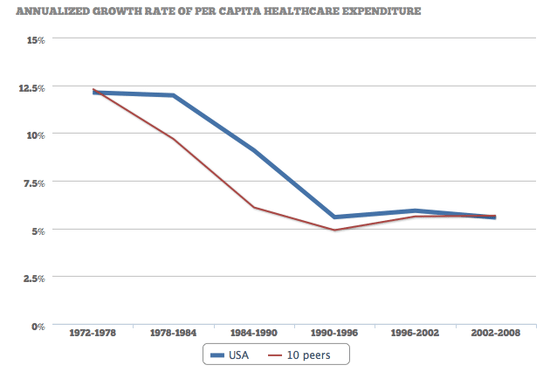
Noah Millman compares per-capita healthcare spending in the US to other industrialized countries:
The problem is not primarily the high growth rate of our health-care spending; the problem is precisely the high level of our health-care spending. Which in turn means that a growth rate that looks reasonable when compared internationally is unsustainable in terms of the bite it takes out of the domestic economy.
The only solutions he sees:
– Either we have to grow nominal GDP much more rapidly than other developed countries while holding health-care cost inflation down to levels comparable to other developed countries.
– Or we have to slow health-care cost growth to rates much lower than those achieved by our peer countries, and keep those growth rates low for an extended period, without, in the process, sacrificing growth in nominal GDP.
– Or we have to take a one-time axe to health-care costs in some fashion so that we can, from that point, grow from a more manageable base.
Chart from Data Collective.
A reader counters this one:
Your reader sez, "The article doesn't take into consideration the outreach of the Apple product line beyond the jobs he created directly" … but he himself is guilty of the exact same error with respect to Ford. There are about 350,000 people in the US making cars, but somewhere north of two million jobs selling, servicing, repairing, painting, and detailing them, or filling them with gas. That doesn't include the people driving the gas trucks, the adjusters insuring the cars, the cops policing their use, or the highway engineers and workers building them. It may seem odd to think of a highway as an "app" for cars, but that's exactly what it is.
Another writes:
How many jobs did he create? Well, he invented the Apple ][ that compelled IBM to develop the PC. He followed that with the Macintosh, which compelled Microsoft to develop Windows. A lot of someones are keeping Windows virus free(ish). He followed this with the iPod, which remains the number one music player on Earth. Someone's selling these things. Those salespeople have entire corporate hierarchies to oppress them. The iPod begat the iPhone, which just so happens to be the numbers one and two (4, 3GS) best selling smartphones on Earth. Someone's selling those too.
Someone's also expanding the infrastructure that allows these iPhone owners to send and receive data (or not, if they have the misfortune of being on the AT&T network). Someone's creating the content that's feeding the voracious data appetite of these devices. Someone's writing the apps that people are downloading from Apple by the billions. Someone is spending the billions of dollars Apple pays out to developers. And that's not even counting the iPad. On that front, let's not forget the someones out there who people call when they need someone to figure out how to make the iPad work with their existing Windows PC-based computing infrastructure and train their workforce to compute post-keyboard and mouse. And what of the Apple Stores?
So how many jobs did Jobs create? That's about as relevant as asking how many jobs did Eisenhower create when he authorized the Interstate Highway system. Focus myopically on the "how many people are required to make the iPad" argument and you miss the "how many people have jobs who wouldn't if this device had never existed" point.
Another:
I'm a professional musician, and I can't tell you how many gigs I would not have gotten if I didn't have an iPhone. Okay, okay, I probably could have had another smartphone, but there was a reason most musicians didn't have smartphones pre-iPhone: they really were geared mainly towards office workers; they were crazy expensive; and, frankly, they were ugly (shock: musicians care about appearances). The iPhone was relatively affordable, very easy to use, and it was sexy. Among freelance musicians in New York, it quickly became first a status symbol (you weren't a serious musician if you didn't have one), and then an absolute necessity (lacking mobile email means lost gigs).
Another:
Jobs is the embodiment of Creative Destruction. The number of jobs he created is important, but so is the number of jobs he destroyed. There are whole job descriptions that have ceased to exist: pre-press operators and color separators and video and audio technicians and manufacturers of thousands of tons of equipment that used to be needed to do what can be done by software in a Mac.
I'm old enough to remember when people got their resumes commercially printed; those little print shops are gone. I was in an audio studio the other day reminiscing with another old timer about the days when every studio had a couple of kids dubbing radio commercials onto tape and sending them out to radio stations across the country. Those jobs are gone, too, because the Mac empowered digital audio and what used to take hours of repetitive dubbing and mailing is now accomplished in seconds with email and an FTP site.
Innovation's effect on employment is dynamic and unpredictable. Jobs brought the enormous power of computers to individuals, and he made those computers engines of creativity rather than just quantification. He gave individuals the power to compete with well-capitalized corporations, and doing that put millions of people out of work, and millions of people to work. The net effect of that on job creation may never be known, but it made possible the modern world, which most of us think is better than the world that came before.

David McCandless and Willow Tyrer parsed 1000 recipes for common flavor patterns and visualized their results:
A good way to build a meal, maybe, if you lack a chef’s intuitive buds. Less data visualization, more dinner visualization.
Detail above. Full infoodgraphic here.
Epidemiological studies reveal that midlife is no more or less likely to be associated with career disillusionment, divorce, anxiety, alcoholism, depression or suicide than any other life stage; in fact, the incidence rates of many of these problems peak at other periods of the lifespan. Adolescence isn’t exactly a walk in the park either—as a teen, I’d worry so much about the uncertainties of my future that I vividly recall envying the elderly their age, since for them, no such uncertainties remained. Actually, old people—at least Swiss old people—aren’t fans of the “storm and stress” of adolescence, either. [Researchers] asked their elderly respondents which stage of their lives they’d prefer to return to, if they could. Most said middle age.
The filmmaker Gary Hustwit, of Helvetica fame, has a new film about urbanization. Nate Berg previews:
[T]here are so many shared characteristics between cities that they can always learn from one another, the film argues. Two of the projects featured in Urbanized—a community-building effort in a Cape Town township and a mass protest against a rail project in Stuttgart—emphasize the social implications of citymaking and design. "Ninety-nine percent of the shape of the city is a result of the top-down approach, at least in the formal design," [Hustwit] says. "Those projects that seem to work best are the ones using people in the city as the compass for deciding what the solution should be."
Greg Hanscom tones down the excitement over cities:
When the final 2010 Census came in, it made clear that we're not walking away from our lawn tractors and two-car garages anytime soon. An analysis of eight metro areas, including Chicago, Washington, D.C., and Austin revealed that in the past decade, 96 percent of the population growth occurred in the suburbs. … That's not to say that we're not on the verge of something here. A huge majority of Millennials — and a goodly number of their Boomer parents — say they want to live in cities. It just appears that, by and large, it's an aspirational notion.
An interview with Hustwit here.
A new infograph illustrates a reader's recent concern about HPV and oral cancer:

Source: Mount Sinai Medical Center
 The Dish