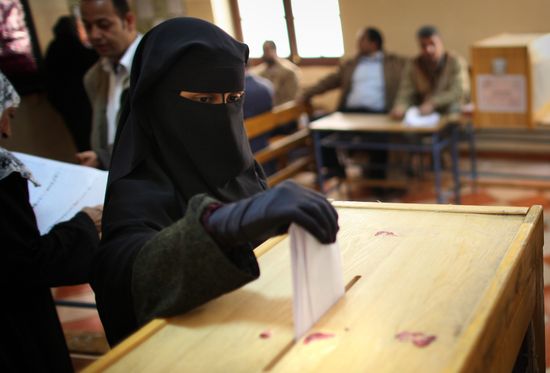
Egypt Votes, Ctd

GT_EGYPT_111128

The first day of Egypt's elections yesterday appears to have gone remarkably smoothly, with some caveats. The voting will continue for several months, as explained in this neat Al-Jazeera infographic. Tony Karon thinks the biggest winners are likely to be the Islamists:

[W]hile the Muslim Brotherhood may have lost support on the Square as a result of its reaction to last week's protests, the likelihood is that it more than made up for that in the support of hundreds of thousands of ordinary Egyptians lining up to vote. And the Islamists appear to understand that it is the political movement capable of rallying and organizing the strongest mass support that will carry the day in a post-Mubarak politics. That's a lesson many of those still holding Tahrir Square may yet learn at their own expense.

Ashraf Khalil looks at five possible worst-case outcomes for the country. Steven Cook cautions against drawing sweeping conclusions about Egypt's future just yet. Robert Satloff wants America to shepherd the process:

[H[aving taken the dramatic step last week of endorsing a position advocated by Islamist parties, the administration has the standing to speak to Egyptian voters this week and throughout the multiple rounds of voting. The idea is not to endorse or warn against specific parties; rather, it is to lay out for voters in a sober, realistic way the implications of their choices in terms of international credibility and investor confidence. Given the stakes involved — especially the health of Egypt's democratic institutions, the durability of its new political order, and the vitality of its economy, about which President Obama spoke so appropriately in February — both Egypt's transition and U.S. interests deserve no less.

(Photo: A woman places her vote in a ballot box at a polling station in a girls school on November 28, 2011 in Downtown Cairo, Egypt. Eleven months after the fall of Hosni Mubarak 45 million Egyptians are voting in the first round of six for it's upper and lower houses of parliament. The complicated process will take four months to conclude. Presidential elections are expected to be held in 2012. By Peter Macdiarmid/Getty Images)


What’s The Appeal Of Black Friday? Ctd

A reader writes:

Easily answered: Life is boring, and people crave the sense of excitement of being "where the action is." Since people are going to shop for Christmas anyway, why not do it at the most exciting time?

Another writes:

The people waiting outside for hours, if not days, are waiting for the limited availability items that are super cheap.  Think Best Buy’s 42" LED TV for $200.  For somebody not making a lot of money, it may be worth it. Then again it could be like waiting for season hockey tickets when I was at college – waiting in line becomes a social event separate from the stated goal.

Update from a reader:

I understand that some people need to wait in line to get that $200 HD TV – assuming that a TV now is a "need" – because they cannot afford to pay something close to full price.  But the news coverage I have seen of Black Friday paints a different picture – one of people grabbing a dozen Wiis or blenders to, I'm guessing, re-sell on EBay.  I don't believe that the woman buying fifteen food processors is introducing everyone she knows and loves to the joys of the Cuisinart.

A friend commented yesterday that, given the commercial nature of Christmas, she has no problem with retail clerks and cashiers wishing shoppers "Happy Holidays," since the religious aspect of the season is so lacking.  She has a point, I think.

For a historic look at Black Friday, Ben Zimmer traces its origins to "traffic-weary police officers in Philadelphia in the early 1960s."

The Daily Wrap

Deadlinessofdoing
Today on the Dish, Andrew detected Oakeshott in Kahneman's "experiencing self," he elaborated on intelligence research, and he's prepared to give up the charitable-donation deduction. We assessed Newt's chances in Iowa and New Hampshire, the public warmed to a familiar candidate, and the DNC went after Mitt. We evaluated Gingrich's immigration strategy after the "amnesty" debacle, the establishment receded, and a RINO self-identified. Some Republicans held out hope for a brokered convention, and global AIDS deaths dwindled. In our AAA video, Andrew explained why he's not a total legalizer, and he reconsidered premium support. 

The Arab League stood up to the Syrian regime, the Israeli settlements formed a "network of control" in the West Bank, and the Republican base stayed sane on Iran. We looked at social market housing in Singapore, wondered about the resilience of US-Pakistan relations, and turned our attention to Egypt's elections.

The financial industry doesn't create societal wealth, African Americans stayed away from OWS, and the new Catholic mass could be worse. For police departments, pot-smoking trumps violent crime, an "icicle of death" gripped the sea floor, and the straw was reinvented. We deconstructed DFW's lesson plans, revisited the details of the DSK scandal, and tracked the rise and fall of bitcoin. We tried to understand Black Friday, mapped the actual origins of food products, and charted the wage gap. American pop forgets American culture, George Harrison's "Sweet Lord" was Krishna, and "the backstory is the biggest one of all."

Yglesias Award nominee here, VFYW here, FOTD here, and MHB here

M.A.

A Brokered Convention?

Howard Megdal speculates

[A] combination of the lack of strength within the current field, the inclinations of current GOP primary voters, the recently changed 2012 GOP rules, and even the best interests of the party itself all point to a strong possibility that there will be no presumptive nominee ahead of the convention.

Rob Richie and Elise Helgesen have more. Doug Mataconis dismisses the notion, as does Michael Barone. Jonathan Bernstein piles on:

[Megdal's argument is] based, to a large degree, on a complete misunderstanding of the latest reform to the nomination process, which claims that Republican delegates in early states will be apportioned by proportional representation. But that reform, or at least that interpretation of it, is simply a myth, as Josh Putnam has explained. Only some delegates in early states will be chosen using p.r. A lot of them will still be winner-take-all — not by state, but by congressional district. Meglal uses Missouri as an example, but in fact only half of Missouri's delegates will be chosen by p.r.

Tolkien’s Legacy

Adam Gopnik cuts to the core of the author's influence on the fantasy genre:

[T]he fantasy readers’ learned habit of thinking historically is an acquisition as profound in its way as the old novelistic training in thinking about life as a series of moral lessons. Becoming an adult means learning a huge body of lore as much as it means learning to know right from wrong.

We mostly learn that lore in the form of conventions: how you hold the knife, where you put it, that John was the witty Beatle, Paul the winning one, that the North once fought the South. Learning in symbolic form that the past can be mastered is as important as learning in dramatic form that your choices resonate; being brought up to speed is as important as being brought up to grade. Fantasy fiction tells you that history is available, that the past counts. As the boring old professor [Tolkien] knew, the backstory is the biggest one of all. That’s why he was scribbling old words on the blackboard, if only for his eyes alone.

Yglesias Award Nominee

"[L]efties, I am asking you politely: please stop. Stop pretending that questionable sources are the gospel truth. Stop pretending that rumor and innuendo are the same as facts. Stop listening to anything Moore and Wolf and Hamsher are saying — because their concern for the truth is roughly the same as that of Hannity and Limbaugh and Coulter, and believe me, it pains me to say that, but it’s true," – Jeff Fecke.

Face Of The Day

134210882

Khitam Hamad, 12, whose face and body was burned after a car bomb exploded in the Iraqi city of Fallujah, poses in a hallway at a program operated by Doctors Without Borders/Medecins Sans Frontieres (MSF) on November 28, 2011 in Amman, Jordan. MSF has been running a reconstructive-surgery program for war-wounded Iraqis since August 2006. The program, which helps Iraqis irrespective of age or ethnic/religious background, is currently treating roughly 120 cases. MSF was forced to pull out of Iraq in 2004 due to the escalating violence in the country. Following the years of violence in the country, the state of medical care in Iraq is poor. There is a chronic shortage of doctors and nurses and much of the country's hospitals are using outdated and damaged equipment. By Mario Tama/Getty Images.

The Amnesty Epithet

Since Gingrich called for a "humane" approach to immigration policy last week, he and Romney have been accusing each other of wanting amnesty for illegal immigrants. Ed Morrissey sorts through their positions:

As frequently happens in GOP squabbles over immigration, they’re defining “amnesty” in different ways. Romney’s defining it as any special treatment for illegals: Because Gingrich wants local community boards to consider the cases of illegals who have been here for 25 years rather than sending them to the back of the line of citizenship applicants, he’s for amnesty. Gingrich is defining it in terms of citizenship: Because Romney would allow illegals to become citizens if they go to the back of the line, pay back taxes, have a clean criminal record, etc, he’s for amnesty.

He follows up here. Relatedly, Bloomberg reports that Romney almost explicitly supported "amnesty" in 2006:

Romney, who at the time hadn’t yet declared his first presidential candidacy for 2008, told reporters and editors in Bloomberg News’s Washington bureau that the 11 million immigrants who entered the U.S. illegally “are not going to be rounded up and box-carred out.” Law-abiding people who pay taxes, learn English and don’t rely on government benefits should be allowed to “get in line” to apply for citizenship, he said.

Ben Smith has more. William Jacobson wonders if Gingrich intentionally set the trap:

While attacking the humanitarian standards on deportation policy proposed by Newt, Romney had no alternative. Not a good showing. In the end, Newt was shown to be someone willing to make hard choices even if it cost him votes and to do so with realism. Romney was shown to be just the opposite.

Cutting Medicare (But Not Abolishing It), Ctd

There are two aspects of the Ryan plan for Medicare: its transformation of the benefit from a fixed entitlement to a premium support plan; and the level of the support. Yuval Levin looks at the first part here, and sees promise. The deepest problem for Ryan was that his plan would not give seniors anything like what they now get; but doing so via premium support, without structural reforms to cut costs, would break the bank pretty quickly as well.

I wish I believed market forces would help bring down costs significantly in this way. So far, the results are not encouraging that savings would be very substantial. I'm forced to concede that healthcare, especially among the elderly, is not really a market, and can only function as a shadow of such. I suspect that once you have conceded the right to healthcare – as Americans essentially have – then rationing must follow given medicine's advances in capacity and cost, and our own adamance on preserving life and health. What premium support plans do is help sustain rationing by price in a highly inefficient private-based system. If we could both enforce the ACA cost controls and replace Medicare with premium support, you'd be getting somewhere.