Is Mitt A Lock?

Mark Blumenthal reports that GOP insiders are somewhat more receptive to Romney than his poll numbers indicate:

Romney leads the field in combined endorsements and potential support. More than one-third of the Power Outsiders (36 percent) have either endorsed Romney or say there is a "good chance" they will support him — more than twice as many as say the same about Perry (17 percent). In fact, on the same measure of endorsements plus potential support, Perry also runs behind both Cain (27 percent) and Gingrich (22 percent).

Jonathan Bernstein says this greatly improves Romney's chances:

I’d say this adds up to pretty strong evidence against the notion that Romney has a low ceiling within the Republican Party. Of course, this doesn’t guarantee he’ll win the nomination. But if these results are really a good indication of what Republican party actors are thinking across the nation, it makes his nomination much, much more likely.

Joe Klein says yesterday was was "probably the single best day of the campaign for Mitt Romney–who didn’t have to lift a finger as his two most significant challengers nuked each other." Larry J. Sabato anticipates a curveball:

From 1976 to 2008, there has been a major surprise every time either in Iowa or New Hampshire. A back-of-the-pack candidate greatly exceeds expectations. Or the frontrunner stumbles. Or the field is scrambled in some other way.

Can The Syrian Opposition Make A Deal?

Just in time for Assad to signal his willingness to accept Arab League mediation, Randa Slim provides an analysis of the precise nature of the opposition he would be dealing with:

This fragmentation and disunity [among Syrian opposition groups] poses a formidable challenge. It makes it difficult to assess who is representing whom, the level of public support each enjoys among Syrians, and the role each is playing in the protest movement. While it is impossible to know which side commands a majority, a critical mass of Syrians has clearly opted for regime change. In this quest, they are laying their lives on the line. The challenge is whether the different leadership centers in the opposition could overcome their differences and coalesce under a unified organizational umbrella akin to Libya's Transitional National Council.

Joshua Landis thinks Assad's offer will likely weaken the opposition.

(Video: Syrian youth purpotedly chant "Up Your Ass Bashar" at an anti-regime rally on Tuesday.)

Which Nations Are Too Big To Fail?

Felix Salmon fears that Greece's reckoning foreshadows Italy's:

Greece can fall and the eurozone can still survive. But Italy — which is just as politically dysfunctional as Greece — can’t. Which is why those Olympian forces will ultimately spell the end not only of Greece’s membership in the euro, but also of European monetary union more generally.

Who Is Still Defending Cain?

131174897

Quin Hillyer of The American Spectator takes off the kid gloves:

[I]t really sickens me that Cain has played the race card by asserting that the harassment story occurred because he is black. I hate it when the Left plays the race card, and I hate it when the right does. No, the story didn't come out because he is black; the story came out because ANY candidate for president who had multiple allegations of harassment against him would eventually need to face the story because somebody in the media would report it. 

Friedersdorf imagines the mindset of a Limbaugh listener:

Herman Cain says Rick Perry is behind the sexual harassment story? Wait a second. So Cain thinks the story was motivated by racism, and that Perry is the one who leaked it? Is Cain calling Perry a racist? 

Kornacki rounds up more evidence that the right is beginning to abandon Cain. 

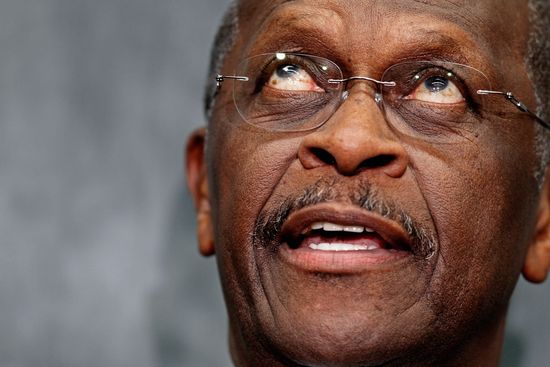
(Photo: Republican presidential candidate and former CEO of Godfather's Pizza Herman Cain participates in a discussion with members of the Congressional Health Care Caucus on Capitol Hill November 2, 2011 in Washington, DC. By Chip Somodevilla/Getty Images)

Why Can’t Huntsman Gain Traction? Ctd

A reader writes:

Forget John Weaver. Huntsman's only path was to consolidate the non-lunatic vote, get the establishment and the media behind him, and hope the base is split among multiple candidates. I can't get over two moments where Huntsman alone absolutely blew it:

(1) The Iowa debate in August when candidates were asked to raise their hands if they would refuse to support a debt deal that had a 10-to-1 ratio of spending cuts to tax increases.

(2) During the Google debate in September when the audience booed a gay, active-duty servicemember in Iraq.

Huntsman raised his hand in August and he stayed quiet in September. He should have "called a timeout" and hijacked the conversation on both occasions. He wouldn't necessarily have needed to stake out radical positions but to simply remind Americans that he is living in the same world as the rest of us.

These are not moments that were anticipated in strategy sessions with John Weaver. If Huntsman had shown that kind of instinct and grit he would have had people like me (life-long Republican who voted for Kerry and Obama) put their day jobs on hold to move to New Hampshire and work for him. That's what we thought we were getting when media profiles called him the Republican Obama. Instead Huntsman seems like a sane, competent pol (which itself sets him apart from the GOP field) but not as special as he would need to be to lead this party out of the wilderness.

Another writes:

Certainly, Huntsman's acknowledgment of climate change, support of domestic partnerships, and work in the Obama administration don't help him with conservative partisans. More broadly, all of this is evidence that he's one who won't toe the conservative line, which, again, doesn't help.  All that said, the substance of his positions certainly would seem to make him more attractive than the substance-free Romney. So why can't he crawl above 5%?

Really, let's stop pretending: It's the bias that dare not speak its name. There's already one Mormon in the race, and evangelical Republican partisans have no interest in a second. The only reason Romney is as high as he is, is that he's the last man standing from 2008. He couldn't pull it out against John McCain then, and now he's neck-and-neck - at best - with Herman-Fracking-Cain! Conservatives despised John McCain, but they held their noses and voted for him over Romney, who has proven himself willing to pander to anyone or any position.  Now it's happening again, and we have another serious, viable, and eminently competent Mormon in the mix.  At what point is someone willing to speak up and call a spade a spade?

There is a religious test in the Republican primary, and Mormons do not pass. It really is that simple.

Another floats an idea:

How would you feel about an Obama-Huntsman ticket?  I daresay it would be the anti-MSNBC, anti-Fox News, anti-Moore, anti-Palin, healing the partisan wounds.  (Nothing at all against Joe Biden, whom I've always liked.)
Congress Goes Big?

Yesterday 40 House Republicans signed a bipartisan letter urging the supercommittee to consider "all options" in deficit reduction, including tax revenues. Halle-fucking-luia. Steve Benen sees the move as a small "piece in a larger picture":

It’s worth emphasizing that the Republican signatories did not explicitly endorse any tax increases on anyone, only going so far as to say they’re open to additional “revenue.” Presumably, some of the 40 GOP lawmakers are only eyeing closing some tax loopholes and scrapping some tax expenditures, and might very well oppose an agreement that called for even modest sacrifices from millionaires and billionaires. 

Dave Weigel isn't holding his breath:

Among the Republicans who's signed this: Ron Paul, whose campaign literature says, as it says every year, that he's "never voted for a tax increase." How do you get to "$4 trillion in deficit reduction" without tax increases? You really don't. 

Kevin Drum hones in on Grover Norquist's "eerie influence." And Brad Plumer looks at economically efficient ways to raise taxes.

Let The Women Speak

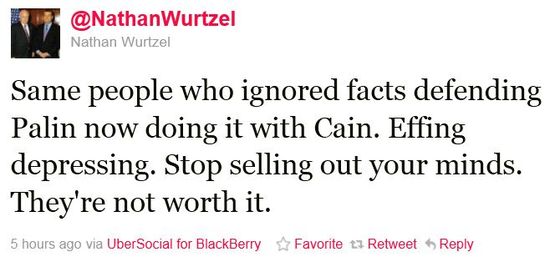
Twitter-@NathanWurtzel-Cain-Palin-Facts

Cain's decision to blame Perry for the sexual harassment charges seems to me a pivotal moment. The narrative of Cain versus evil-librul-media was, if anything, a plus for the guy. The narrative of Cain reminding people he's not a political neophyte and is capable of the usual bitter campaign rivalries … not so good for the brand. And without any clarity of what on earth really happened – and specifics are vital to making any kind of judgment – this can only get worse. I think the Cain campaign via the NRA needs to release all the women from a gag order and get this on the table as soon as possible. If it's trivial, we can move on. If not, we can assess. And I have to repeat my first impression: sexual harassment is almost never a one-off event; it is about abuse of power, always a relevant issue when assessing a possible president; the Clinton years revealed what can happen when politics is frozen by rigid denials of sexual misconduct. We have now learned that the pay-out to a second woman was $45,000. That's a lot for some mild banter.

The only way past this for Cain is through it. Let the women speak, if they wish. If they refuse to come forward or detail the accusations, then there's nothing more to be done. But the golden rule of political scandal applies: disclose everything, apologize for what needs to be apologized, and get it over with. But Cain seems unable to get there. Why?

The Next Lehman Brothers

Big_Bank_History

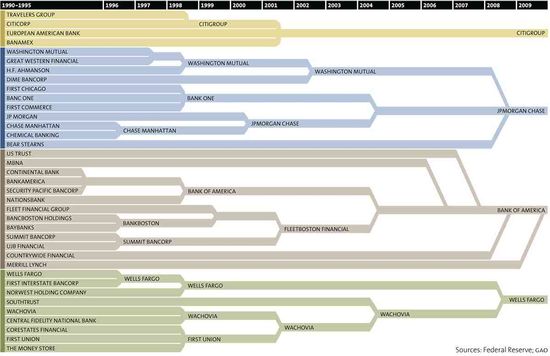
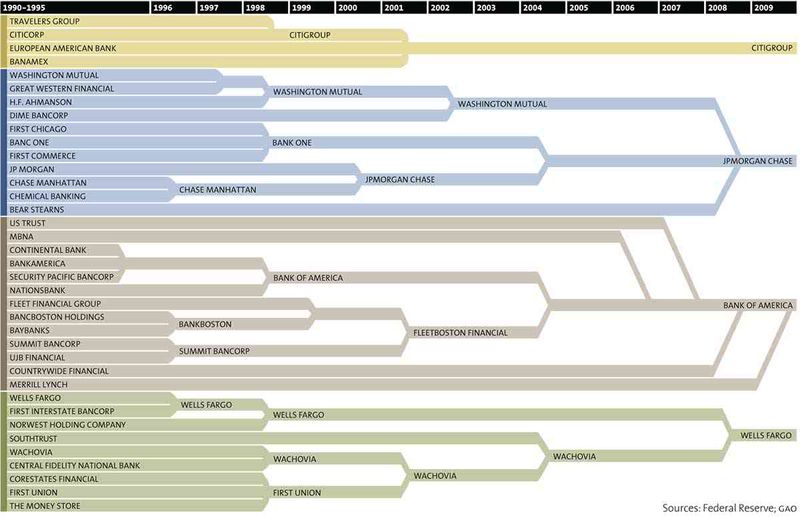
The Economist puts Dodd-Frank to the test in an extensive simulation of a banking crisis (click through for the full two hours). Stephen Gandel's takeaway

Dodd-Frank doesn't end Too Big to Fail. The only one on the panel who wanted to discuss putting the fake troubled bank into bankruptcy – which would be actually allowing it to fail – was Jerome Powell, who had been an undersecretary of the Treasury under George H.W. Bush. And even he said he thought Dodd-Frank makes it tougher to allow banks to fail, not easier.

(Graphic from Mother Jones. Click to enlarge.)

Papandreou’s Method In The Euro Madness

It's becoming clearer. His shock proposal for a referendum – kept from his European partners – was actually designed for his domestic audience. And it seems to have worked. Today, Papandreou's conservative opposition dropped their objection to the austerity agreement held last week, because it became clear Greece's very participation in the euro was now at stake. A parliamentary confidence motion could therefore be won decisively by Papandreo – and a referendum actually averted. From the FT's must-read liveblog:

Over in Athens, the narrative of today’s developments is becoming clearer. According to the prime minister’s comments to his cabinet, the key turning point appears to have been when Antonis Samaras, the conservative opposition leader, said today that he would be willing to back the new bail-out agreement in order to ensure Greece stays in the euro.

The conservatives opposed Greece’s previous bail-out on the grounds that harsh austerity would deepen the country’s recession and leave banks without liquidity to fund investment. Kerin Hope has more from the text of Papandreou’s address to minister at their emergency meeting earlier: “There is no need for a referendum following the conservative opposition’s switch of its position and willingness to back the October 26 package.”

“We must hail the fact that [the main opposition party] New Democracy will vote for the new bail-out agreement.” “We had a dilemma: consensus or a referendum … Failure to back the package would mean the beginning of our departure from the euro. But if we have consensus, then we don’t need a referendum.”

We may have under-estimated the Greek prime minister's political skills.

What Would Romney’s Mid-East Policy Look Like?

GT_ROMNEY_111007

If his advisors are any indication, it won't be pretty. Adam Serwer recently reported on the troubling past of Walid Phares, a Romney foreign policy advisor who has major baggage from the Lebanese civil war. Mario Loyola responded with a half-baked defense of Phares. Serwer fights back. On Phares' general mindset:

[I]n Phares' book Future Jihad, which Loyola describes as an "indispensable contribution," Phares argues that prior to 9/11, American foreign policy was essentially under the control of Islamic fundamentalists. "[T]he Wahabi influence was so profound and subtle that it made its arms within the State Department, CIA, and information agencies think that they, not the Wahabis, were in control of policy." It's hard to find a foreign policy decision Phares disapproves of that isn't the result of covert Islamist infiltration, from US policy during the Soviet invasion of Afghanistan to Bill Clinton's intervention in the Balkans to support for ending Lebanon's civil war along terms favorable to Syria.

Ackerman asks how Phares would respond to the Arab Spring:

If Romney wins, Phares is likely to get a high-level position advising Romney's Mideast policy. Romney wants to help the Arab Spring succeed, which is a worthy goal. It's also a goal surely to be set back by any affiliation with Phares. The idea that the Arab world's democratic forces would embrace a man tied to sectarian massacres of Muslims, and who argued that Christian Arabs are a different ethnic group than Muslim Arabs, doesn't survive a second's worth of scrutiny.

Larison agrees:

This is why the selection of Phares as one of Romney’s advisers matters. It is another hint of the alarmist foreign policy Romney favors, and it tells us that Romney’s judgment in selecting advisers may not be all that good. Given Romney’s tendency to invoke expertise and his willingness to defer to those he considers experts in a field, it matters a great deal that Romney considers Phares a reliable guide to Middle Eastern affairs.

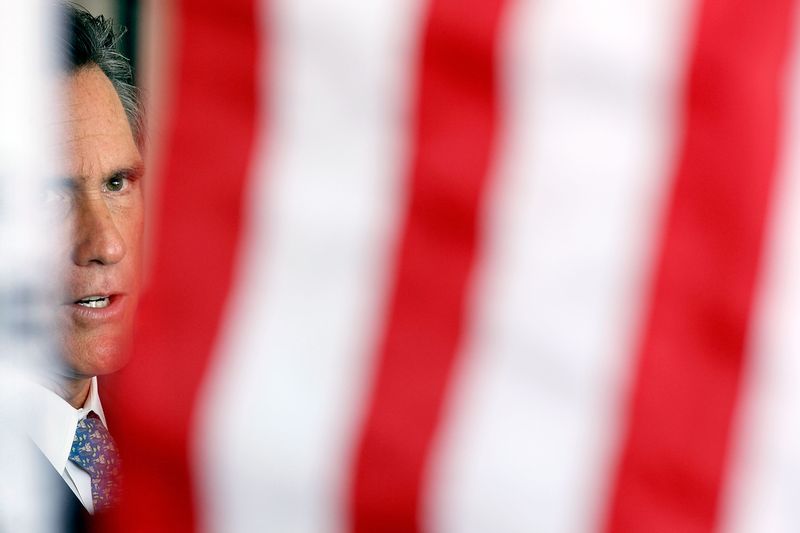
(Photo by Chip Somodevilla/Getty Images.)