Can Cain Weather This?

A compilation of the different answers he gave yesterday:

Joe Klein bets that the harassment story won't damage Cain:

All this may work to Herman Cain’s advantage. I was listening to Rush Limbaugh for a few minutes in a cab this afternoon and the immediate assumption by Limbaugh and several callers was that Cain was being set up by the liberal media. The notion of black man as sexual predator is a particularly toxic stereotype–and it may intensify the self-righteous satisfaction some Republicans are getting from supporting a conservative black man for President. 

So far, I'd second that, as I did yesterday. If no extra details are provided, once my reader's point is taken into account, it's currently a win for Cain. He has been able to play the race card, the faith card, and the liberal media card. Each one looks like an ace to the base. Which, of course, intensifies the GOP's dilemma in the medium run. Nate Silver likewise thinks Cain might survive:

[G]iven the already extant tensions between the political establishment, which is broadly dismissive of Mr. Cain, and the conservative grass-roots, which has evident affection for him, the accusations might carry less weight against him than they would against a more “mainstream” candidate.

Rod Dreher even defends Cain's singing:

[I]n context of the entire video, Cain’s performance doesn’t look strange at all. He didn’t just burst into song. He was asked to sing. Here’s the entire video; go to around the 58:00 mark for context. Cain said he would do so as an opportunity to offer a testimony to what his religious faith has done for him. In the fuller context, especially given that he was asked, as a final question, to favor the audience with a song, what he did strikes me as charming. 

I'm sorry but it's pretty weird for a potential president. First Read is waiting to see how the story develops: 

It all depends if there's another allegation or a new piece of information that contradicts his current story. If there is, that would be a knockout blow. Indeed, conservative commentators largely gave Cain a free pass yesterday. … But if another shoe drops, he most likely won't get another free pass from them.


How Did The West Win?

Pankaj Mishra doesn't go easy on Niall Ferguson's Civilisation: The West and the Rest:

To ask, as Ferguson does, why the West broke through to capitalist modernity and became the originator of globalisation is to assume that this was inevitable, and that it resulted basically from the wonderfulness of the West, not to mention the hopelessness of the East. Needless to say, most contemporary scholars of global history do not hold the West and the Rest in separate compartments. Far from developing endogenous advantages in splendid isolation from the Rest, Western Europe’s ‘industrious revolution’, which preceded the Industrial Revolution, depended, as Jan de Vries and other historians have shown, on artisanal industries in South and East Asia.

Perry: I’m Bad At This Language Thing

Perry's new ad, which is running in Iowa, treats his linguistic failings as a virtue:

Will Wilkinson isn't reassured:

Not to be overly pedantic, but talking is a kind of doing. Indeed, talking is primarily how one gets things done in politics. How does Mr Perry convey that he is a doer, and not a talker? By talking. What else is there? Interpretative dance? A presidential candidate unable to best a foe in a public exchange, or to communicate his position on a complex issue when the heat is on, is about as useful as a one-legged fullback.

Obama On Cannabis, Ctd

Several readers are making this point:

In light of the Obama administration's response to the petitions relating to marijuana legalization, I thought I would point out a little known fact about the drug czar: he/she is legally required to oppose any effort to legalize marijuana or any other illegal drug, regardless of the facts. This is required by sec. 704 of the Office of National Drug Control Policy Reauthorization Act of 1998, where, among the duties laid out for the drug czar is to "take such actions as necessary to oppose any attempt to legalize the use of a substance (in any form) that — (A) is listed in schedule I of section 202 of the Controlled Substances Act (21 U.S.C. 812); and (B) has not been approved for use for medical purposes by the Food and Drug Administration".

In light of this, having the drug czar write the response to the marijuana petitions is clearly a farce. I started a new petition pointing out this fact and asking for a response by someone else, which can be found here. It appears that the petitions require 150 signatures to become searchable on the White House's site, so if you are so inclined I would welcome any help getting the word out about the petition. That clause of the ONDCP reauthorization act is clearly detrimental to any kind of free and open exchange about drug laws between the people and the government, and I feel people should be made aware of it.

Why Borders Still Matter

Air traffic

Frank Jacobs extols our "invisible obstacles": 

Borders seemed to mark the edge of the known world. Or, inversely, they were the high water marks of the Great Unknown, the Eternal Other. … Tracing them across the globe, we find enclaves and exclaves, disputed and neutral zones, improbably straight and impossibly jagged borders, deadly borders born in war and old ones almost faded into irrelevance. Borders reflect humanity’s need for obstacles, for a line in the sand between Them and Us. And even if they coincide with rivers or mountain ranges, they remain entirely human constructs. They are there because we expect them to be, because the map says that they are. 

(Hat tip: Matthew Zook. Image by Aaron Koblin.)

The Most Unequal City In America

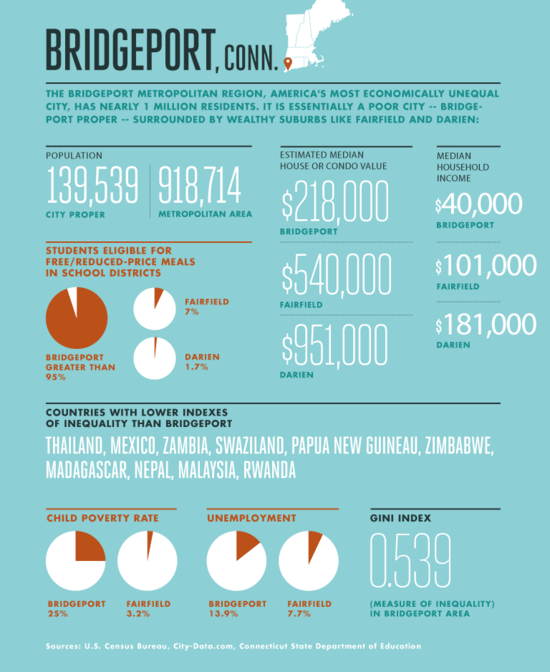
Ben Carlson spotlights Bridgeport, CT:

The top 20 percent in the Bridgeport area — which includes Fairfield County, one of the wealthiest areas in the United States — took home nearly 60 percent of its income, while the bottom 20 percent took home 2.5 percent of the region’s money. In this nexus of billion-dollar hedge funds and bombed-out housing projects, the top 5 percent raked in a mean income of $685,000, while the bottom 20 percent’s mean income totaled less than $15,000. To put that in perspective, if the Bridgeport metro area were a country, it would rank 12th from the bottom in the world for economic equality — lower than Mexico, Papua New Guinea and Zimbabwe. 

Infographic after the jump:

Bridgeport

What We Owe To The Spud

Potato

Charles Mann tracks the potato's journey from the Andes to Europe:

Before the potato (and corn), before intensive fertilization, European living standards were roughly equivalent to those in Cameroon and Bangladesh today. On average, European peasants ate less per day than hunting-and-gathering societies in Africa or the Amazon. Industrial monoculture allowed billions of people—in Europe first, and then in much of the rest of the world—to escape poverty. The revolution begun by potatoes, corn and guano has allowed living standards to double or triple worldwide even as human numbers climbed from fewer than one billion in 1700 to some seven billion today. 

(Photo by Susy Morris)

A Defense Of Copying, Ctd

A Dish reader voiced his support for software patents. Timothy B Lee shoots back:

The people complaining loudest about software patents are the very people whose efforts software patents are allegedly designed to encourage. If most of them think they’d be better off without that "protection," that should give policymakers cause for soul-searching.

Why We Save Daylight

It's good for business:

Shifting daylight one hour later means more light in the late spring and early fall for after-school and after-work leisure activities, and that means more time for gassing up, driving to the ballpark, and hitting the driving range. Paper-plates manufacturers, lighter-fluid makers, plant nurseries, and service stations anticipated a $4 billion windfall from the extended daylight hours.

(Video hat tip: The Morning News)