Social Market Housing

Singapore housing

Philip Truscott examines the Singapore model: 

Jane Jacobs famously complained that the public housing projects took some mixed income neighborhoods which could have been viable and sealed their doom by concentrating too many low income and unemployed people in the same buildings. Singapore’s HDB does act as a direct landlord for a very small number of people who meet a strict income ceiling (about $1160 USD a month), however the low income tenants are spread thinly among owner occupiers. Income ghettoization is limited. My realtor tells me that one of the blocks in my own HDB estate is for tenants rather than owners but from the outside I cannot tell which building it is. Another form of deliberate social mixing takes the form of racial quotas intended to prevent the formation of ethnic enclaves. Access to the more attractive and less attractive neighborhoods is shared out more equally.

(Photo by Flickr user regardless)

The First Bendy Straw

From a short history:

[Joseph B.] Friedman inserted a screw into the straw toward the top. Then he wrapped dental floss around the paper, tracing grooves made by the inserted screw. Finally, he removed the screw, leaving a accordion-like ridge in the middle of the once-straight straw. Voila! he had created a straw that could bend around its grooves to reach a child's face over the edge of a glass.

Mind The Gap

Screen shot 2011-11-27 at 6.24.06 PM

A special report from The Economist asks why the wage gap has been so hard to close:

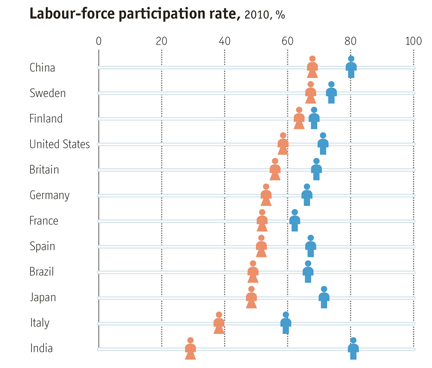
Back in the 1990s women in rich countries seemed to be heading towards a golden era. They were continuing to move into the workforce in ever-increasing numbers, more opportunities were opening up for them and the pay gap with men was getting smaller. Now there is a palpable sense of frustration. Catching up with men, particularly at the top, seems to be taking much longer than expected. At the same time women in some of the richer emerging markets seem to be pushing ahead. In China the numbers in senior positions are rising across the board, and in India women are getting top jobs in the crucial IT industry.

(Image: From a larger Economist chart on the female work force around the world)

The Gingrich Surge

Charles Franklin studies it: 

Gingrich’s path is somewhat different [than the Bachmann, Perry and Cain surges]. His recognition levels have remained at the top of the field, along with Romney’s, at 80-90% with only the slightest of upward trends. This means none of the Gingrich favorability trend is due to new-found visibility, as it is for all the rest save Romney and (to a lesser degree) Paul. Rather Gingrich’s trends show that even as a well known figure public affect for him is uniquely variable.

The Perverse Incentives Of The Drug War

Unlike solving violent crimes, cracking down on drug offenses can net serious money for police departments. Radley Balko links that finding to some troubling stats:

A drug offender is much more likely to be arrested in Chicago than he was 10 or 20 or 30 years ago. But kill someone in Chicago, and you're only about half as likely to be caught as you were in the early 1990s.

Thoughts from a Chicago-area cop here.

“Gratheism”

A reader writes:

I sit with those who as of this moment cannot believe. When I was 20 I had a perhaps-mushroom-influenced mental breakdown around the belief I had discovered the nature of God – core to my discovery being that no single path is better than another, as the son of a now agnostic Christian-American and a spiritually Hindu Indian immigrant, it was clear to me there was no one right way.

As I descended (or ascended?) back into rationalism I sit with an increased sensation that we as humans must make deep efforts on one another's behalf, because we may be all we have. Articles like Dali_Crucifixion_hypercubeother, that there is no nihilism in that, and that empathy for others borne of the lack of surety that there will be some other accounting, later, is in fact required.

Said differently, the notion that the universe loves us, that all will be okay, might diminish our incentives to live this life with a healthy respect for it's randomness, with the humility that there may be only one shot, with a deep appreciation for empathy as the cornerstone of our humanity without requiring religious underpinning, and a belief that no further belief system is required, with its concomitant anti-intellectual and non-empirical remnants, to influence that sheer love of each other.

At the same time, I support and personally feel belief in the mystery of it all, recognizing that we don't know what we don't know; and I have a strong sense that the teachings of Buddha, of karma, of Judaism, of Mohammed, and of Christ have a great deal to offer – that these world views all are directionally healthy if interpreted without literalism, that they all imply reasons for gratitude and that they all help build social fabric as shared belief systems, and that those things are good things which probably outweigh the obvious downsides of groupthink and the devastating divisions they also cause with humans who otherwise have so much in common.

For lack of a better term I call this world-view Gratheism, aka Grateful Atheism, and believe it's a needed antidote to the condescending atheism of writers whose bravery I admire, like Hitchens and Dawkins, but who are – I don't think – building much social fabric, and who I suspect are not winning any converts.

A Critical Week For The Euro

Wolfgang Münchau thinks it may already be too late for Germany to rescue the pinnacle (the euro) of its entire post-Hitler project, (the European Union). It's not hard to see why Merkel has resisted essentially paying for the profligacy of her largely Southern neighbors:

The ZDF television poll released Friday found that 79 percent of respondents opposed eurobonds and only 15 percent backed them. It said 63 percent thought Merkel was doing a good job in the crisis and 29 percent disagreed. That figure has improved steadily since early October — when 45 percent thought she was doing a good job and 46 percent disagreed.

If Merkel is gaining by refusing to budge, then the odds of a successful, swift resolution – essentially a quantum leap in European financial governance – are small. Which means we may actually have passed the moment when this unraveling could have been raveled.