Toys making their escape:
Month: November 2011
Islamist Cross-Pollination
Ryan Evans, reviewing Fawaz Gerges' new book on al-Qaeda, makes the case that Islamist groups are closer to al-Qaeda than most think:
Gerges falls into the trap of many of his fellow al-Qaeda scholars – he imagines a firewall between violent transnational Islamism and the broader Islamist movement. Throughout the book he characterizes al-Qaeda as something apart from the Islamist movement and shies away from including them in the same category, no matter what the category might be. Yet, both historically and presently, there remains traffic (what social scientists call cross-cutting ties) between the two. There is no doubt that al-Qaeda seeks to realize its vision through drastically different means than other adherents of political Islam newly empowered in the wake of the Arab Spring – most notably, the Muslim Brotherhood – but the end goal is shared: an Islamic state governed by Shari’ah.
Daveed Gartenstein-Ross examines al-Qaeda's post financial crisis strategy.
End College Sports? Ctd
A reader parts with Pollitt's critics:
While the many responses to Katha Pollitt have tended to make her argument look more persuasive, not less, to me there's one thing missing in all the back-and-forth: Where is the conservative outrage against college sports as an economic phenomenon?
At least with regard to football and basketball, here we have mainly public institutions (state colleges and universities) crowding out private enterprise. Defenders of the NCAA status quo like to point out that college football and basketball programs often turn a profit, but that only increases what should be the conservative case here. If the activity can be done profitably, then the government has no business doing it at all, right? Isn't the government engaging in profitable commercial activity exactly what conservatives mean when they talk about "socialism"?
If colleges could not award scholarships based on athletic merit but instead had to run varsity football like they run, say, varsity ultimate frisbee, then the NFL would have to establish for-profit development leagues – just like baseball or hockey has, or even, on the margins, basketball. Without major NCAA competition, professional football and basketball leagues would prosper, and they would be wholly private, profit-earning enterprises, whose players would earn salaries set by the free market rather than toiling without pay. Is there any conceivable application of conservative economics that would not prefer that system, or indeed view the alternative of government-run minor leagues crowding out the private sector as abhorrent?
The irony is that, in the dark heart of socialist Europe, soccer teams actually conduct themselves on a much more capitalist basis than does the NFL, which relies on socialist state-run athlete factories to develop talent. Soccer clubs hire young players, and pay them, and expect to make a profit running developmental minor-league teams. The capitalist player-development model in European soccer actually offers more realistic chances for economic opportunity and advancement for underprivileged players than does the socialist player-development model in American football or basketball. So why aren't American conservatives crusading to end athletic socialism and privatize sports?
Another writes:
Another aspect to consider regarding college athletics is the Olympics. US colleges are funding a huge number of the Olympic athletes, who are not just representing the US, but many other countries as well. There could surely be another way to fund and train these athletes, but since this is a system that at least in this respect is proven to work, it seems counterproductive to end it rather than make the reforms needed to deal with abuses. Here's a blurb from Stanford's athletics website:
Stanford sent more athletes to the Beijing Olympics than any other college in the U.S, winning 25 Olympic medals. If Stanford were a country, it would have ranked #11—tying with Japan—in total Olympic medals.
How To Avoid Hellacious Travel

The above detail is one of many lessons from the Thanksgiving Day travel infographic. Adam Dachis recaps:
You can't always control where you're flying to and from, however, but you can control when. … Flying on Thanksgiving Day (the 24th) … will make your trip considerably easier. When compared to the busiest flying day (the 27th), there will be about one million fewer passengers traveling around the United States.
The Rise Of Polyamory?
Elizabeth Marquardt thinks polyamory is being normalized:
The debate about legal recognition of polyamorous relationships is already well underway. A major report issued in 2001 by the Law Commission of Canada asked whether marriages should be “limited to two people.” Its conclusion: probably not. A British law professor wrote in an Oxford-published textbook that the idea that marriage meaning two people is a “traditional” and perhaps outdated way of thinking. Elizabeth Emens of the University of Chicago Law School published a substantial legal defense of polyamory in a legal journal. She suggested that “we view this historical moment, when same-sex couples begin to enter the institution of marriage, as a unique opportunity to question the mandate of compulsory monogamy.”
Dreher, no surprise, is unhappy with this alleged trend and sees no rational reason to deny polyamorists legal rights once marriage equality is law. But the case for civil marriage with multiple partners is a huge leap from allowing every citizen to enter a meaningful civil marriage with someone else. Of course, the far left will try to use marriage equality as a spring board for this. But it seems to me a completely different question – morally, socially and sociologically, especially in its impact on women.
Our Record Low Interest Rates
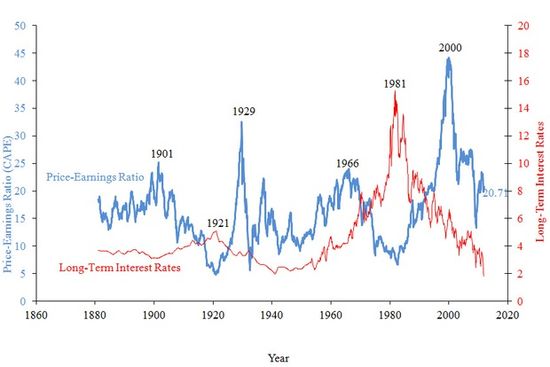
Paul Solman asks:
What's going on? Well, rather obviously, investors are a lot more worried about the credit of Greece — or Spain or Italy — than ours. Investors are also more worried about stock investments. Investors are also more worried about almost any other asset into which they might put their money.
Investors also seem pretty sure that U.S. inflation is not going to be a problem anytime soon. If inflation scared them, they'd hardly let the United States lock in an interest rate of less than 2 percent for an entire decade.
So then why isn't it plausible to draw the following conclusion: that U.S. interest rates have been going in the "wrong" direction because investors are scared that the U.S. is going to reduce its debt and deficits, and such a reduction might horse-collar the world economy?
Well, let's assume gridlock even past the next election. The trigger cuts meet the sunsetting of the Bush tax cuts to provide a sharp dose of austerity in the US. Not so crazy after all, is it?
A Gay Kiss On Al-Jazeera
More striking: the two are straight and just friends, and merely protesting against the chance of a reversal of marriage equality in Spain under the new government.
Did Anyone Read The IAEA Report On Iran’s Nukes?
Here's an interesting argument that, despite the headlines, the new report does not actually refute the reassuring claims in the 2007 NIE finding. Money quote:
The NIE left open the possibility that Iran could continue its weapons-relevant activities. With four years of additional perspective, the latest IAEA report gives greater detail on the weapons work that Iran did prior to 2003, then updates the available information on what lesser work occurred after 2003. The new activities included:
– Engaging in experimental research, after 2003, on hemispherical initiation of high explosives.
– Further validation, after 2006, of a neutron initiator design.
– Conducting modeling studies, in 2008 and 2009, that could determine the yield of a nuclear explosion.
Carrying on scattered research activities does not amount to a full-fledged restart of an integrated weapons program. That type of activity still appears to have halted in 2003. The activities since seem more like Iran is refining its previous understanding of nuclear weapons design — not breaking for a bomb.
How The Occupation Began
Mattathias Schwartz tells the tale:
Kalle Lasn spends most nights shuffling clippings into a binder of plastic sleeves, each of which represents one page of an issue of Adbusters, a bimonthly
magazine that he founded and edits. It is a tactile process, like making a collage, and occasionally Lasn will run a page with his own looped cursive scrawl on it. From this absorbing work, Lasn acquired the habit of avoiding the news after dark. So it was not until the morning of Tuesday, November 15th, that he learned that hundreds of police officers had massed in lower Manhattan at 1 A.M. and cleared the camp at Zuccotti Park.
If anyone could claim responsibility for the Zuccotti situation, it was Lasn: Adbusters had come up with the idea of an encampment, the date the initial occupation would start, and the name of the protest—Occupy Wall Street. Now the epicenter of the movement had been raided. Lasn began thinking of reasons that this might be a good thing.
Marc Tracy thinks Adbusters isn't nearly as important to OWS as one might think. Thomas Stackpole gives a history of the magazine.
(Photo of original Adbusters call to occupy via Negative Ink)
Strategic Thanksgiving Travel
A primer on what international relations can tell you about the yearly ordeal.
 The Dish