The Twilight Belt

Screen shot 2011-11-18 at 12.10.12 PM

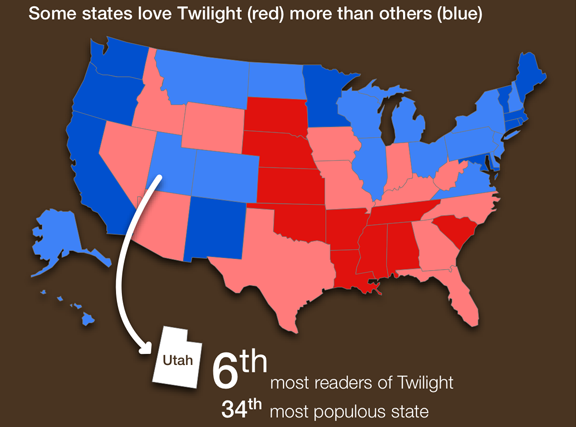
Goodreads collects data from their users to map it: 

On the map above, the readers in the red states rated the book highly (the darker the red, the higher the rating), while readers in the blue states gave it a lower rating). The Midwest and the South represent The Twilight Belt, while the coasts were decidedly less impressed with the book. Reviews were mostly distributed according to population, with the notable exception of Utah. Utah is the 34th most populous state in the US, but it generates the 6th most reviews of Twilight. In terms of cities, Salt Lake City—the 125th largest city in the country—is second only to New York in number of Twilight reviews.

Only Child Myths, Ctd

A reader writes:

While I agree with Susan Newman that having an only child doesn't necessarily mean that child will be predisposed to selfishness and bossiness, there are still other factors to consider after adolescence. While I have two wonderful younger brothers, my wife is an only child.  Two months ago, her mother passed away unexpectedly.  It was a very difficult time for us, and still is, but her comment that struck me more than any other was:  "I've never wanted a brother or sister more in my life." She felt so alone, and when around her father, she felt like she had to be "on"; he needed her to be supportive.  

Another reader, an only-child, makes related points:

I'm sure I benefited from being the center of my parent's attention, because it provided me with lots of evidence that I was valued, thus I came to value myself, but not to the point of disregarding the preferences of others. Being an only child also allowed me to feel comfortable with solitude.  Although I enjoy the company of others, I am still content to be alone.  I probably wouldn't have come to appreciate reading as much if I had always had a sibling around to play with.  So I see benefits of being an only child.

I don't feel deprived that I grew up without siblings, but I disagree with the idea “…that siblings really may be ‘good for nothing.’”  When I was the caretaker for each of my parents in their dying months, many times I thought about how nice it would be if I had someone with whom to share that responsibility. I am glad I had the opportunity to care for them during that time–we had many sweet moments–but it was exhausting.  I know that even if one has siblings, caretaking can fall primarily on one person, but just having emotional support from them during that time would have been helpful.  Caretaking also had a huge negative impact on my income for close to two years at a time that I was at the peak of my earnings.  This not only affected me then, but also now in terms of the lost contributions to my retirement.  If I had had siblings to share caretaking responsibilities, it would have been nice not to have taken such a financial hit.  It is what it is, however.

While it felt inconsequential earlier in life, I find that I miss having siblings now that I am in my 60s.  I am widowed with no children, so it would be nice to have siblings who share a common history (even though each sibling has a different history with the same parents).  All families are not the Waltons, and the possibility certainly exists for siblings to become estranged, but they can also become best friends. Siblings are not necessary to have a successful life, but I certainly would not call them "good for nothing."

Another reader goes in another direction:

One thing that I’ve never seen discussed about the only child phenomenon: how it leads to fewer inter-generational family connections.  Picture it: if two only children marry, their kids will have no aunts or uncles or cousins. Aunts, uncles and cousins are invaluable parts of life, not as close or intense as relationships with siblings or parents, but still locked-in, blood.  

Sure, kids of two singletons will probably have plenty of adults who are friends of their parents, and those people’s kids, to socialize with, but that’s not the same as relatives whom you interact with at every holiday, wedding, wake, and other family event for decade upon decade, for better or worse.  My life and that of my siblings has been rich with such relationships (mother from a family of 6, father from a family of 8).  One uncle taught me how to shave.  One aunt encouraged my reading and writing (she started calling me “Professor” when I was 7 years old). My hundreds of cousins (when we count the family back to the great-grandparents, which we do) run the gamut from whack-job to saint, local jailbirds to national journalists.

I sometimes think about China’s one-child policy primarily in these terms: whole generations without aunts, uncles or cousins.  How sad.

Insider Trading On The Hill

Roger Parloff wants to ban it:

While Congress never consciously created the cracks in the insider trading laws that its members now enjoy slipping through, they have consciously refused to seal them. Legislation has been introduced in each session of Congress since 2006 (by Louise Slaughter of New York and a handful of others), known as the STOCK Act (for "Stop Trading on Congressional Knowledge Act"), that would solve most of the problem. But until Sunday's 60 Minutes piece, it somehow never gained any traction.

Parloff reports that new STOCK Act bills are now making their way though Congress. 

(Hat tip: Bainbridge)

Is Day Care A Disaster? Ctd

A reader writes:

I read Jonathan Cohn’s piece on daycare in the New Republic. It is rather depressing, but not totally surprising. I would argue that a big part of the problem is probably that there is not much respect and/or substantial compensation for those who work in this profession. My wife has run a daycare out of our home for about 16 years, currently taking care of four children (ages 2, 2, 4, 4) full-time (7:00 am to 4:00 pm), one child three days a week, and two kids in the morning before I drive them to their local school.

She has a Masters degree in early childhood education, and spent several years teaching kindergarten and first grade before our own children were born. She loves the kids she teaches (yes, teaches, she really gets tired of being called a babysitter). She organizes a flexible curriculum with various themes, subjects and activities, reading to the children several times a day, with pauses for comments and discussion, having them journal before nap, doing finger plays, art projects, indoor and outdoor free play (our “dining room” is filled with kids books, toys, play food, dress up clothing, etc).

She used to have the children sit on the couch with her to watch Mr. Rogers when he was still on PBS, but now doesn’t have them watch any television. She keeps daily logs on the children’s activities and achievements for parents, puts together a weekly newsletter for the families, takes periodic safety classes, buys food for and runs a daily “restaurant,” and keeps extensive and accurate records of meals served and expenses for state agencies and for annual taxes.

She was recognized for excellence by our local community childcare organization. For all this she makes (before taxes) about $28,000 dollars a year (or about 18 dollars an hour; because she cares for teacher’s kids she has a break during the summer). Based on her earlier experiences from working at a larger daycare center, she would certainly earn significantly less than this if she were just a center staff member. Fortunately, I earn enough that her income is not our main source. However, for most of those who work in larger institutionalized daycare centers there is precious little economic incentive to become a dedicated professional. Until we value children’s “first two years” and formative experiences as much as we do public education we will continue to have a minority of truly excellent daycare options.

Another reader adds:

I am taking time from my workday to respond immediately on this one, because your post may inadvertently mislead your readers on a point of critical public importance: Please do not call "daycare a disaster." Well-funded daycare is quite possibly better for children than staying at home with mom (let alone a nanny.) But it's VERY expensive. My expertise in this comes from serving on the Board of Directors of Princeton University's day care center. Princeton's center is called U.N.O.W. Day Nursery. 

Each infant class had four teachers plus an aide.  Each teacher was assigned two specific infants as her special charge. Naturally, there was a good deal of helping each other out, but each pair of babies bonded especially closely with one caregiver. This provided adequate care. I always said that UNOW's care was exceptional by industry standards, and also the minimum I would ever find acceptable. Two babies per teacher is actually a lot to handle — comparable to having twins. But a skilled, dedicated person can manage it, with help and support.

The intermediate classes had three teachers (plus, on occasion, an aide), for numbers of children ranging from 10 to 18.  The oldest class had three full-time teachers, plus an aide, for 22 children.

Princeton University provided the building, including a huge, well-equipped outdoor play area, building insurance, all maintenance, cleaning, and a certain amount of equipment. They also subsidized the tuition on a sliding scale. Most, but not all, families were Princeton-affiliated.

The full charges per child, in 2007, were about $1,500 per month. That covered all salaries and benefits for the staff and administration (consisting of a director and an office manager), relocation and worker's comp. insurance, and some supplies. The tuition charges for the older children subsidized the care for the younger ones, since $1,500 per month does not begin to cover the cost of adequate infant care, as I explain below.

With these numbers, we were able to pay senior teachers over $40,000 per year, junior teachers from $28,000 and up, and to give everyone full health insurance and generous, paid vacation.  Due to this, most of the teachers had college degrees, and there was very little turnover.  Many of the teachers had started at the center as idealistic, young college graduates in the 1970s, and were still there, 40 years later.  The job is stressful and exhausting, but emotionally rewarding for people who love children. Still, I thought the salary was pretty meagre for the long, caring days they put in. But by industry standards, it was princely.

In New Jersey, the state-mandated minimum staffing for a day care center is two adults for eight infants. Given the number of feedings and diaper changes tiny babies go through over the course of the day, for all practical purposes this means one woman changes diapers all day long while another feeds and cleans up after eight small babies.  Meanwhile, a nursery class can be 25 children with two teachers (12:1.)  And those teachers are often paid minimum wage, with no benefits, and no education or training.  THAT'S a disaster.  Daycare itself is not.  But like anything else, quality costs money.  For appropriate infant care, it costs as much as $35,000 per child per year.  

Many years– when we had more than one child enrolled– my entire salary just paid for day care. And I'm a lawyer!  But it was worth it, because the children were very happy and I kept my career on track.  Most women in the U.S. either don't have that option, or hire a nanny, either because it's cheaper or for the snob value. Sure, a nanny is cheaper (especially for multiple children).  But high-quality, high-cost group care is better. That's why it costs more. 

Another reader:

I read with interest the topic of Day Care being a disaster.  I'm a mother of two girls (5 and 2).  We had to space out when to have the second so that both of them weren't in daycare at the same time because we couldn't afford that.  I was/am thrilled with the daycares we chose for our daughters.  One was in-home and then we moved a few miles away so we switched to a toddler/preschool type daycare. The in-home daycare (at an annual cost of $15,600 each (I'm not fucking kidding) kept my children engaged, learning, and clean (they would often come home having had a bath after lunch).

As a full-time working mom, having days where I didn't have to do bath-night was awesome.  Now my youngest is in the toddler/preschool daycare that costs $9,360 a year and we are loving it – the social interaction, the stimulation, etc. is much more than I could ever provide at home. My older daughter is in Kindergarten at a private school (for the low bargain price of $5,400 but the Chicago public schools are shit). I'm a secretary and my husband is a project manager so it's not like we're rolling in the dough but we are able to do this, own a small house in Chicago, and budget accordingly. (Once both girls are in school together and we're paying tuition under 10K we're going to feel wealthy!)

When we were shopping around for daycares, the most prevalent thing we noticed is that you get what you pay for.  Some of the daycares we visited, that were much more affordable, were awful.  Dark, toys weren't engaging, low pay for teachers so the turn-around was high, etc.  Running a daycare is extremely difficult and very expensive – kids break toys so who wants to buy fancy toys.  And then they make a mess of everything else so it's very hard to keep everything in good shape.  I thank God we're fortunate enough to afford decent care, but it's the same thing in day care as it is in life – only the privileged are among the lucky to get good services.

A final reader:

Oh boy. Daycare.

When we were looking to send our daughter to one, we searched high and low. There are some spectacularly expensive programs run by private schools and/or universities. Many of my co-workers sent their kids to these programs – at $400 a week or higher. (This is Baltimore.)  These places had waiting lists, philosophies  - but the cost was prohibitive.

The programs at the lower end of the spectrum – those run either in-home, or in a larger facility were more affordable, but very hit or miss. Some were over-stuffed and it appeared like our daughter may not get attention. Others looked like a fly-by-night operation. It was frustrating.

We ended up in a very good in-home daycare. It is so good I feel guilty paying what I do (I'd pay double in a heartbeat.) The woman and her mother pay close attention to the kids, spend time reading and learning every day, and always play outside when reasonable. (Also a plus – NO TV!) It is also diverse. Some kids come from single-family homes on government assistance, and others (like us) are just working parents who want the best for their kid. Many are the third or fourth kid from the same home to attend the daycare. 

We are extremely fortunate – but after reading those stats you posted, I feel like we dodged a bullet. 
Does “Ethical Consumption” Work?

GT_FREERANGE_111117

Dara O'Rourke defends the idea that we can change corporations by buying "ethically produced" products like free-range meat:

A small percentage of consumers have already moved a portion of the market toward more ethical and sustainable practices. But the larger promise of ethical consumption remains unmet: to empower consumers to express their values—whatever they are—in the marketplace. If people could walk into a retailer or click on a shopping site and get instant information about which products best match their personal values, they could truly vote with their dollars. The big question is whether NGOs, governments, and progressive companies will work collectively to drive the market toward this more sustainable future.

Scott Nova is more skeptical:

[I]t’s reasonable to expect a fully developed ethical-products sector in which most companies attain the benefits of ethical marketing despite misleading, exaggerated, or downright false claims about labor (and other) practices. Even GoodGuide, a large improvement over past rating efforts and a useful tool for consumers, gives generous scores to major apparel brands whose primary achievement has been developing more sophisticated forms of empty rhetoric. 

Many more responses to O'Rourke here.

(Photo: Free-range chickens get feed in a pen at the Schoenecke organic-accredited poultry farm on January 7, 2011 in Elstorf, Germany. By Joern Pollex/Getty Images.)

The Coming Age Of Water Scarcity?

First the economy comes for your coffee, then it takes your water:

Due to rising population, coupled with increasing demands by the agriculture and energy
industries (often referred to as the water-food-energy nexus), global demand for clean water will outstrip supply by an average of 40 percent by 2030. While this reality poses grave risks to thousands of communities, it is also the driver of a daunting, and often confusing, economic dilemma which businesses must prepare for. It's time for companies operating in the many dry regions around the world to equip themselves with the tools and mindset they need to navigate this new normal.

How Big Is The Marijuana Market? Ctd

A reader writes:

I need find out where Keith Humphreys is getting his pot.

Given the condescension and snark he directs at people who might dare to question his numerical analysis, I find it amusing that in his post of "data, nuance, the encouragement of independent thinking and a lot of other stuff [ideological marijuana legalization advocates] will find upsetting", he pulls out of the air a number which (a) appears to come from nowhere, lacking a citation or any supporting data, and (b) would in fact make any pot smoker I've ever spent time with VERY HAPPY.

$120 AN OUNCE?  Did he last buy pot in 1980?

In NYC I pay $150 for a bag containing slightly less than 1/4 of an ounce (that is, $600 an ounce, or 5x).  It's high grade and delivered to my door, and of course it's NYC, but $120 per OUNCE?  Hell no, Keith. While I haven't conducted a scientific survey, I have some experience, having been around in New York, and having bought from states in New England, the South, and the West. The consensus I come to is that $300 is a tremendously good price for an ounce of retail-level marijuana (and 1/2 of what I pay). 

Another reader piles on:

How much is Kevin Humphreys smoking to estimate the national average of an ounce of weed to be $120? I'm no expert, but I do buy a lot of pot and that number sounds suspect. So I checked out the site priceofweed.com. For Virginia it lists the average price per ounce of low quality pot at $217. The average for high quality? $447. Here in southwest VA I pay $60 for an eight ounce and about $400 for an ounce for high quality bud. (The discrepancy between the two is because of the volume discount.) So if Humphreys is going to use the upper estimate of the value of marijuana as a commodity he should also use the upper estimate for the price of an ounce of marijuana

Another:

I have some knowledge as to what pot ought to cost on a typical basis as my wife treats her fibromyalgia and irritable bowel syndrome with it.  Until recently, we lived in a state without a medical marijuana law and therefore had to obtain marijuana illegally, just like most of the rest of the county. 

I have never encountered decent quality marijuana for less than $200/ounce in the western US, and more often it is closer to $250-300/ounce.  There is some price fluctuation based on the time of year relative to when big outdoor harvests have taken place and supply is highest (usually in the middle of fall around October).  That's if you want to go black market.  Where I live, medical dispensaries charge anywhere from $50-$65 for 1/8 ounce of marijuana, depending on the strain, which means the per-ounce price goes up to $400-500.  If we re-adjust for those numbers, assuming a relatively low average of $240/ounce (double what Humphreys assumes), we come up with a half-billion ounces to meet the same $120 billion figure, leaving us with a more manageable per-capita consumption rate for the US of about 1.62 ounces per person, per year. 

Furthermore, medical patients often use about an ounce a month, assuming one 1 gram joint per day (or potentially more, depending on the method of administration and condition being treated), and consistent recreational users probably go through an ounce in two to three months, on the low side.   As you can see, the $120 billion figure isn't that exaggerated once you actually determine what it is that people pay.  No matter what, that's a lot of untaxed dollars being made off of a virtually harmless plant. 

Humphreys responds to these sorts of criticisms in the comments of his post:

Many people have commented about the ounce price saying it doesn’t match their personal experience. This brings up an important analytic point, which is that no one can tell what the average ounce price is nationally based on their personal experience, which is why policy analysts use national data. If your local experience is different than national data, it means that your local experience is different than national data.

Just north of the Mexican border, you can buy commercial grade (4-6% THC) marijuana for $200-$500 per *pound*. The price for the very same marijuana is triple that in the Northeast. Sensimilla costs much more than run of the mill marijuana all over the country (double or triple the national average price), but it’s a small part of the market so if that’s what you buy you get a distorted sense of average prices nationally. Most people don’t realize that marijuana is overwhelming smoked by lower income people (That’s obvious if you count days of use, people miss it because they often just count users) and there is a whole market of lower-grade, lower cost cannabis (e.g., $70/ounce) that supplies it. The sense of average prices of middle class people (not to mention the subset of Americans who read drug policy analyses on the Internet) thus tends to be way higher than national average prices.

More than a year ago, CNBC looked at the various estimates and concluded that a legal cannabis industry would probably we valued between $35 and $45 billion:

Assuming comparable taxes to tobacco of 40-50% (excise and sales tax), a $40 billion marijuana market would yield $16-20 billion in taxes.