Last night's talk and discussion was truly a marvelous and stimulating time. I just want to thank the Shorenstein Center, Alex Jones, Tom Frank and all those who were generous enough to honor me by asking me to give the Theodore H White Lecture at Harvard. I'm in illustrious company. It was so great to meet so many dishheads and to engage in some really challenging dialogue. The Dish can be a solitary endeavor and you forget that many readers are out here, are real people and can interact, you know, in person, in physical form. I realize how much I miss the atmosphere of a university, especially the energy of the young. So thanks again. And sorry I overslept for much of the panel discussion this morning. Mortifying. It's been a crazy week of travel, blogging, TV, lecturing and finishing a column after the talk last night. But the speech went well, I thought. When there's a transcript, I'll link to it.
Month: November 2011
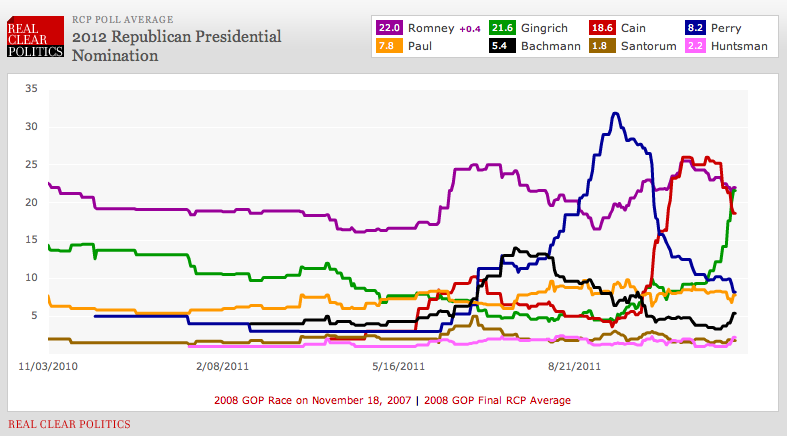
What Is Fueling The Gingrich Surge?
The GOP base:
In the Vanderbilt Poll, conservatives comprised a majority of every major candidate’s supporting coalition. However, only Cain and Gingrich drew more than 80% of their support from avowed conservatives. … It is hardly surprising that Cain’s supporting coalition looks so solidly conservative. But it is a big surprise in the case of Gingrich. Remember, this is the guy who was being excoriated just six months ago for denouncing the Republican budget as “right-wing social engineering.”
Chait wonders whether the Newt bubble will pop:
Gingrich has tons of liabilities — non-orthodox positions, erratic behavior, little money or organization — but he does have experience in the national spotlight. It's not completely inevitable that he will implode.
Chart from RCP's poll of polls.
“We Lost Our Way”
Ponnuru argues that Republicans have misinterpreted Bush-era transgressions, leading to the disastrous delusion that they must "avoid accommodation at all costs — that the principal obstacle to achieving conservative policy goals is a lack of spine and not, say, a lack of popular support":
That mythology influences the Republican presidential primaries … It’s why they have, to an unusual extent, showcased unpopular ideas that have no chance of going anywhere, such as abolishing the Environmental Protection Agency. … Meanwhile, the real mistakes of the Bush years keep being made. Republicans had nothing to say about wage stagnation then and are saying nothing about it now. The real cost of Republicans’ fixation on ideological purity is that it distracts them from their real problems, and the nation’s.
Larison adds:
It is natural for activists and high-information voters to believe that their preferred policies will help their party win elections, and it is understandable that they interpret electoral defeats as punishments for following the wrong policies. … It is part of a mentality that says that we can have it all, which is the same mentality responsible for overwhelming public support for entitlement programs combined with strong hostility to paying for them.
Rant Of The Day
Zerohedge captions:
Nigel Farage needs no introduction: the famous Euroskeptic is one of very few men who has had the temerity to question, often in an abnormally high decibel fashion, the stupidity of the Eurozone leaders from day one. Now that he has been proven correct, he has every right to gloat, which he does to everyone's delightful amusement in the European parliament.
The Real Green Card
A reader writes:
One of Esquire’s Americans of the Year, BFD! You were the answer to one of the $2,000 questions on Jeopardy last night.
So I heard from many readers and a few stunned friends. I guess I really am an American now.
Is The Conventional Campaign Dead?
A couple weeks ago, Dan Balz noted that GOP candidates aren't spending much time in the early states. Dana Houle added that on the ground operations and TV ads don't seem to matter as much as they once did. Ryan Lizza ponders the impact:
[A] campaign process that relies less on paid advertising and retail politics and more on delivering one-liners at debates and stirring things up on talk radio is one that is especially well-suited for what might be called “politainment” conservatives like Michele Bachmann, Herman Cain, and Newt Gingrich, and not so great for successful governors like Tim Pawlenty, Jon Huntsman, and Rick Perry.
Ask Me Anything: Change The Constitution?
How Big Is The Marijuana Market?
Morgan Fox sized it up. Keith Humphreys thinks Morgan is exaggerating:
For the sake of argument, in this case let’s take Fox’s upper estimate of $120 Billion/year. That’s too big a number for any of us to relate to or understand, so Step 1 is to convert it into ounces or joints of marijuana. The price of an ounce varies based on where you are, whether you buy in bulk, and what grade you purchase. But $120/ounce isn’t a bad estimate for a national average in any case, and here it makes the math easy so let’s use it. If marijuana costs $120/ounce, Americans would have to purchase 1 billion ounces a year to reach the $120 Billion dollar estimate. Already you will be suspicious of Fox’s market number because this works out to over 3 ounces per American (1 billion ounces divided by slightly over 300 million people), assuming that everyone uses marijuana, including newborns, people in comas and emphysema patients.
Quotes For The Day
"Instead of sitting on our thumbs, wishing Ronald Reagan were around, or chasing the latest mechanical rabbit flashed by the media, conservatives ought to start rallying around Romney as the only Republican who has a shot at beating Obama. We'll attack him when he's president," – Ann Coulter, November 16th:
"If you don't run Chris Christie, Romney will be the nominee and we'll lose," - Ann Coulter, February 12th:
Is Day Care A Disaster?
Building off his reporting on the importance of early brain development, Jon Cohn tackles the US day care system:
[T]here's a spectrum of shoddy care – from mediocre to poor to awful. The hard part is figuring out exactly how many kids fall into each category. And despite considerable research and consultation with experts, I came up with only two reliable sources. One was a study of day care in four states, by researchers in Colorado. The other was a more comprehensive national survey, by the National Institute for Child Health and Human Development. The results were similar: In the Colorado study, only 8 percent of day care centers were “good” or “excellent” while 40 percent were “poor.” The NIHCD study found that three out of four infant caregivers give only minimal intellectual and cognitive stimulation.
 The Dish