“Breaking The Internet” Ctd

Fallows recommends the above video explaining the Protect IP Act or SOPA:

Every developed society has had to work out the right balance of how far it will go to ensure that inventors and creators will get a reasonable return for their discoveries. If it does too little — as in modern China, where you can buy a DVD of any movie for $1.50 from a street vendor — it throttles the growth of creative industries. (China both over-controls political expression and under-controls commercial copying.) If it does too much — encouraging "patent troll" lawsuits, arresting people for file-sharing music or video streams — it can throttle growth and creativity in other ways. There is no perfect answer, but this bill would tip the balance way too far in one direction, to defend incumbents in the entertainment industry.

Is Penn State Only A Symptom?

Hugo Schwyzer thinks the underlying disease is the dominance of old boys' networks in American professional life:

Whether they’re found in corporations or athletic departments or churches, Old Boys’ Networks often tend to be characterized by three things: an insistence on intense loyalty to the organization, a disdain for outsiders, and a systematic process by which younger men (but rarely young women) are groomed by older ones for future leadership. If we don’t want more Penn States, we need to do more than opine about accountability. We’ve got to dismantle the Old Boys’ Networks (OBNs). And the most enduring way to dismantle them is for young men to refuse to join in the first place. That’s easy to say—and harder to do.

Nicole Rodgers pushes it further:

These Penn State college football men make up a very powerful club, one with lots of prestige, influence, and money. I’ll add that the Catholic Church—infamous for its own pattern of harboring pedophiles—is also an old boys' club, albeit one of a very different sort. There seems to be something distinctly masculine about the type of cowardice that allows one to prioritize loyalty to powerful institutions and friends over protecting children. Can you imagine this many women knowing or suspecting that a child molester was in their midst and not bringing in the police?

Jason Berry likewise compares Penn State to the Catholic Church.

“Intellectuals And Power Go Together Like Chocolate And Cod”

Bryan Appleyard worries about Italy's new technocratic government:

I am all for intellectuals but their big problem is that they have ideas. This is fine if you are prepared to abandon them when the world proves them wrong, as it always will, but disastrous if you cling to them because you feel they must be true. Intellectuals, perhaps because they suffer from science-envy, find it hard to grasp that something can be true one minute and false the next. 

Greg Scoblete, on the other hand, focuses on the power of financial institutions.

Today In Syria

Assad appears to have murdered at least 12 people today, spitting in the face of a new, conciliatory Arab League offer [NYT] to send civilian and military monitors so as to avoid the economic sanctions the League will impose in several days. Worryingly, Egypt's military government appears to be playing the role of Assad's international advocate in multilateral efforts. However, Turkey continues to stiffen its stance, and protestors make clever use of technologies (like this iPad/Phone app and this livestream from the beseiged Baba Amr neighborhood in Homs) to get the word out. Here's a group of youth in Hama marching against Assad:

This blog features a Syrian venting his anger at Russia, China, and Iran for propping up Assad. Indeed, there's a whole Twitter feed devoted to shaming Russia with Assad's crimes, which highlighted this video of Syrians burning the Russian flag:

Finally, this video of a 15 year old boy – shot because he refused to attend a pro-Assad rally – is paired with a petition asking Obama to recognize the Syrian National Council as the country's official government:

Storming The White House

Last Friday someone shot at the White House [NYT]. A brief history of such incidents:

Since the Brits torched it in 1814, the White House has faced not just gunfire, but fence jumpers, gate crashers, and more than one air assault.  … [T]he most dangerous attack actually took place over 150 years ago and fell into none of the aforementioned categories. Why did this particular event stand out? Because, they write, it was “perhaps the only instance” wherein someone outside the White House nearly managed to harm the president—an incident in the early 1840s when “an intoxicated painter threw stones at President John Tyler as he strolled on the south grounds.” 

Our Skewed Foreign Policy

On neoconservatives, Israel, and Obama, I wrote:

To think that these hateful nutcases are taken seriously in Washington reveals just how skewed our foreign policy is. Obama is trying to move past it – for the sake of America and Israel – but he was checkmated in his first term. One powerful reason to re-elect him is that he can try again.

Larison counters:

[T]he substantive differences between Romney and Obama on many foreign policy issues are few, and their respective Iran policies are virtually indistinguishable. That isn’t an argument for Obama, nor is it a “powerful” reason to support his re-election. It is little more than a “lesser of two evils” argument. That’s fine as far as it goes, but it doesn’t say much for Obama. He may have been “checkmated” on some issues by opposition at home, but it doesn’t change the reality that Obama has been actively contributing to the skewing of U.S. foreign policy through continued militarization and the strengthening of the imperial Presidency. The main argument in his favor is that his likely replacement would be far worse.

I agree in part. Panetta keeps talking about a much reduced military presence in the world as if that were a bad thing. But why should the US with no serious state enemy in the world like the USSR be spending almost as much on "defense" as we did in the Cold War? What on earth are we doing adding a military base in Australia to piss off China? Why shouldn't China have a sphere of influence in the Pacific? Nowhere has Obama challenged these neo-imperial assumptions, buttressed by what Eisenhower warned us about. We'd still have a permanent presence in Iraq if the Pentagon had its way. And why on earth do we have so many troops in Europe? It's absurd. Absurd.

But on the core question of advancing our national interests in the Middle East by insisting on a settlement in Israel-Palestine, Obama is trying very hard against an implacable and fanatical opposition of evangelical end-timers and neocon neurotics. And Romney, in contrast, wants to go to war with Iran, do whatever Israel says, and increase offense spending. I call it offense because I see no way that putting a base in Australia somehow defends the homeland of the United States. It does nothing of the kind. It just projects global power.

Israel’s Idea Of An Alliance

They're planning for a devastating, multi-pronged war on Iran's nuclear facilities and communications with no guarantee of informing the US in advance, according to Eli Lake's reporting. Israel would, in other words, pour gasoline on a Jihadist fire that would spread across the West and then ask for understanding:

One American close to the current prime minister said, “When Netanyahu came into office, the understanding was they will not make the same mistake that Olmert made and ask for something the president might say no to. Better to ask forgiveness than to ask permission.”

If Israel independently launches World War Three, I don't think forgiveness is an option. This isn't an alliance. It's a form of blackmail.

How Reliable Are Grand Jury Reports?

 Many readers (mostly lawyers) are echoing this reader:

In your post “McQueary’s Story Changes” you state, “Good grief. If I cannot make a judgment based on the exhaustive findings of a Grand Jury investigation, then I can make a judgment on nothing.”

Certainly you cannot be serious.  In the U.S. judicial system a grand jury investigation is how we get to indictments.  Said another way, a grand jury report very often precedes a not guilty verdict.  One of the most entertaining quotes is judicial history is judge Sol Wachtler’s comment that prosecutors have so much control over Grand Juries that they could persuade them to “indict a ham sandwich.”  A Grand Jury investigation is not a balanced view of events—its very nature is biased toward bringing charges.  Every hear of the Duke LaCrosse Case?

Yes, but I conceded that the same day:

I may well have been wrong to trust the Grand Jury report summary. Its details may help. But we won't get the full story till the trials.

But the point at issue was whether McQueary told the cops or physically stopped the rape. It may be that the summary elided some details, which is why I was wrong to read it definitively. But the cops maintain still that McQueary didn't contact them, and McQueary admits he didn't physically stop the rape. A reader who has served on a Grand Jury relays his experiences:

If you've never served on a grand jury it would be easy to make this mistake.

When you are on a Grand Jury you hear a LOT of cases over a number of days/weeks.  The last time I served an a GJ we heard, on average 4-5 cases per day for 2 weeks straight.  Only once out of all of those cases did the GJ NOT recommend trial – the process is skewed for that to be the case. As a GJ member your job is not to weigh guilt or innocence or debate and analyze a lot of facts.  You are given limited evidence from the prosecutor/witnesses and what amounts to rebuttal from the defense. The GJ simply decides, based on these presentations, if there is enough evidence to take the case to trial.  

Another reader:

Surely you know that a 23 page report in no way encompasses all of the evidence or even a sufficient summary of the evidence presented to the Grand Jury.  I know you are not a lawyer, but the Grand Jury Presentment is a summary of the strongest pieces of evidence justifying criminal charges.  Without reading the full grand jury testimony of McQueary, we don’t know what he testified to in those proceedings.  Likewise, we don’t know anything about Paterno’s testimony. Of course we can make inferences from the information in the Presentment, but moving from inference to condemnation based on a double spaced 23 page document is a bridge too far. 

I already conceded that. Yet another:

We have NOT read Mr. McQueary’s testimony itself.  Moreover, in a Grand Jury a witness is asked questions by the Prosecutor and is not free to ramble on and tell his story.  There is no re-direct from or by another attorney to get at the second side of the story.  Thus the Grand Jury findings do NOT purport to be a detailed timeline of what occurred  in the specific instance.  The only fact relevant to the grand jury investigation of Mr. Sandusky is that Mr. McQueary saw Mr. Sandusky having sex with a child.  The details of Mr. McQueary’s response would not be relevant once the basic fact of rape was established and there would be no need for the prosecutor to question Mr. McQueary at length about what happened afterward.

Given the incomplete nature of the Grand Jury Report, I do think a little bit of circumspection regarding what Mr. McQueary did or did not do is called for, particularly by somebody like you who has a platform. 

Another:

It must be remembered that this is a grand jury presentment.  This isn't the jury that decides guilt or innocence.  This is the jury that provides two things, and two things only:  1) has there been a crime committed and 2) is there reasonable suspicion to believe that the defendant (Sandusky) committed that crime.  That's all.  As much as the gruesome details appear to be more than enough information to determine Sandusky's guilt, the presentation is only scratching the surface.  It's entirely possible that detailed information of what McQueary did and didn't do was not included because the grand jury believed it unnecessary for the limited purpose of the indictment.  It's also possible that the prosecutor decided not to have that information included in the indictment so that they wouldn't tip off Sandusky and his lawyer to what McQueary said.  If McQueary did more than what was inferred in the presentment, then the prosecutors have done McQueary a great disservice and that information should be made public.

A final reader:

There is no judge present, there is no attorney for the accused, all you have is the prosecutor putting forth their evidence to try and convince 16-23 people that there is probable cause and that they should indict. There is no defense and the proceedings are secret.  I despise this man, I've made my own judgments, but I also think that it's important that he get his day in court. I would not want to live in a country where my criminality is judged solely on the findings of a grand jury investigation. So you can make a judgment, sure, but be more measured in the weight you give to this report.
“Israel’s Watergate”

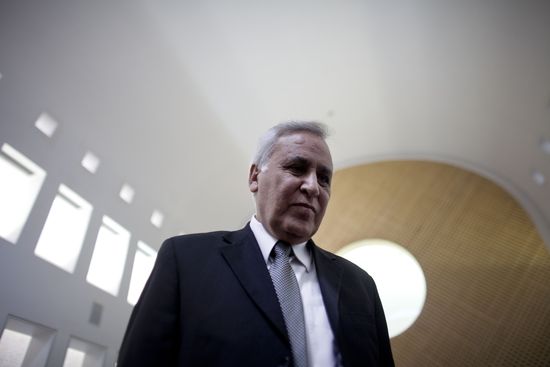
GT_KATSAV_111115

That's how Mishy Harman describes the conviction of former President Moshe Katsav for rape and sexual misconduct, whose sentence came down last week:

[T]he ruling has dominated public discourse, relegating even the [International Atomic Energy Agency]’s recent report on the Iranian nuclear program to the back pages … [Katsav's verdict] epitomizes the demise of the public’s faith in the presidency, and it breeds further disdain toward the country’s impoverished public sphere more broadly. Those who abuse their office do not only disgrace themselves, they erode the power of subsequent holders of their position to act honestly on Israel’s behalf. And perhaps even more significantly, they send a message to the country’s youth that politics is a loathsome calling, the realm of those who criminally use power for their own benefit.

Stewart Weiss draws parallels between the culture among Israel's political class and Penn State coaches.

(Photo: Former Israeli president Moshe Katsav arrives at the Supreme Court in Jerusalem for the reading of his sentence after appealing his conviction for rape and other sexual assault charges on November 10, 2011. Israel's Supreme Court rejected an appeal lodged by former president Moshe Katsav against his conviction on charges of rape and other sexual offences, and upheld his seven-year prison sentence. By Uriel Sinai/AFP/Getty Images.)