Is Your DVR Killing Sports Broadcasts? Ctd

A reader does his research:

Has Yglesias (or Kevin Drum, who launched this discussion) checked out TV ratings lately? The Patriots/Eagles NFL game last Sunday scored a 38.7 household rating in the New England area – more than a third of all households were watching that game – and 15.6 rating nationally. A few weeks ago, Sep. 12-18, the top three shows on all of broadcast TV (and five of the top 10) were NFL games. The NFL consistently dwarfs all competition. College football is no slouch either. Ratings for the NCAA basketball tournament last year were the highest in 20 years, also leading all network TV broadcasts.

This is why CBS paid $10.8 billion last year for broadcast rights to the NCAA men’s basketball tournament.  This is why DirecTV pays the NFL $1 billion annually for exclusive rights to its NFL Sunday Ticket package (the right to broadcast basically all NFL games to subscribers).

I realize that Drum and Yglesias were expressing their changing personal tastes, but this proposed shift from pro sports to Hollywood is not reflected at all in the numbers. Sports broadcasts remain the #1 revenue-generating and eyeball-drawing form of entertainment in the country – it’s not even close. In fact, with the rise of the DVR and more viewing options than ever before, pro sports (especially the NFL) has become the last true "broadcast" entertainment, in the sense of TV that advertisers can expect millions of people to consistently sit down and watch it together.
Will OWS Hibernate For The Winter?

134186723

John Heilemann has reason to believe so:

It’s perfectly possible that … the raucous events of November 17 were the last gasps of a rigor-mortizing rebellion. But no one seriously involved in OWS buys a word of it. What they believe instead is that, after a brief period of retrenchment, the protests will be back even bigger and with a vengeance in the spring—when, with the unfurling of the presidential election, the whole world will be watching. Among Occupy’s organizers, there is fervid talk about occupying both the Democratic and Republican conventions. About occupying the National Mall in Washington, D.C. About, in effect, transforming 2012 into 1968 redux.

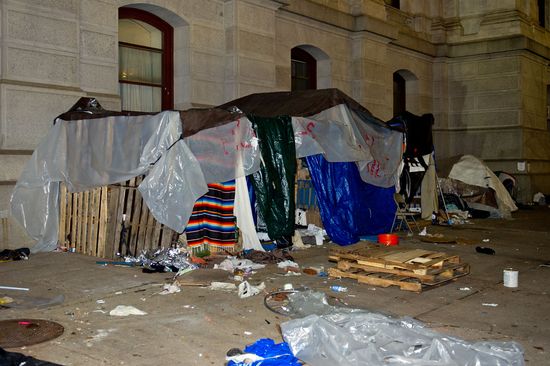
(Photo: An Occupy Philly camp area is seen after the 5 pm deadline to clear the encampment expired November 27, 2011 in Philadelphia, Pennsylvania. The city has issued a summons to protesters to leave the site where almost 50 members of Occupy Philadelphia are demonstrating. By Jeff Fusco/Getty Images)

Who Cares About Free Will?

Richard Chappell, critiquing a piece by Sheldon Richman, argues that the philosophical dilemma is simply irrelevant to politics:

[P]olitical liberty is an entirely different matter from psychological (let alone "metaphysical") freedom. The former is threatened by external coercion, whereas the latter is threatened by (e.g.) internal compulsion. These are different! Even if it turns out that moral responsibility is an illusion, that just means that people aren't to be held morally accountable for the things they choose. It's not a reason to impede those choices (given the usual proviso that they don't harm others).

Recent Dish on free will here.

The Daily Wrap

134268964

Today on the Dish, Andrew discussed the foreign policy views of the next generation (more here), he went another round on race and IQ, and responded to readers on research and scientific truth. We reflected on Barney Frank's legacy (his quote for the day here), and Cain "got out in front" of on his own alleged affair. Andrew examined the implications of a possible Cain withdrawal for Newt and the GOP field (related quote for the day here), we braced for the "buyer's remorse primary," and took the Obama coalition's pulse. Andrew warned against Gingrich's nihilistic radicalism, Robert Paul Wolff graded Newt's doctoral dissertation, and Tyler Cowen entertained tax hikes for the top 0.1 percent. In our AAA video, Andrew addressed the Dish's comments policy.

The UK embassy in Tehran came under attack, bailouts represent the cheaper path in Germany, and the fate of the fledgling euro is "fantastically difficult." Egypt held elections, we tracked events in Syria, evaluated Obama's strategy of offshore balancing, and wondered about the long-term consequences of America's "little wars."

Technology hurts pro sports, students should play a role in education reform, and science is a "great equalizer" of political power. We lingered on women and comedy, checked in on the search for extraterrestrial life, and revisited the cost of marijuana. Richard Chappell saw virtue in conspicuous giving, Noah Millman determined the best conditions for innovation, and The Economist orchestrated a resurgence. We questioned FAA regulations surrounding takeoff and landing, Marc Theissen blamed the supercommittee's failure on OWS, and readers weighed in on George Harrison's "My Sweet Lord" and music plagiarism.

Quote for the day here, chart of the day here, FOTD here, MHB here, VFYW here, and VFYW contest winner #78 here

M.A. 

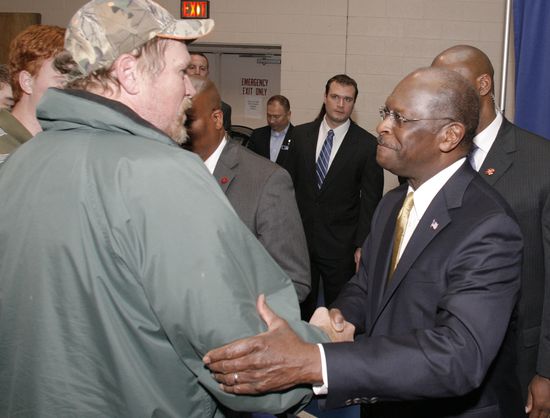
(Photo: Republican presidential candidate Herman Cain greets a supporter after delivering a speech about foreign policy at Hillsdale College November 29, 2011 in Hillsdale, Michigan. Earlier in the day Cain told staff members that he would be reassessing whether he should continue his bid for president, after a new accusation of an extended extramarital affair. By Bill Pugliano/Getty Images)

The Study Of Intelligence, Ctd

A reader writes:

I feel you're overreaching with this sentence from the recent discussion of racial difference and IQ: "But basic scientific research – the kind done at the NIH because no private funder would be interested – remains engaged in finding out truth for its own sake." I'm a former employee of a NIH press office, and was frequently asked by skeptics to justify research projects that weren't focused on a particular condition or cure. The answer is on the website of the National Institute for General Medical Sciences: "The mission of the National Institute of General Medical Sciences (NIGMS) is to support research that increases understanding of life processes and lays the foundation for advances in disease diagnosis, treatment and prevention" (emphasis mine).

Scientists don't have the luxury of unlimited funding to seek out "truth". Basic scientific research may not have any obvious, immediate applications, but it is always conducted in the hope that it will have some utility in the future.

Sure. But what the NIH does is preserve a place for completely open-ended basic research. That's the point. The reader who wrote the first response to the thread follows up:

Research funding in the US is seldom done purely in the pursuit of "truth."  The NSF (the federal agency most likely to fund research for the sake of "knowledge," let alone "truth") requires that grantees identify their work's impact on their chosen field and on society as a whole. The NIH requires statements of impact with all grant proposal submissions.  Correctly, grant agencies prioritize proposals that have a clear, positive social impact (e.g., protease inhibitors), and deprioritize proposals with limited or, more importantly, unclear impact.  Maintaining strict funding prioritization is critical in a universe where only 5-20% of grant proposals are funded.

Second, researchers do NOT enter their chosen field or adopt a research program simply to "find out truth for its own sake"; they are interested in making an impact.  Sure, motives are muddied by politics, upbringing, commitments made earlier in life to what is and what is not important (e.g., the need to delineate gay versus straight in biological terms), and those chance encounters that open academic doors to certain individuals mostly by chance.  But if you talk candidly to any aspiring undergraduate researcher about their future plans, most will tell at some point that they want to do something big and be the one who finds the truth that will change everyone's life (i.e., win the Nobel prize, be the hero).  Truth, divorced from ego, history, and practicality, is just not a major driving force these kids (unless they're mathematicians, philosophers, or artists).

To my previous point, limiting your analysis to "racial panic" is a mistake.  If I'm a new researcher, my chosen subject needs to pass a simple smell test: "Will I get enough out of this work to make it worthwhile in terms of what I must sacrifice?"  Funding agencies must ask the same question.  If you can find a sponsor and young, energetic, smart researchers excited enough to explore and publicize the causes of persistent racial differences in IQ, then you'll have a research program healthy enough to build critical mass.  Until then, "truth" itself is just not sufficient to justify doing any kind of work.  People seek impact, attention, good pay, and validation – and not necessarily in that order.

To argue that the pursuit of scientific truth is often not the sole motive for research seems to me obvious. But basic research – with far fewer obvious useful paths ahead of it and no guarantee of success in proving anything – is obviously distinguishable from targeted research paid for by venture capitalists and the like. My point about race and IQ is related: the very topic is so fraught with controversy that no research program on it would ever be funded in a mainstream university. And so we return to our original story. There's no grand conspiracy, no crude attempt to quash all research into race and IQ – just a toxic atmosphere around the subject so that those interested have every incentive to look elsewhere for research topics. That's all.

Why Americans Don’t Like Pop, Ctd

A reader counters another:

Oh PLEASE.  Stop with the over-simplification that all American music forms comes from the Blues. Ragtime per Wiki: "It was a modification of the march made popular by John Philip Sousa, with additional polyrhythms coming from African music." And Rock n Roll?  Stairway to Heaven doesn’t sound like Blues to me.  The British invasion brought over tons of traditional folk music tropes as well.  Any sampling of iconic rock albums will have thoughtfully arranged folk/art/serious compositions alongside thumping blues tunes.  Put up a post on Fairport Convention, Sandy Denny or Bert Jansch.  Johnny Marr was totally influenced by Bert.

And FURTHERMORE, I'm tired of the "only black people have soul" line of BS. 

Tell me the aforementioned Sandy Denny doesn't have a soulful voice (and without the ridiculous improvisational gyrations that contemporary singers use to show off?)  What about PJ Harvey? Cat Power? Eva Cassidy?

American music culture is a wonderful MIX of influences.  And it ain’t all African. And I'm tired of the trope that rock is pejoratively labeled as white guys stealing the blues.  They have, but they've done so much more with it conceptually IMHO.  (I could go on, but I'd probably get a Poseur Alert!)

As for me, I don't like 'pop' music because I find it derivative and uninteresting.  It's for kids who haven't heard it before, made by record labels who want to sell records based on what's previously been successful.

The February Lull

In this election cycle there is an especially long period between the early state primaries and Super Tuesday. Nate Silver imagines scenarios where this could matter:

The long gap in the nomination calendar could … give Republicans more time to contemplate how their nominee might perform against President Obama, a comparison that might not help Mr. Gingrich. Put another way, there would be more time for the party and its voters to develop “buyer’s remorse” over their seeming nominee. The news media — which has some incentives to keep the horse race going — might play along, applying more scrutiny to him while seeking out any sign of hope that Mr. Romney’s campaign was still alive.

Or it could allow Gingrich to get his ground organization in line in time for the next battles. Whatever happens, it looks likely to be long, drawn out and eventful.

Face Of The Day

134242624

Greenpeace activists try to promote the use of renewable energy, using solar and wind power, on November 29, 2011 on the Durban beachfront. UN climate talks got under way on November 28 in Durban amid calls for action to head off worsening drought, floods and storms but also to fears of a bust-up just two years after a near-fiasco in Copenhagen. By Alexander Joe/AFP/Getty Images.