Explaining Conservative U.N. Hate

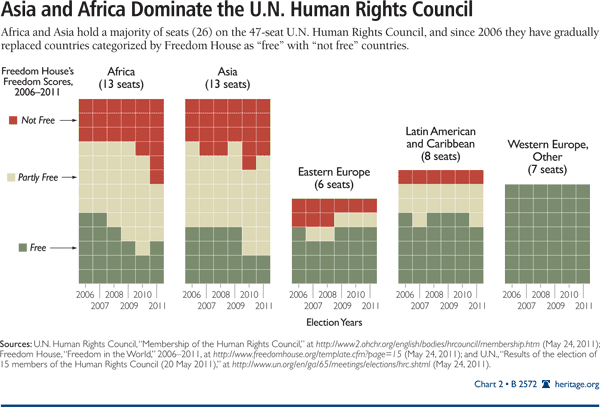
B2572_chart2600px

David Bosco has a theory as to why it's the only international organization the right routinely goes after:

[T]he UN–at least its General Assembly–is a forum in which the United States is routinely outvoted and in which its special place in the international system receives no formal recognition. What's more, many of the states that vote against the U.S. are themselves corrupt and unrepresentative.  The UN General Assembly is quite unique in this respect–it's the one multilateral forum where the U.S. can be humiliated–if losing a public vote should be thought of as humiliating–on a regular basis. Most other institutions, including the World Bank, IMF, WTO, and NATO, either operate by consensus or accord the United States special voting powers. 

He documents the hate among GOP presidential candidates here.

(Chart via Brett Schaefer.)

Pot For PTSD

Sgt. Ryan Begin wants the federal government to reconsider its position on medical marijuana:

At one point, Begin, diagnosed with PTSD shortly after coming home, was taking more than 100 pills a day. So many that he would stuff dozens of bottles into a backpack to lug everywhere he went. Now, he’s cut his dependency on prescriptions to zero. Their replacement? Five joints a day.

“Using marijuana balances me out,” he says. “It takes those peaks and valleys of PTSD and it softens them. It makes my life manageable.”

Modern Love In China

Nicola Davison provides a rather dire snapshot of matchmaking efforts in China:

A lack of young women – a result of the skewed rate of baby boys born under China's one-child policy – means an estimated 30 to 50 million men will be without a wife in 20 years.

Sushma Subramanian and Deborah Jian Lee previously reported on the romantic trials of China's educated and ambitious single women. Meanwhile, Shanghai's single retirees seem to be doing alright.

Women At War

GT_Libyan_Woman_WIth_Daughter

Diana Wueger criticizes the common assumption that wars are about fighting between male soldiers:

[C]ivilians are often targets, not just collateral damage; 90 percent of conflict casualties are civilians, many of whom are women and children. A 2009 study by the Peace Research Institute of Oslo concluded, "men are more likely to die during conflicts, whereas women die more often of indirect causes after the conflict is over." When our understanding of a given war focuses so overwhelmingly on its male soldiers and statesmen, we miss the larger context — namely, we underestimate the many roles women can and do play — which makes it harder to end war and create durable peace.

She has some follow-up thoughts here.

(Photo: A Libyan woman, wrapped with the flag adopted by Libya's new rulers, sits with her daughter at a university campus in Tripoli October 27, 2011. By Marco Longari/AFP/Getty Images.)

Animal Ink

Tim Donnelly, a vegan, wrestles with tattoo ethics after finding out that there are "charred bones of dead animals in the ink, fat from once-living things in the glycerin that serves as a carrying agent, [and] enzymes taken from caged sheep that go into making the care products":

For some veggies I talked to, it seems the concern is similar to one they have about sugar: most mass-produced sugar is made using a process that includes bone char, making tons of delicious, sweet, and seemingly harmless things decidedly not vegan, or even vegetarian, but devilishly hard to avoid.

The Effects Of Neglect

Jonathan Cohn emphasizes the importance of a child's first two years in brain development:

A baby wails, waiting for somebody to provide milk, dry clothing, or maybe just a warm embrace. When comfort comes quickly, the body produces fewer stress hormones, the baby calms down, and the brain goes back to business as usual. And if this happens repeatedly, as it should, the nerve impulses crackling in the brain will carry the signals for effective coping with stress over and over again—building pathways that the baby can use later in life to solve problems and overcome difficulty.

But the baby who is ignored or neglected just keeps screaming and flailing. Eventually, he exhausts himself and may appear to withdraw. Yet the quiet child is not a content child. Constant activation of the stress system causes wear and tear on the brain, altering the formation of neural pathways, so that coping and thinking mechanisms don’t develop in the same way.

Cohn concludes that the "science of early adversity … offers a blueprint for tackling the effects of poverty and neglect, one that is more precise and observable than any tools policymakers have ever had at their disposal." Yglesias is pessimistic that anything will be done.


Netanyahu Isn’t Israel

Jeffrey Goldberg's claim that Obama disliking Netanyahu doesn't mean he hates Israel has got Jennifer Rubin hoppin mad:

It’s time for pro-Israel liberals to be honest: This president’s animus toward the Jewish state is so evident that only a foolish prime minister would trust him with the survival of the Jewish state. And Netanyahu is no fool. Surely Goldberg could concede both these points?

Goldberg's pithy response:

Surely Goldberg will not concede both these points. Rubin, like many of her colleagues to my right, believes that Netanyahu is the living embodiment of the State of Israel. Her formula: If you dislike Netanyahu, you dislike Israel. This is absurd. Barack Obama has shown zero animus to the state of Israel or to the idea of Israel. In word and in deed, he has been in Israel's corner; he has spoken eloquently in defense of Israel's right to exist as a Jewish state, and he has provided it with unparalleled defense support.

The Daily Wrap

Gingrichproposition
Today on the Dish, we scrutinized Gingrich's boomlet (and his close ties to Freddie Mac), and Newt's ideological deviations were overlooked as he assumed the not-Romney position. Losing Iowa would stymie Mitt's path, the right is suddenly obsessed with Calvin Coolidge, and the Supreme Court challenge to Obamacare is bigger than we think. We wondered if the supercommittee was even taking the trigger mechanism seriously, the chairman of the Senate Republican Conference is ready to go big, and we speculated about Mark Kelly's possible political career. Andrew explored the implications of the productivity paradox, Krauthammer spewed partisan propaganda, and readers weighed in on the seismic implications of fracking. In our AAA video, Andrew explained his highbrow affinity for Judge Judy.

Europe approached a black hole, Syria neared a turning point, and Marc Lynch held out hope for Egypt. China is not becoming more democratic, and no, the U.S. should not write off Taiwan.

Andrew pooh-poohed tobacco prohibition, we searched for a hybrid rental/home-ownership model, and charted marijuana's economic potential. Mass protests matter, math and science majors ditched the STEM track for better grades, and Amazon disrupted the publishing ecosystem with a digital library. The SOPA would wreak havoc on the Internet, driving laws faced a slippery slope, and men aren't funnier than women but get more credit for being funny. Rick Perry mangled the truth and the English language in his own campaign ad, Andrew offered an explication of his faith, and we met the woman behind a familiar voice.

Moore award nominee here, VFYW here, VFYAW here, MHB here, and FOTD here

M.A.

(Photo by Chip Somodevilla/Getty Images.)
Rick Perry Attacks Obama, English Language

Rick Perry claims Obama called the American people lazy: 

Michael Scherer looks at the full Obama quote and determines that Perry is lying:

Did President Obama argue that “Americans are lazy,” as Perry alleges? No. He argued that American policy makers have been lazy in not doing more to attract businesses. (Obama’s standard line about the American people, by contrast, is that they are the “best workers in the world.”) 

Dan Amira pays close attention to Perry's grammar:

[T]aking things out of context is hardly new ground for a political campaign. What is new ground is a candidate mangling the English language in a TV ad, which he presumably had the opportunity to tape as many times as necessary. "Can you believe that?" Perry asks in the opening moments of the ad. "That's what our president thinks wrong with America?" We imagine the ad team doing 97 different takes of this line, then finally saying, "Eh, screw it," and giving up.