Romney’s Early-State Weaknesses

Nate Silver highlights them:

[A]lmost any winner of Iowa apart from Mr. Romney himself would present some kind of threat to him in one of the next three states. (The exceptions are probably Michele Bachmann and Mr. Santorum.) Mr. Romney certainly does not need to win Iowa to win the nomination. But unless he builds up more of a cushion in the national polls before the voting there, a loss for his campaign in the caucuses would at least make for an exciting January.

Europe’s Looming Black Hole

It's hard to generate great interest in the interest rates in the Netherlands, but the possible implosion of the euro and the collapse of the entire post-Second-World-War project is now imminent. Yesterday, the markets started punishing Holland, a state, after Germany, with a usually stellar fiscal reputation. A downgrade of France's debt now looks unavoidable. Growth is at 0.2 percent across the euro zone. Italy hangs by a thread, and is now essentially run by someone unelected with foreign monitors watching his every move. Ditto Greece. And the odds of the combined austerity programs in France, Italy, Portugal, Ireland and Greece creating a debt trap from which it is impossible to emerge is also very real. If this doesn't scare you, check out this analogy:

Dhaval Joshi, at BCA Research, delved into the world of physics to explain Europe's predicament. "Approaching a black hole, cosmologists define the event horizon as the point beyond which it is impossible to escape a guaranteed ultimate annihilation," Joshi said. "The fascinating thing is you can cross this point of no return without realizing that your doom is certain. So the question is: has the euro area unwittingly crossed its own event horizon? We believe not, although it is getting dangerously close."

The only way to stabilize this situation is for the European Central Bank to commit sufficient resources to avoid the black hole. The longer the wait the higher the cost. Or the euro zone can simply disintegrate into two halves, with all the fiscal and financial chaos that would mean.

Does the ECB have the funds? Did the Fed? It can print money. And so Germany faces an existential crisis: do we return to printing money as we did in the past to save Europe? Or do we allow Europe to fail? I can see why Merkel doesn't want to choose. But if she doesn't soon, the markets will choose for her.

Hope For Egypt

Marc Lynch keeps it alive:

I remain broadly optimistic that Egypt, like Tunisia, will make its democratic transition despite all the turbulence. This is not because the SCAF has demonstrated any real commitment to democracy or the rule of law. It is because there is a broad and deep public consensus in support of democracy, and enough powerful competing forces to prevent any easy return to Mubarak-style authoritarian rule. It is also because the Obama administration at the highest levels is determined to help get Egypt right, and has been working hard — often behind the scenes — to push the SCAF in the correct direction. 

Moore Award Nominee

"Those who see the Syrian popular struggle for democracy as having already been hijacked by these imperial and pro-imperial forces inside and outside Syria understand that a continuation of the revolt will only bring about one outcome, and it is not a democratic one – namely, a US-imposed pliant and repressive regime à la Iraq and Libya. If this is what the Syrian demonstrators are struggling for, then they should continue their uprising; if this is not their goal, then they must face up to the very difficult conclusion that they have been effectively defeated, not by the horrifying repression of their own dictatorial regime which they have valiantly resisted, but rather by the international forces that are as committed as the Syrian regime itself to deny Syrians the democracy they so deserve." – Joseph Massad, Al Jazeera English.

Why We Need Protestors

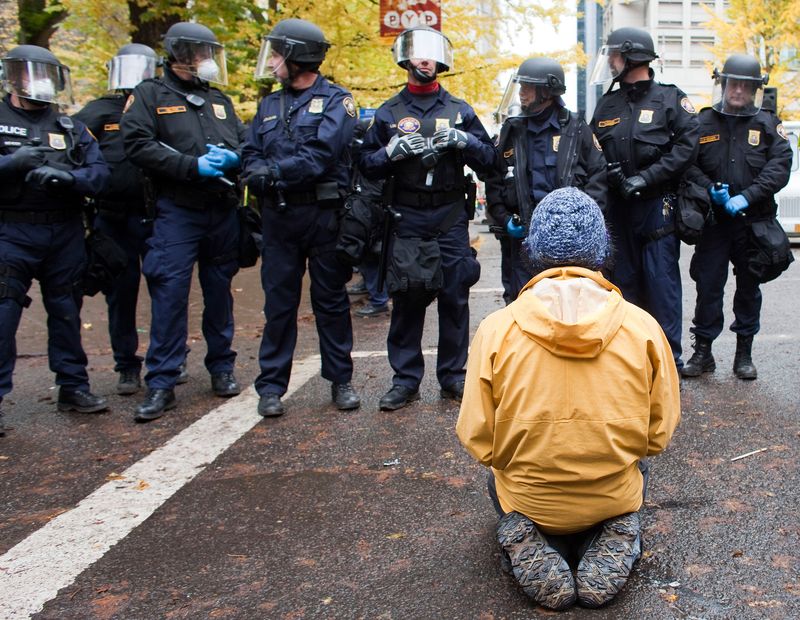
GT_OCCUPY_111114

Alasdair Roberts bemoans the extraordinary powers American police departments have available to disrupt mass protest:

One might not worry about the decline of crowd politics. After all, we still have the voting booth. At the same time, social media seem to give us the capacity to create “virtual crowds” in cyberspace, with none of the disorderliness created by actual crowds in city streets. But these are imperfect substitutes for mass protest, which retains its distinctive capacity to crystallize discontent with the status quo, and thus to create opportunities for substantial change in government policy. When we tame the crowd, we diminish the country’s capacity to respond creatively to economic and social crises.

(Photo: A protester sits in the street in defiance of police orders near the Occupy Portland encampment November 13, 2011 in Portland, Oregon. Portland police reclaimed the two parks in which occupiers had been camping. By Natalie Behring/Getty Images.)

Hewitt Award Nominee

"Well, no one is asking him to go out there and asking him to be a jingoistic cheerleader. But when you call your own country 'lazy' when you are abroad and you call it unambitious and soft when you're home, I think what you are showing is not tough love, but ill-concealed contempt," – Charles Krauthammer, Fox News. Chait explains how Krauthammer wrenches Obama out of context. I notice that he also said on Fox that Obama spent

$1 trillion on the stimulus which increased unemployment

He knows this causation is nonsense. It was not $1 trillion, and it prevented unemployment being far worse in the short term. Criticize it on its long term effects, but please. This is partisan propaganda.

The Economic Case For Legal Cannabis

Pot-package 

Morgan Fox makes it:

The potential of the industry as a whole is frequently overlooked. Marijuana is by most estimates a more valuable commodity than corn and wheat combined, with experts estimating its annual value to be between $10 and $120 billion. The employment potential of such a market is enormous. This does not factor into federal considerations, as evidenced by recent Justice Department crackdowns on the medical marijuana industries in places like Montana and California that have jeopardized thousands of jobs. If economic stagnation continues, however, employment and tax waste will become more and more relevant in driving public support for ending Prohibition. Unfortunately, that support may have to increase dramatically before any real ground is gained.

(Photo from a 2009 competition to design packaging for legal joints.)

The Productivity Paradox

Maxwell Wessel explains the policy dilemma:

If we adopt the perspective that productivity will continue to increase exponentially, we should be looking to fix the long-term employment problem through non-traditional avenues. Perhaps that means investing more in the arts, an area very difficult to automate. Perhaps that means providing subsidies for domestic business operations. But one thing is certain, if the paradox of productivity holds, we can't just talk about free-market solutions to the employment problem. 

More on the economy's "bright spot" here. I suspect that the hipster, foodie, neo-arts-and-crafts movement alternative – bringing employment back to local produce, services and skills – may turn out to be the right one. But anyone not currently aware of the contradictions of capitalism is asleep. The innovations and globalization of capitalism may well be accelerating unemployment in the West (while transforming much of the rest of the world), and the only way to get back to full employment here may be by accepting a new and relative poverty, in which we recover the skills that cannot be out-sourced, the needs that require personal contact, the skills that require long and difficult practice: nursing, car repair, baking, restaurants, carpentry, construction, teaching, to name a few off the top of my head.

I don't know how an individual baker in a town can compete with a Safeway. But I'm not sure we should confidently predict a return to "normality" as we have known it since World War II.

The US Can’t Sell Taiwan To China

Paul V. Kane wants [NYT] Obama to give up our alliance with Taiwan in exchange for debt forgiveness. Joe Weisenthal finds the idea ridiculous:

[I]n short, what Kane is advocating is an abdication of our strategic self-direction in exchange for extinguishing a threat (Chinese holdings of U.S. debt) that doesn't exist. What's scary is not that this will ever happen — it won't — but that the size of the debt is causing people to think loonier and loonier things. Eventually we might do something really dumb.

Blake Hounshell nods. Fallows thinks the above video captures the reality of the Taiwan situation better than Kane does.