What Does The Court Think About Killing The Mandate?

Scott Lemieux considers the Supreme Court's choices:

If the Court strikes down the legislation, the political impact will depend on how the Court does it. The Court has allocated 90 minutes just to the question of whether the individual mandate can be “severed” from the rest of the bill—that is, whether the mandate can be ruled unconstitutional while the rest is kept in place. Ruling that the mandate can be severed from the rest of the ACA would appeal to Kennedy and Roberts for two reasons: They like “minimalist” opinions that don’t go beyond what is necessary, and striking down the relatively unpopular individual mandate would probably not attract a great deal of public opposition. On the other hand, from a Republican perspective, striking down the mandate would have unpredictable consequences. Without it, the ban on discriminating against people with pre-existing conditions in the ACA would potentially destroy the private insurance industry while creating a disastrous insurance price spiral. This could lead to a near-complete repeal of the bill—but it could also lead to a public insurance system. Kennedy must be worried about this possibility.

Yuval Levin wants conservatives to make the case against the whole law on policy rather than constitutional grounds.

Cain Draws A Blank, Ctd

Paul Waldman is skeptical that the massive Libya flub will hurt the Hermanator. Like Philip Klein,  E.J. Dionne thinks coverage of the Libya issue misses Cain's larger mistake:

National Review’s “The Corner,” essential online reading for conservatives, summarized Cain’s comments with this headline: “Cain Supports Collective Bargaining for Public Employees.” That headline will damage Cain among conservatives more than anything written about his Libya meltdown. Among Republican primary voters these days, you can survive sexual harassment charges for a while, and you might even be forgiven some gaffes. But you can’t give an inch to unions.  

The GOP Won’t Make A Deal

Ezra Klein wonders whether they will come to regret it:

Republicans have not said yes to any of the [budget] deals the Democrats have offered. They continue to assume a better deal is just around the corner, and thus far, they have been right. Currently, they may be assuming that yet a better deal could be struck with, say, President Mitt Romney, and if he wins the election, they may well be right. If Obama wins, a reinvigorated Democratic majority might prove them wrong. But the fact remains: Their strategy of saying no has, thus far, paid great dividends, though not ones Republicans have decided to collect.  

Face Of The Day

132910882

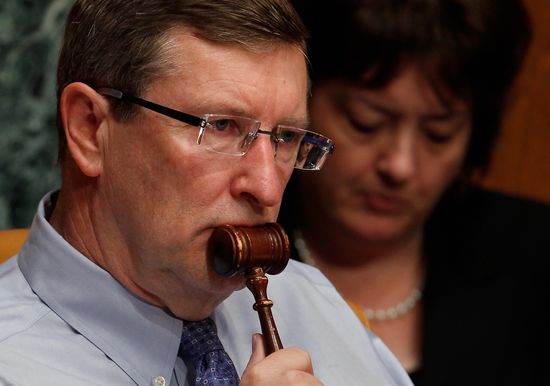
Senate Budget Committee Chairman Sen. Kent Conrad (D-ND) listens to testimony during a hearing on Capitol Hill on November 15, 2011. Congressional Budget Office Director Doug Elmendorf presented the committee with the CBO's fiscal and legislative policy options for increasing economic growth and employment in 2012 and 2013, including increased aid to the unemployed, tax credits to lower and middle income households, and reducing employees' payroll taxes. By Chip Somodevilla/Getty Images.

Putting Sandusky’s Interview Under The Microscope

A reader writes:

In another life, I spent a significant amount of time working in penitentiaries, doing drama therapy with pedophiles. I learned a lot – so much of which I wish I could forget these days. I realize that we have to presume innocence, but the data about Sandusky is overwhelming – It parallels everything I learned about pedophiles during my years of working with them.

They organize their lives around their obsession. They structure their lives in such a way as to continue their abuse. They are extremely devious, and will go to great lengths to get what they want. And, if not caught early enough, they can end up with hundreds, and sometimes thousands, of victims. (One particularly disgusting inmate described at length the kits he carried with him at all time – one in his home, one for travel, one in his car. They included Vaseline, candy, toys, towels, etc. He was constantly in search of victims. His entire life was structured around that search.)

In listening to the Costas interview, I was drawn back to my days spent in the Massachusetts Treatment Center for Sexually Dangerous Persons in Bridgewater, MA. First, Sandusky exhibits no affect in the interview. There is no outrage, no emotion, no anger, no sadness. Imagine, just for a moment, if YOU were innocent and accused of these horrific crimes. Your emotional state would be intense. His is anything but. This is, sorry to say, classic pedophile affect.

Second, and most compelling, is his answer to the question: “Are you sexually attracted to young boys – to underage boys?”

Obviously, if he were innocent, there is only one answer to this question: “No!” (Again, imagine if someone asked you that question. There would be only one answer and it would be emphatic, and probably outraged.)

But, listen carefully to his response. First, he repeats the question – twice. Next, he outlines his “enjoyment” of young people. Then, he says he “loves to be around them.” Finally, he catches himself and eventually gets to “No,” nearly fifteen seconds after the question is posed. Again, this is classic pedophile. He first attempts to explain himself – almost getting lost in that explanation – before he finally comes to the only obvious answer.

However, he has no problem answering this question: “Are you a pedophile?” The answer to that question is quick: “No.”

Why? Because, he absolutely doesn’t believe – in any way – that there is anything wrong with what he has done. He doesn’t believe that pedophilia is wrong – pedophiles never do. They construct vast and complex justifications for their actions, usually centering on the victim, what the victim wanted, and how much pleasure they give their victim. The term itself – pedophilia – is anathema, because it defines, as abnormal, an activity and way of life that they view as perfectly legitimate.
“Invisible Winks”

Ben Casnocha explains how a writer can nod to insiders without alienating outsiders. He uses me as an example:

Andrew Sullivan wrote a blog post awhile back … in which he ended with a sentence not in quotation marks that was actually a sentence from a Yeats poem. Again, he doesn't quote Yeats with quotation marks, but he closes with Yeats's words, which happened to fit the topic perfectly. Those who didn't know it was Yeats presumably read it and absorbed it normally. Those who did catch the reference found an easter egg and felt smart — and closer to Sullivan as a result. It was the perfect invisible wink: greater bond with insiders, neutral effect on outsiders.

His bottom line:

The best inside references strengthen bonds with those who get it while not being so obviously inside baseball that outsiders feel excluded.

 My own view, apart from being flattered, is that when I'm writing on this blog, I am writing for readers many of whom have followed the blog for years and it's inevitable that in that organic process, in-jokes, somewhat obscure references (Yglesias Award? Hathos Alert?) help build a community. But I try not to get all insidery too much. But if a new reader expects only political analysis and instead comes upon random postings on facial hair, well … that's what happens when actual human beings interact outside an institutional authority. Things get real.

Will Americans Do Dirty Jobs? Ctd

Burgers

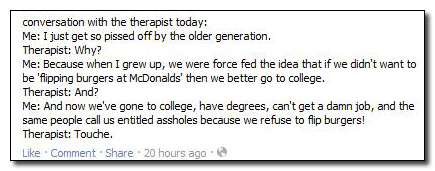
John Cheese explains one element of the employment conundrum:

[A]t some point between my grandfather's time and now, getting your hands dirty became something to be ashamed of. My generation perpetuated that. We made it socially unacceptable to:

A) Do any job that requires sweat and/or a uniform.
B) Work 70-hour weeks to get ahead.

So if you don't do either of those things, what's left? Getting an education and waiting for a good job in your field. But now, when we catch you doing that, we mock you and tell you to go flip burgers. And that's bullshit. We told you your whole lives that those jobs were for idiots and failures. You think you're too good for those jobs because that's what we've been fucking telling you since birth.

Why Not Do Nothing?

A reader challenges me on this post:

I am not certain I agree with you entirely on the budget – the belt tightening seems to me likely to be self-defeating by depressing demand and creating further pressures on the federal budget – but it seems to me your real preference should be for gridlock.

If the supercommittee does nothing, we are supposed to get an automatic cut to entitlement and defense expenditures. If Congress further deadlocks on taxes, we go back to the Clinton era tax rates. Again, I am not certain that this is a good idea in the short term, but your preferred fiscal outcome is the default option here … just so long as those darn Washington politicians don't wreck it by gettin' all bi-partisany up in there, to paraphrase an old friend.

My quibble is that I doubt that the House will allow the defense cuts (Romney is already pledging more defense spending) – and then the bottom really falls out of market confidence. I also fear too drastic and immediate a return to fiscal retrenchment, for the reasons you outline. But a clear agreement on a future path, credibly phased in, with structural reforms, as in Bowles-Simpson, would, it seems to me, be more manageable than the nerve-wracking do-nothing option.

It's what leadership is. And I worry that Obama's often-smart hanging back on the ropes is not adequate to this moment.

Newt Is Dumb, Ctd

A reader piles on:

Newt’s megalomania has the appeal of radical fervor combined with imperious grandeur: think of Napoleon or Peter the Great overturning the old order and establishing a glorious new one. Just what's needed in a constitutional presidency.

Another:

Remember, he didn't get tenure at West Georgia College, and that couldn't have been all that hard to do.

Another:

I admire much of Professor McWhorter's writings, but is his point about Newt Gingrich's vacant grandiloquence not captured succinctly in the aphorism, "Diarrhea of the mouth, constipation of the mind"?
That just about sums it up.