Penn State: A Wound That Shouldn’t Heal

Charles P. Pierce looks ahead:

There will now be a decade or more of criminal trials, and perhaps a quarter-century or more of civil actions, as a result of what went on at Penn State. These things cannot be prayed away. Let us hear nothing about "closure" or about "moving on." And God help us, let us not hear a single mumbling word about how football can help the university "heal." (Lord, let the Alamo Bowl be an instrument of your peace.) This wound should be left open and gaping and raw until the very last of the children that Jerry Sandusky is accused of raping somehow gets whatever modicum of peace and retribution can possibly be granted to him. This wound should be left open and gaping and raw in the bright sunlight where everybody can see it, for years and years and years, until the raped children themselves decide that justice has been done. When they're done healing — if they're ever done healing — then they and their families can give Penn State permission to start.

Nick Gillespie rightly complicates another aspect of Pierce's otherwise superb piece.

Krugman vs Summers – And Obama

Felix Salmon watched:

This debate, because it took place within a basically Keynesian, leftist worldview, was very interesting. Both Krugman and Summers spent a lot of time saying that they agreed with each other — with one big difference. They both quoted Keynes as diagnosing “magneto trouble” — the engine of the economy is broken, and it needs to be fixed. Summers has faith that, in Churchill’s phrase, “Americans can always be counted on to do the right thing, after they have exhausted all other possibilities” — the right thing, here, being to fix the magneto with expansionary fiscal and monetary policy. Krugman, by contrast, sees political gridlock as far as the eye can see, and says that it doesn’t matter how innovative or philanthropic or demographically attractive the U.S. is — if you don’t fix the magneto, the car won’t start, and America’s magneto ain’t gonna get fixed any time soon.

As David Leonhardt memorably put it, where debt and politics meet is a hard place to be. It seems to me increasingly obvious that we are collectively going to have to accept a sharp further drop in our standard of living because, at some point of mathematical certainty, the debt will become unserviceable. So our politics, as in Europe, is going to become a scramble for declining resources. A sane and responsible polity will fess up to this and propose and negotiate a fair balance of sacrifice – before the rout happens and chaos determines our choices.

The battle will not just be between rich and poor, or, rather, super-rich and faltering middle class. 131728450It will also be between young and old, which was in some ways what the elections of 2008 and 2010 were. The young won the first; the old won the second. To my mind, as readers know, the bulk of the public austerity should come in entitlement spending and defense, both of which have grown out of all proportion to the economy as a whole. But I cannot in all fairness – and yes, the word is fairness, not equality – support this without returning to the revenue levels of the Clinton years. That we can actually do this while lowering rates (because the weight of the myriad deductions in our insane tax code is so massive) is a huge dose of sugar to help the medicine go down.Which makes the GOP's refusal to do this so outrageously irresponsible, a betrayal of conservatism at its core.
But the GOP is not solely to blame. The president too, by blinking in front of his own deficit commission, is also responsible for the paralysis.

I think a lot of the criticism of this president is piffle. I think he's done an extraordinary job in foreign policy and has kept this country afloat economically in times as perilous as the 1930s. But his refusal to back a specific plan to save our finances, and to do so before the crisis deepens, in order to reverse a potentially devastating confidence collapse in Europe … this is failure of an historic kind. I understand why, politically, this is difficult. But this is a moment for transcending political constraints. This is a "Yes We Can" moment. This is why we supported him – because he seemed someone who could at times transcend politics, for the greater good.

He still can. The super-committee will almost certainly fail. Once that happens, the US will be telling the world it is less capable of grappling with its debt than Greece or Italy. Then what? If Obama seeks re-election just by not being a scary Republican, he will deserve to lose. We need him to campaign for Bowles-Simpson (or his variation thereof) and radical tax reform, and promise he will work with any Republican prepared to help finalize the deal – but that he will do it with Democrats alone if needs be. If that means ceding Medicare as an electoral advantage, so be it. We did not elect him to be a reactive defender of the Democratic machine. We elected him precisely because he said he wasn't that.

I worry that he is going to run on fear. He must run on hope – and a plan that entails risk but promise. This is the moment that will make his presidency. It is no time to think small.

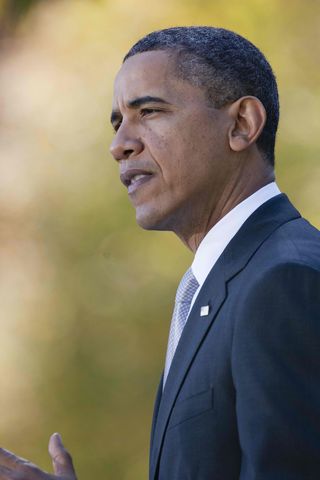
(Photo: U.S. President Barack Obama speaks in the Rose Garden of the White House in Washington, D.C., U.S., on Monday, Nov. 7, 2011. Obama issued three executive orders aimed at helping veterans find jobs and pressed Congress to pass tax credits for businesses that hire former members of the military. By Andrew Harrer/Bloomberg via Getty Images)
Newt Is Dumb

From a linguist's perspective, John McWhorter explains that Newt Gingrich is not smart ("you'll find that he's using artfully constructed rhetoric to cloak ideas that are simply wrong"):

Gingrich's patterns of speech are largely analytically acute, and sometimes aesthetically interesting, but substantively, they are very often lacking. Language is supposed to be a package that carries substance, but Gingrich is sometimes so pleased with his uninterrupted stream of words, that he mistakes it for an actual flow of ideas.

Only in Washington could such a half-baked, narcissistic, know-nothing blowhard be regarded as an intellectual.

McQueary’s Story Changes

92180710

An e-mail he sent to friends contradicts the grand jury testimony:

“I did the right thing…you guys know me…the truth is not out there fully…I didn’t just turn and run…I made sure it stopped…I had to make quick tough decisions.”

A reader adds:

If this is true, it means that McQueary both stopped the assault and then properly reported it to both the coach and the athletic director. (As an earlier reader noted, this is the proper process of notification in Pennsylvania, as opposed to going straight to the police). Again, if true, I believe this would demand a retraction of many of your awful smears upon McQueary. I’m sure that, like me, you’re also curious about the extent to which McQueary followed up on his initial reports (if at all), but can we not wait until he has had a chance to speak up for himself before we destroy a man’s good name? In what other situation would you say such things about a person based on a single piece of source material (in this case, the grand jury presentment)?

Good grief. If I cannot make a judgment based on the exhaustive findings of a Grand Jury investigation, then I can make a judgment on nothing.

But again, this is not about me being self-righteous or anything. It is not about being vain, as David Brooks preposterously asserts today, hiding behind a mound of social science so as to avoid a moral call. It’s about what was the right thing to do. And McQueary himself – by his new email – has now plainly agreed with me on what the right thing to do was. He now says he did it. The Grand Jury says he didn’t. The email was not under oath. I do not think it’s a smear to criticize an act of omission that was found as fact by a Grand Jury. And, frankly, I’m mystified by those seeking to exonerate anyone in this set of facts.

I don’t think I brag about how moral I am. I know I’m very often a sinner. And I am not judging McQueary’s conscience: that is between him and his Maker. But I am able as a blogger to say what I think is right and wrong, and to feel horrified by what has happened to so many children. My reaction is no different with Penn State, an institution I have no attachment to, than with my own Church, to which I am attached from baptism on.

This is not about my or anybody else’s vanity. It is not in the end about McQueary’s character. It is about a child’s dignity and body. And how it was trashed and raped, and how the man who did it went on to do it again and again and again to more and more children because some people failed to do what was plainly, easily, the right thing to do.

Meanwhile, Sandusky denies everything in this mesmerizing interview:

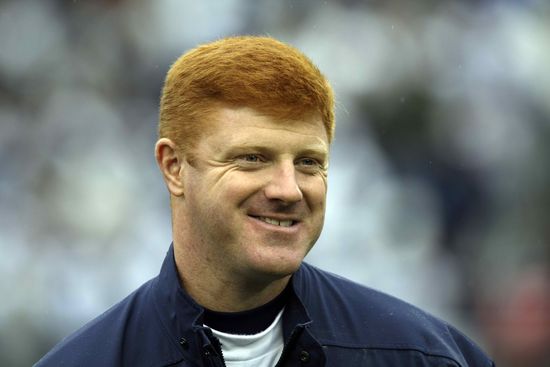
(Photo: Assistant coach Mike McQueary of the Penn State Nittany Lions smiles before the start of their game against the Minnesota Gophers at Beaver Stadium on October 17, 2009 in State College, Pennsylvania. By Chris Gardner/Getty Images)

What Happens If Iran Gets The Bomb?

The International Atomic Energy Agency's confirmation (pdf) of what we already knew – Iran is moving towards getting nukes – has poured a gallon of gasoline on the raging pro-Iran war fire. N-Pod, and other usual suspects have all come out guns a-blazing, while Romney makes his standard "Obama is the problem" non-argument. The most serious scenario for war:

[T]he Obama administration should not discount the possibility of an Israeli-Iranian nuclear conflict. From the very start, the nuclear balance between these two antagonists would be unstable. Because of the significant disparity in the sizes of their respective arsenals (Iran would have a handful of warheads compared to Israel's estimated 100-200), both sides would have huge incentives to strike first in the event of a crisis. Israel would likely believe that it had only a short period during which it could launch a nuclear attack that would wipe out most, if not all, of Iran's weapons and much of its nuclear infrastructure without Tehran being able to retaliate. For its part, Iran might decide to use its arsenal before Israel could destroy it with a preemptive attack. The absence of early warning systems on both sides and the extremely short flight time for ballistic missiles heading from one country to the other would only heighten the danger. Decision-makers would be under tremendous pressure to act quickly.

Fallows isn't convinced that a strike would succeed in preventing nuclearization. Paul Pillar hears echoes of Iraq in the coverage of the report. Yaakov Katz thinks the IAEA move will actually make war less likely:

The report also means that for the time being, an Israeli military strike will likely move to the back burner, and Jerusalem will focus instead on getting the world to impose crippling sanctions on Iran, not crippled sanctions like those that have already been passed.

Benjamin Weinthal explains what sorts of new sanctions might succeed in preventing an Iranian bomb. Marc Tracy imagines how China could be brought on board. And Ackerman develops a contingency containment strategy that might strengthen the American hand in the Middle East. For my part, I cannot see how we can prevent Iran from getting a nuclear bomb, and I cannot see how we can prevent the current insane Israeli government from launching a war on Amalek, if Netanyahu and Barak are as deranged as Dagan and others fear they are. And if they do strike first, the impact on the West – a wave of Jihadism, a masssive attempt to unleash weapons of mass destruction on the West as revenge – would be cataclysmic. Not just in terms of human casualties but in terms of pushing what's left of the world into the worst depression of all time. If Israel believes this will help Israel, they truly need to be saved from themselves.

Containment is the only policy that makes sense; and it is a policy Israel refuses to tolerate and which the US has recklessly disavowed. Which means that it's likely that the country that could indirectly launch a third world war against the West could be Israel. You think Obama could stop them? And since the Israeli government has a lock on the US Congress, and a fervent following in the opposition fundamentalist party here, we'd all be directly implicated in an attack, even if we are never told in advance.

It's staggering that a world power would make its very survival contingent on one extremist government in another distant country. And there are times when I think we are sleepwalking into the worst conflagration since the Second World War.

Where The Young Are Restless

Youth_Unemployment

Mike Konczal compares unemployment in America and in Arab Spring nations:

I can’t find what ages are used for youth for “youth unemployment” in the IMF’s definition, and I’m not even sure if it is consistent across the different countries they estimated.  As such, I’m including ages 16-19 and ages 16-24, though I believe they are more likely looking at 16-24.  For 16-19, we are at the same level of youth unemployment for Egypt and well above the region as a whole.  At the broader 16-24 range, we are above Syria and Morocco, which both saw large-scale movement in the Arab Spring.

Gingrich Should Fail

Josh Marshall explains why:

The big problem for Newt is that Republican power brokers will not let him within 30 miles of the Republican nomination. A win is just too close. Why throw that away on someone as toxic, erratic and unpopular as Newt? Newt is a creature of the conservative Id, churning with resentment and provocation. Someone like Mitt can learn the buzzwords. But it’s Newt’s world. He half created it. Mitt may have to live there with him for the next several months. But politically Gingrich has never able to live outside of that world. In the end, he won’t beat Mitt because he can’t beat Obama.

Today In Syria: Bloodiest Day To Date

A minimum of 70 people were murdered in Syria, one of the worst 24 hours in Assad's killing spree. The largest single cluster of killed were in Daraa – and yet, as the above video documents, enormous crowds continue to gather in the city. The regional and international pressure continues to mount – Jordan's King Abdullah called for Assad's resignation, Turkey is threatening to cut off its electricity supply to Syria (possibly angered [NYT] by massive refugee influx), and the EU slapped on a series of new sanctions targeted at regime leadership. Anne-Marie Slaughter has some suggestions as to how the US can help:

The U.S. should encourage the Arab League to ask the UN for a resolution supporting the creation and defense of a buffer zone on the Turkish-Syrian border and the subsequent creation of safe corridors to that zone from cities where the Syrian government has concentrated its assault. Turkey would have to take the lead, along with the FSA, in implementing this resolution, but NATO could provide logistical support. At the same time, the U.S. should immediately begin organizing a medical and disaster relief response. If a government will not protect its own citizens, the doctrine of responsibility to protect allows the international community to step in, but not necessarily with soldiers.

Robert Danin has other non-military suggestions – including the threat of force. Steven Cook, going further, thinks it's past time for threats. Meanwhile, Syrians continue to be murdered:

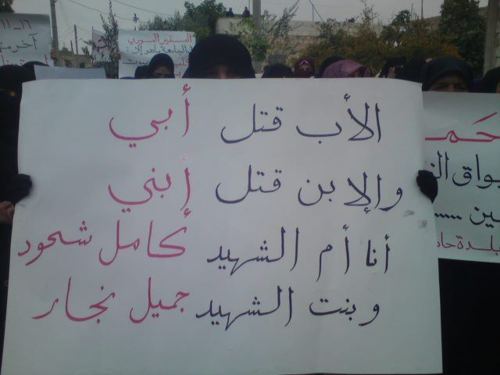
The following sign reads "The Father [Hafez al-Assad] Killed My Father / The Son Killed My Son / I am the mother of the Martyr Kamel Shuhoud / I am the daughter of the Martyr Jameel Najar:"

Tumblr_lunv8mlFwg1r1boeoo1_500

Funerals for these martyrs, like this one in Idlib today, can become significant demonstrations themselves:

Finally, a protestor in Homs thrown in jail describes the effect of his imprisonment: "I feared for my life so I eventually started agreeing to everything they said. I would have confessed to owning a tank if they had asked me."

Romney’s Ceiling

Bernstein examines it:

 The best hint you can get of Romney's ceiling isn't the horse race head-to-head numbers; it's his unfavorable numbers, which run right now at around 20% of all Republicans (24% of those who recognize his name). But even that has very limited utility; after all, we've just seen Newt Gingrich dramatically improve his favorable/unfavorable ratings, and surely Newt's unfavorables were a lot more deep-seated than Romney's.