The Next Generation’s Non-War, Ctd

A view filtered through Steven Pinker. Money quote:

David Sirota credits Ron Paul, who is popular among voters aged 18 to 29, for this generational shift. Sullivan invokes the hard lessons of the Iraq invasion, presumably formative for young adults.  Both may be right to a degree: the Iraq war certainly showcased the horrors brought on by unnecessary unilateralism, and young people have found Paul a resonant critic of foreign adventure.  But working through both I see Pinker's larger trend: in recent decades, every cohort is less invested in aggression than its predecessors, more empathic, less inclined to violence.

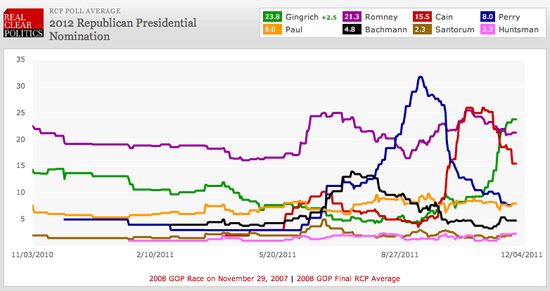
Is Cain’s Loss Really Newt’s Gain?

Screen shot 2011-11-29 at 2.37.02 PM

Jonathan Bernstein isn't swallowing my line that Newt will gain from Cain's coming withdrawal:

I just don't see a solid, very large anti-Romney block of voters in the GOP. A faction, perhaps 20% or 25% tops, yes, but that's it. And it's clearly true that there's no great enthusiasm for Romney. But the same can be said of all the other candidates, none of whom has been able to approach 50%, either. And party actors have been very reluctant to line up for any of the surge candidates other than (while he was hot) Rick Perry. Which, again, makes me believe that if Perry (somehow) catches fire again he'll have a real shot at the nomination, but the other anti-Romneys just don't.

Neil Sinhabubu thinks he's caught Bernstein in a contradiction:

Jonathan writes that "party actors have been very reluctant to line up for any of the surge candidates other than (while he was hot) Rick Perry." Here I want to recall something Jonathan was saying a lot last year. The people who really control public opinion and deliver primary votes in the GOP aren't elected officials. They're people who are basically paid like entertainers — Rush Limbaugh and Bill O'Reilly. And while it's deeply in the interests of elected officials and staffers that their party win elections, since their career prospects depend on that, entertainers don't have such a strong reason to care. They can happily get behind the unelectable guy who says more exciting things. So if Gingrich doesn't win big endorsements of any kind from GOP officeholders, who cares?

Can The Euro Be Saved?

Poland puts forth a proposal. So does James Surowiecki, who says only ideology and psychology stand in the way:

The frustrating thing about all this is that there is a ready-made solution. If the European Central Bank were to commit publicly to backstopping Italian and Spanish debt, by buying as many of their bonds as needed, the worries about default would recede and interest rates would fall. This wouldn’t cure the weakness of the Italian economy or eliminate the hangover from the housing bubble in Spain, but it would avert a Lehman-style meltdown, buy time for economic reforms to work, and let these countries avoid the kind of over-the-top austerity measures that will worsen the debt crisis by killing any prospect of economic growth.

Dan Drezner thinks Surowiecki is oversimplifying: 

A deal could be reached, but no one should be kidding themselves — it is fantastically difficult, and saying that just "politics" or "ideology" or "psychology" is getting in the way doesn't make it any easier.  

The FAA Bans Tech During Takeoff Because …

There's no evidence [NYT] that it can't crash the plane. Aviation-wonk Jim Fallows points out that pilots regularly use technology passengers are made to power off. The only defense of the regulation he can muster:

[H]ere is the only, admittedly weak rationale behind the "turn all equipment off" diktat. If anything went wrong on a crowded airline flight, the flight crew would need everyone's full attention, now. The prevailing theory is that passengers are less likely to be distracted if they're not cocooned by their acoustic headsets or distracted by their iPads.

Follow-up here.

His Sweet Lord, Ctd

A reader writes:

George Harrison did copy "He's So Fine," but not "with impunity," as your reader claims. He was sued for it – and lost, paying $587,000, the cost of the copyright (not to mention lawyer fees). The case, Bright Tunes Music v. Harrisongs Music, took about 10 years to wind its way through the courts, and it's now taught in most introductory copyright law classes to illustrate the point that, even if – like Harrison - you claim not to have consciously copied, you can still be found to have infringed. Some more detail on the case (including snippets of the songs for those who want to actually hear the two songs!) can be found at the excellent Music Plagiarism Law Project.

Another defends Harrison:

The fact that George did not need to plagiarize to create great music is self-evident. His creativity speaks for itself, having penned some of the most iconic songs in rock history, including "Something", "Here Comes the Sun" and "While My Guitar Gently Weeps". Or did he steal those, and all the other wonderful songs he wrote, too? And to call "My Sweet Lord" "the most obviously plagiarized song in rock ‘n roll history" is to turn a tone-deaf ear to much of the work of Led Zeppelin, who have been widely (and justly) criticized as the rock era's plagiarists and thieves extraordinaire (just ask Willie Dixon). And I challenge your reader to provide one shred of credible evidence that John Lennon ever made the statement "he knew exactly what he was doing when he stole the original song").

Said reader must have been referring to this:

In a 1980 interview with Playboy magazine, John Lennon expressed his doubt of the notion of "subconscious" plagiarism: "He must have known, you know. He's smarter than that. It's irrelevant, actually—only on a monetary level does it matter. He could have changed a couple of bars in that song and nobody could ever have touched him, but he just let it go and paid the price. Maybe he thought God would just sort of let him off."[6]

Another:

I have never heard your previous correspondent's Lennon quote, but I was amused as "Imagine" – a song I much love, though I know you have doubts – while not plagiarized, always seemed to me heavily inspired by the fairly unique chord structure of "Everybody Plays the Fool" (IV-V-I-III7, if anyone is paying attention).  And finally, as seems de rigueur in moments like this, I have to quote T.S. Eliot: "Immature poets imitate; mature poets steal; bad poets deface what they take, and good poets make it into something better, or at least something different."

Another:

1) Harrison didn't deny being inspired by other songs, but argued in court that he was inspired by the gospel song "Oh Happy Day," and that "He's So Fine" was likely similarly but independently inspired. "Oh Happy Day" dates back to the 18th century, but the version [seen above] was a huge hit in 1969, just before "My Sweet Lord" appeared.

2) George was somewhat more obviously ecumenical with the song in concert – in his Japanese concerts during the '90s he'd include Buddha and Jesus in his name checks, and there's at least one '70s concert where he adds Allah during something of an extended improvisation of the song.

Another may have attended that very concert:

I saw Harrison on his 1974 tour (which was wonderful, despite the dreadful reviews). During his song "Awaiting On You All," it came to a long vamp where George called on the audience to chant the name of their Lord. So, yes, Krishna, if so inclined. But I distinctly remember him asking Christians to chant "Oh Christ! Oh Christ!" He said something like, "It's not cursing, it's chanting. Show your love." He was literally encouraging his audience of all faiths to join together to praise God.
Are The Millennials Detached From War?

Another Pew report, which complicates this earlier one, finds that more than three-quarters (77%) of adults over 50 said they have an immediate family member who served in the military; among people between 18-29 years old, the number is only one-third. Mary Dudziak discusses the political implications: 

As Americans become more isolated from the costs of war, military engagement no longer seems to require the support of the American people. Their disengagement does not limit the reach of American military action, but enables its expansion.

Stephen Bainbridge is reminded of Byron Farwell's history of Queen Victoria's "little wars": 

The British public paid almost no attention to the pervasive little wars: "Even at the time, punitive excursions, field forces, and minor expeditions were so commonplace that most Britons never knew of them." … The USA increasingly wages continuous warfare with decreasing political checks on Presidential power. It's like we've become a country of neo-Victorians. …  I can't help but recall that the era of Britain's little wars ended with the catastrophe of World War I. 

The Reinvention Of The Economist

Megan Garber studies the transformation of a newsweekly: 

This is what we tend to forget when we talk about journalism’s evolution: The news brand, in the past — for all its exclusivity, for all its anonymity — was much more than a brand, with all the corporateness and cravenness that that term can imply. It was also an identity. It was a purchased proxy for a personal worldview. … What The Economist has managed to capture — to recapture — is, I think, the sense of self and self-containment that defined media brands before those brands became social. The Economist sells a self-image that’s high-class, high-culture, high-end. Depending on where you stand, it is either congratulatory or aspirational. But, even then, it’s inviting. 

Newt’s Coup de Grace, Ctd

My hunch that Gingrich will be the primary beneficiary of Cain's possible withdrawal is backed up by new and old data from PPP:

Our last national survey found that Gingrich's favorability with Cain voters was 73/21. Meanwhile Romney's was 33/55.  That's the same basic trend we've seen in every Republican primary poll we've done in the month of November. On average in 7 polls we've done this month Gingrich's favorability with Cain voters is 69/22. Romney's average is  31/57. In other words Gingrich's net favorability is 73 points better with Cain supporters than Romney's.

Then this:

On average across six polls we've asked a second choice question on this month 37% of Cain voters pick Gingrich to only 13% for Romney.  In fact Romney isn't any more likely to be the second choice of Cain supporters than Michele Bachmann (14%) or Rick Perry (12%).