An Online Wonder Of The World?

Jonathon Keats lobbies for Wikipedia's addition to the World Heritage List:

Change is not necessarily antagonistic to preservation. That false assumption has put the World Heritage Committee at odds with the very people whose heritage Unesco claims to support. For example, the people of Djenné, Mali, whose mud-brick houses were inscribed on the list in 1988, have ever since been bullied by heritage professionals to avoid making alterations that would facilitate modern amenities like showers and tile floors. One irate local compares a room in his neighbor’s dirt house to a grave. Unesco’s static concept of physical heritage is exterminating the evolving intangible heritage of the Djenné people. Wikipedia protects the past without impeding the future.
A Two-Dimensional Future?

Former Apple engineer Bret Victor rants against a vision of the future that revolves around flat screens, or what he calls Pictures Under Glass:

We live in a three-dimensional world. Our hands are designed for moving and rotating objects in three dimensions, for picking up objects and placing them over, under, beside, and inside each other. No creature on earth has a dexterity that compares to ours. … With an entire body at your command, do you seriously think the Future Of Interaction should be a single finger?

(Hat tip: Josh Rothman)

Right And Wrong Under Fire

Timothy Kudo, a Marine formerly deployed in Iraq and Afghanistan, recalls two civilian casualties that occured under his watch. While under fire, his Marines were approached by a motorcycle that refused to stop, despite warning shots:

I know that our decision was right and, given the outcome, that it was also wrong. We trained to kill for years and given the opportunity, part of us jumped at the chance to finally be Marines. Despite the school construction and shuras, that’s what it meant to make a difference in uniform; it meant killing our enemies. But these men weren’t enemies. They were just trying to get to a home so close that their family was able to watch them die. After the shooting, the families encircled us in hysterics as they collected the bodies. It was the first and only time I saw an Afghan adult woman’s face. The wailing continued in the distance as we continued on our mission.

Face Of The Day

Screen shot 2011-11-09 at 11.45.21 PM

Starting in the early 80s, Donna Ferrato has spent a decade photographing battered women:

[Her photographs] helped change how domestic violence was viewed in America. She spent the 1980s living with victims and their abusers, staying in battered-women’s shelters and accompanying police officers rushing to domestic conflicts.

The result was her seminal book, “Living With the Enemy,” which Aperture has reprinted four times over the last 20 years. It is the rarest of photographic projects: one that has significantly affected the problem it documents, helping to change laws and establish and finance domestic violence shelters throughout the country.

More recent work by Ferrato, photographing OWS, here.

Death And Desire

The poet Mark Doty contemplates the two:

Before the crisis years of the AIDS epidemic I had that sense that one does of a long, expansive living ahead of me. When my friends and my partner began to sicken and die around me, that shifted everything in a sense that you just don't know what prospect is ahead of you. For me, that exacerbates desire. On the other hand you have to negotiate because desire enflamed can become a blinder. It's a balancing act I have never felt especially good at. Secretly, I believe balance is boring,

Could A Single Marine Unit Take Down The Roman Empire?

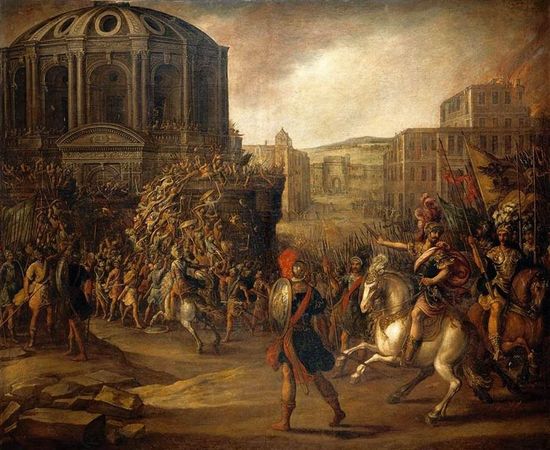
Juan_de_la_Corte_-_Battle_Scene_with_a_Roman_Army_Besieging_a_Large_City_-_WGA05366

A thought experiment on Reddit is on its way to becoming a major motion picture. Alyson Sheppard tries to answer the question:

Historian Goldsworthy says the MEU would probably lose in the long term—without the ability to resupply their modern weapons, they simply wouldn’t be able to overcome the Roman numbers. However, he says, they could destabilize the Roman Empire, encourage civil war, and initiate regional fracturing. "[The Marines] might discredit the Emperor by defeating the closest army to Rome," he says. "But they would lack the numbers to control Rome itself—with a population of a million or so—let alone the wider empire." 

(Photo: "Battle Scene with a Roman Army Besieging a Large City" by Juan de la Corte)

Happy-Go-Lucky

The etymology of happiness harkens back to a time when the feeling wasn't expected:

Greek mythology, ancient Egypt and cultures throughout the Mediterranean before and after Christ perpetuated the idea that happiness was almost always a miracle. … In English, for instance, the root of happiness comes from the Middle English and Old Norse happ, which meant chance and fortune and shows up in the words “perhaps,” ”happens,” happenstance,” and “haphazard.” In Spanish and Portuguese the words felicidad and felicidade stem from the latin world felix, which means luck, sometimes fate.

The Church Diet

Bigquestion

After noticing the obesity of his congregants, Rev. Rick Warren convinced his megachurch to join him in becoming healthier. He enlisted the help of metabolism expert Dr. Mark Hyman:

As [Warren] talked about Saddleback, he mentioned that the church had thousands of small groups of  6 to 10 people who meet every week to discuss the Bible and their own spiritual journeys. “A light bulb went off,” said Hyman.  “That’s the best delivery mechanism for a healthy-living curriculum.”  Warren embraced the idea instantly. Later, Hyman outlined a program for Saddleback, which he called “lifestyle medicine delivered through the power of small groups.” “The most important ingredient in the cure is the healing power of the group,” he wrote.

After one year, 72% of participants had lost weight. Dee Eastman, the director of the healthy living plan, explained, "We know there’s a 50 percent better chance of sustaining long-term lifestyle change if you do it in community."

(Image by Flickr user bunchofpants)