“The Prophet Muhammad Was A Cat Person”

Azadeh Moaveni recounts the travails of dog ownership in Iran:

Over the past fifty years, most Iranians had managed to shake off many of the conservative beliefs that had been ingrained in them for generations: the belief that music was haram (Islamically forbidden), that alcohol was “Satan’s piss,” that a woman who didn’t cover her hair lacked virtue. Dogs, however, resisted this cultural normalization.

Science Needs More Stories

Katherine Harmon flags a new paper making the case:

In the scientific realm, anecdotal evidence—the individual patient, the single result—tends to be shunned in favor of large, dense data sets and impersonal statistical analyses. Although that foundation must remain the core of solid research, examples and narratives should be invoked to round out the explanation of what the hard science says, Zachary Meisel and Jason Karlawish, both of the Perelman School of Medicine at Penn, contended in an essay published online Tuesday in JAMA, Journal of the American Medical Association. “Stories are an essential part of how individuals understand and use evidence,” they wrote. And they can have a powerful effect on public opinion and policy. “Each time, those who espouse only evidence—without narratives about real people—struggle to control the debate. Typically, they lose.”

Can Medicine Make Us Moral?

Bryan Appleyard thinks not:

In my undrugged state of mind, I decided to do A. I then take a morally enhancing pill and decide, instead, to do B. The pill – and ultimately somebody like Dr Sandberg – has decided that B is morally superior to A. This has nothing to do with me and, therefore, nothing to do with my moral status, I am merely a pill popper, and everything to do with somebody else’s idea of what I should be. 

Continuing Creation

Quilt

Brian Swimme, a cosmologist, teamed up with Mary Tucker, a religious historian, to connect physics and theology. Josh Rothman contemplates their message:

[P]hysics shows us that the non-living world is incredibly dynamic, surprising, and creative — it's just that the creativity happens over very long scales of time. It's an important fact, they write, that the universe is itself 'set up' for creativity. The universe, they argue, isn't anarchic, meaningless, absurd, or pointless; it's creative in its essence. This should make a difference in the way we think about the meaning of our own lives: By being creative and creating novelty, we're participating in a universe-sized process.

(An intergalactic quilt of the Crab Nebula by Jimmy McBride via David Pescovitz)

The Idea Of Church

Kevin Sessums has a beautiful mediation on the many forms that church can take. He took his godson Kennedy, who recently came out, to the musical Godspell: 

When Kennedy walked me to the subway afterward he said, "I saw a production of this once and hated it so wasn't really sure I wanted to see this. But I was really moved by this tonight. And I'm an atheist." That literally stopped me in my tracks. Had he just come out of another kind of closet to me? I gave him a hug. "Are you still an atheist?" I asked. "Yes," he said. "But I was moved." On the subway ride home I hummed one of the songs from the show – Day by Day, which is a how I've come to live my life – and thought about Kennedy's honesty as well as his sweetness and goodness, especially compared to the spiritual rancidness that passes for religion that has accompanied the rise of the political right and has caused so many young men like Kennedy to stake their own claim to goodness in less bigoted ground. If that means they have to also claim to be atheists, so be it. But we all need to believe in something. Last night I believed in a godfather living day-by-day sitting with his atheist godson who was born again when he was 18 sitting in a communal setting watching a musical called Godspell and being moved to tears. That might not be everyone's idea of church, but it is mine.

American Nietzsche

2543957664_08b5f17244_o

Ross Posnock reviews the new book by Jennifer Ratner-Rosenhagen:

[Ratner-Rosenhagen] notes that for [George Burman Foster, a Baptist minister and University of Chicago professor], Nietzsche “had shown that modern man should not try to deny his messianic urges, but instead become an Ubermensch worthy of them.” Foster argued that despite the philosopher’s hatred of Christianity, Jesus and Nietzsche would have been friends, for Jesus too was a “revaluator of values” and “lived dangerously.” In Foster’s “functionalist” view, Nietzsche had helped him realize that Christianity had to be reinvented for the new century, its absoluteness and otherworldliness irreconcilable in a world “where the fixed had yielded to flux.” Ratner-Rosenhagen concludes that for Foster, Nietzsche is “a saviour who teaches man to find the saviour in himself.” And “like so many other early twentieth-century liberal Protestants,” Foster “enlisted Nietzsche to come to terms with what his own Christianity meant to him.”

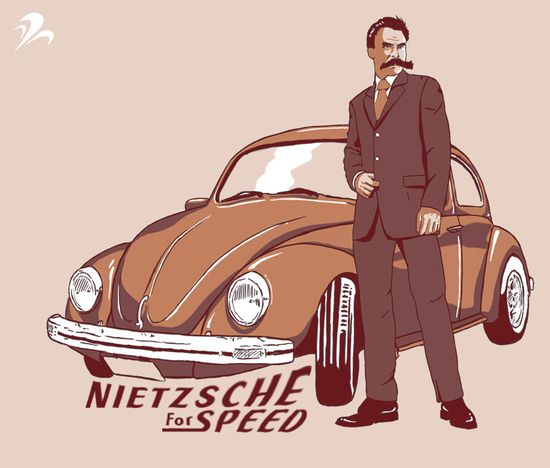
(Image by Rafael Branco)

The Gap Between Knowledge And Awareness

The unconscious workings of the brain can trump conscious thought:

If you spend an afternoon trying to teach [patients with anterograde amnesia] the video game Tetris, they will tell you the next day that they have no recollection of the experience, that they have never seen this game before—and, most likely, that they have no idea who you are, either. But if you look at their performance on the game the next day, you’ll find that they have improved exactly as much as nonamnesiacs. Implicitly their brains have learned the game: The knowledge is simply not accessible to their consciousness.

The Rise Of Israel’s Ultra Orthodox

GT_ORTHODOX_111109

Gershom Gorenberg outlines how the ultra orthodox have been enabled by the Jewish state:

Remaining a full-time Torah student allowed a man to stay out of uniform. The deferment helped lock young men into the kollel lifestyle. So did the education gap: Though ultra-Orthodox men spent years engaged in study, their schooling did nothing to prepare them for jobs in a modern economy. From their teens on, their curriculum was devoid of mathematics, sciences, foreign languages and other general studies.

Joshua Hammer reviews Gorenberg's new book. Cris Campbell is concerned:

When non-working radicals out-reproduce the rest of the population, bad things happen.

(Photo: Ultra-Orthodox Jews pray at the Western Wall in Jerusalem's Old City of on March 4, 2011. By Daniel Bar-On/AFP/Getty Images.)

“Philosophy: The Kevin Bacon Of Wikipedia”

Screen shot 2011-11-11 at 11.10.43 AM

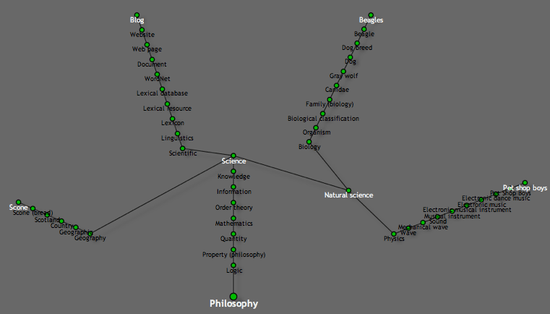
We somehow missed this great widget, from back in May, that shows how all paths lead to philosophy… on Wikipedia. Creator Jeff Winters explains

There was an idea floating around that continuously following the first link of any Wikipedia article will eventually lead to "Philosophy." This sounded like a reasonable assertion, one that makes a certain amount of sense in retrospect: any description of something will typically use more general terms.

(Hat tip: Maggie Koerth-Baker)