Jennifer Fulwiler justifies why she turned to Catholicism:
If everything that we call heroism and glory, and all the significance of all great human achievements, can be reduced to some neurons firing in the human brain, then it's all destined to be extinguished at death. And considering that the entire span of homo sapiens' existence on earth wouldn't even amount to a blip on the radar screen of a 5-billion-year-old universe, it seemed silly to pretend like the 60-odd-year life of some random organism on one of trillions of planets was something special. (I was a blast at parties.) By simply living my life, I felt like I was living a lie. I acknowledged the truth that life was meaningless, and yet I kept acting as if my own life had meaning, as if all the hope and love and joy I'd experienced was something real, something more than a mirage produced by the chemicals in my brain.
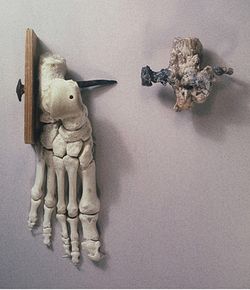 thrown into a river or trash heap. It is therefore difficult to identify their bodies, and their exposure to scavenging animals would have hastened the destruction of their bones. Crucifixion nails were believed to have magical or medical properties, so they were often taken from a crucifixion site or victim. Without the smoking gun of a nail in place, it becomes difficult to interpret whether skeletal remains show evidence of crucifixion or were otherwise subject to taphonomic processes, like scavenger activity.

 The Dish