It's Saturday, I'm in LA, and have some old friends to catch up with. I won't be liveblogging.
Month: November 2011
Understanding The McRib

Willy Staley explains why the McDonald's cycles the sandwich in and out of its menu – basic economics:
The theory that the McRib’s elusiveness is a direct result of the vagaries of the cash price for hog meat in the States is simple: in this thinking, the product is only introduced when pork prices are low enough to ensure McDonald’s can turn a profit on the product. The theory is especially convincing given the McRib's status as the only non-breakfast fast food pork item: why wouldn't there be a pork sandwich in every chain, if it were profitable?
James McWilliams questions whether McDonald's pork supplier treats its animals ethically.
Revenge Through Nude Pics
That's Hunter Moore's business model:
Is Anyone Up? is fairly simple in concept: someone anonymously submits nude photos to Moore through the site's submission form. Perhaps it’s a jilted ex, or a recent hookup, or a vengeful friend. These days, the site receives many self-submissions as well. Provenance doesn’t matter. Moore uploads those photos and attaches identifying screen-grabs from the person’s Facebook, Tumblr or Twitter accounts—whatever’s available. He sometimes adds a pithy caption and a reaction gif at the end, usually from a television show or meme. And that’s pretty much it. Is Anyone Up? currently receives, Moore said, 30 million page views a month.
Apparently, what Moore does isn't illegal. But even Gawker thinks this goes too far:
Stalker porn should make you think twice the next time you sext your significant other. It also requires your Facebook account to be wide open, so lock that down tight. The embarrassment of showing up on IsAnyoneUp must be awful—but that's nothing compared to the fact that your mistake is making people like Hunter Moore rich.
Is The Internet An Echo Chamber?
Contra Eli Pariser, Jesse Walker doesn't think the internet isolates its users, especially in the realm of politics:
Last year Matthew Gentzkow and Jesse Shapiro, two economists at the University of Chicago, did a formal study of the levels of ideological segregation online. Their paper, to be published in an upcoming Quarterly Journal of Economics, noted that the Net “makes it easy to consume news from multiple sources.” … Not surprisingly, the scholars found “no evidence that the Internet is becoming more segregated over time.”
Mental Health Break
A mesmerizing colored-pencil stop-motion music video:
Hudson – Against The Grain from Dropbear on Vimeo.
The Chemistry Of A Kiss
A passionate kiss causes our blood vessels to dilate as the brain receives more oxygen than normal. Our cheeks flush, our pulse quickens, and breathing becomes irregular and deepens. Our pupils dilate, which may be the reason so many of us close our eyes. We also activate five of our twelve cranial nerves that spread out intricately to different parts of the face. The nerve pathways guide the way we interpret the world by helping us see, smell, hear, taste, and touch. On top of that, our lips are associated with a disproportionately large part of the brain.
How The World Shapes Our Brains
Samuel McNerny explores the theory of "embodied cognition," the theory that "the mind is not only connected to the body but that the body influences the mind:"
[O]ur cognition is influenced, perhaps determined by, our experiences in the physical world. This is why we say that something is “over our heads” to express the idea that we do not understand; we are drawing upon the physical inability to not see something over our heads and the mental feeling of uncertainty. Or why we understand warmth with affection; as infants and children the subjective judgment of affection almost always corresponded with the sensation of warmth, thus giving way to metaphors such as “I’m warming up to her.”
Other recent thoughts on mind-brain issues here.
“Queer Eye For The FBI”
That's Andrew O'Hehir's spin on the new biopic of J. Edgar Hoover. Beverly Gage sees the FBI founder's ambiguously gay relationship with his aide Clyde Tolson as evidence of complicated social views with respect to homosexuality:
It is easy to write off the more open aspects of Hoover and Tolson’s relationship as proof of old-fashioned naiveté—to assume that folks in the 1950s were unaware. But this gives the people of the past far too little credit and flattens out an intriguing social history. If Hoover’s story tells us anything, it’s that today’s binaries—gay vs. straight, closeted vs. out—map uneasily onto the sexual past.
Kenneth Ackerman is skeptical that the two were involved. Peter Suderman thinks the film just isn't very good, regardless. David Denby's believes Hoover's professional zeal was a reflection of his personal self-denial:
Hoover, we realize, is obsessed with keeping America safe because he feels unsafe himself. Internal subversion is a personal, not just a political, threat to him.
The View From Your Window
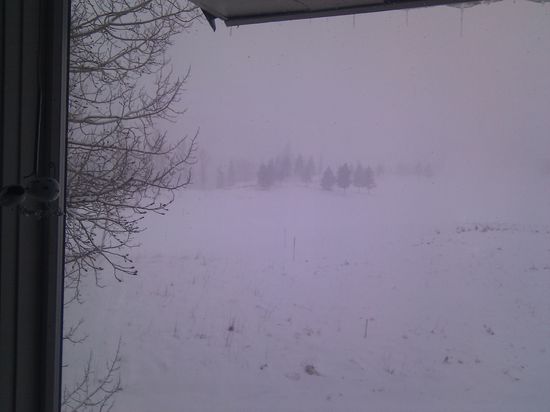
Aspen, Colorado, 12 pm
When Fracking Imitates Fiction
Jonathan Franzen’s second novel, Strong Motion, featured a seismologist who discovers that an outbreak of earthquakes is the byproduct of industrial drilling. Brian Ted Jones takes a deep breath:
This past Saturday, a 5.6 magnitude earthquake struck the tiny town of Sparks in Lincoln County, Oklahoma. … Up through 2009, Oklahoma had averaged about fifty earthquakes a year. The total number of quakes reported in 2010? 1,047. This swift and dramatic change in Oklahoma’s vulnerability to earthquakes has some people wondering if the practice of hydraulic fracturing — or “fracking” — might be the culprit. Fracking is the process of injecting highly-pressurized fluids into the earth to break up shale and rock and release otherwise inaccessible sources of natural gas. The waste fluid is then shot back underground at sites called “injection wells.” There are 181 active injection wells in Lincoln County Oklahoma.
Chris Wood takes a closer look at fracking and the dangers it poses to underground water supplies. We no longer use the original frackant, napalm. But companies are pretty secretive about what they do use:
Some ingredients, such as tallow soap and crushed nutshells, are benign. Others are pure poison. … In his second week in office, President Bush assigned Cheney to craft a new energy policy. The 2005 energy bill that emerged contained, among other features, a plum for the fracking industry: a unique exemption from the US Safe Drinking Water Act’s prohibition on injecting any substance underground that might endanger potable groundwater.
 The Dish
