Matt Wisniewski digitally blends images discovered via Tumblr. An example of his work:

Matt Wisniewski digitally blends images discovered via Tumblr. An example of his work:
Clive Thompson says yes:
[M]astering “crap detection 101,” as digital guru Howard Rheingold dubs it, isn’t easy. One prerequisite is that you already know a lot about the world. For instance, Harris found that students had difficulty distinguishing a left-wing parody of the World Trade Organization’s website from the real WTO site. Why? Because you need to understand why someone would want to parody it in the first place—knowledge the average eighth grader does not yet possess. In other words, Google makes broad-based knowledge more important, not less. A good education is the true key to effective search. But until our kids have that, let’s make sure they don’t always take PageRank at its word.
Dan Savage sympathizes with straight guys:
[H]eterosexual male identity — and in America I don’t want to get too pointy-headed about it, but it’s really this package of negatives. You know, to be a straight guy is not to be a woman and not to be a faggot and so it doesn’t really leave you much room to maneuver. If there’s anything about your interests or personality that can be remotely perceived as feminine or faggoty, you have to kill it or people won’t believe you’re straight or you’ll be tormented — you know, questions for the rest of your life.
Fray's new issue, from where this Savage interview is taken, focuses on Sex & Death; Steve Silberman's account of losing his father is also worth checking out.

You have until noon on Tuesday to guess it. City and/or state first, then country. Please put the location in the subject heading, along with any description within the email. If no one guesses the exact location, proximity counts. Be sure to email entries to VFYWcontest@gmail.com. Winner gets a free The View From Your Window book. Have at it.
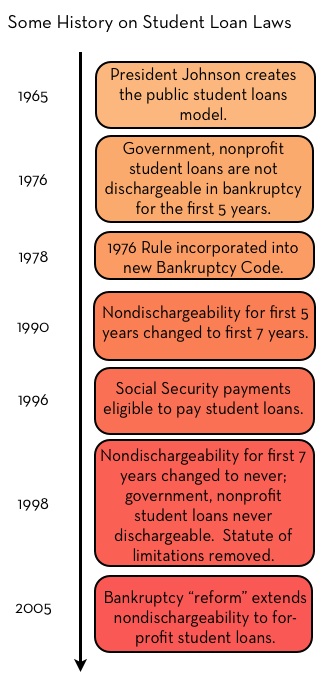
Bob Lawless gave a quick history on student loan law. Mike Konzcal graphed it, arguing that we should undo the rules from the 1990s and 2000s because it's "hard to see these [changes] as anything other than a giant subsidy to private agents." Pareene concurs:
Every single law Congress has passed regarding student loans since the federal program was introduced in 1965 has benefited lenders and made repayment or bankruptcy harder for borrowers. In addition to being unfair, this seems perhaps like bad policy, unless we really think it’s best for college graduates to spend their first decade (or decades) in the workforce sending substantial portions of their income to private lenders.
Konzcal's graphic after the jump:

"So You Want To Be A Writer" by Charles Bukowski:
if it doesn't come bursting out of you
in spite of everything,
don't do it.
unless it comes unasked out of your
heart and your mind and your mouth
and your gut,
don't do it.
if you have to sit for hours
staring at your computer screen
or hunched over your
typewriter
searching for words,
don't do it.
if you're doing it for money or
fame,
don't do it.
The poem continues.
(Image: By Andre Petterson via My Modern Met)
James Surowiecki spells it out:
It’s well established that when housing prices go up people feel richer and spend more: the rule of thumb is that they spend between five and seven per cent of the increase in housing wealth. But when housing prices go down people cut their spending by the same amount in response. Between 2006 and 2011, American homeowners saw the value of their homes drop by seven trillion dollars or so. That means that—even if consumers had no debt at all—we’d expect a dropoff in consumption of about four hundred billion dollars.
Brad Plumer eyes the implications:
If Surowiecki’s right, then it means policies to ratchet down household debt — like the White House’s plan to help homeowners refinance their mortgages at low rates — may not do all that much to boost consumption. Americans are already spending about as much as they can, even with their current debt loads. Something else needs to help consumers close the gap.

David Sirota argues that cities are instituting conservative economic agendas, even if they're voting for Democrats. Chicago is a prime example:
Citing the city’s budget crisis, officials have sold off highways and parking meters at cut-rate prices — all to pad the profits of corporate investors (the schemes are now being explored by other Democratic cities including Pittsburgh and Los Angeles). Despite this, during its once-in-a-generation contested mayoral election in 2010, the city’s voters chose investment banker Rahm Emanuel over other far more economically progressive candidates, and Emanuel quickly filled his administration with corporate consultants eager to accelerate the privatization already under way.
Taibbi complains of a similar pattern in New York.
(Image by Atelier Olschinsky via Colossal)
Lindsey Graham says we can't close Gitmo because "we need a jail, we don’t have one, and Gitmo is the only jail available." Amy Davidson sighs:
There are a hundred and seventeen federal prisons in the United States, holding more than two hundred thousand prisoners. The security measures in Guantánamo can’t match those in the most locked-down of them, the ADX “Supermax” in Florence, Colorado. And that is only the federal system. Our jails may be crowded, but we’ve got plenty of them, of every description: by some measures, we are a nation of prisonkeepers.
Adam Serwer points out that each prisoner at Gitmo costs US taxpayers $800,000 per year.
 The Dish