Gingrich’s Jacobinism

Bruce Bartlett remembers how, as Speaker, Newt "did everything in his power to dismantle Congressional institutions that employed people with the knowledge, training and experience to know a harebrained idea when they saw it":

In short, Mr. Gingrich’s unprovoked attack on the C.B.O. is part of a pattern. He disdains the expertise of anyone other than himself and is willing to undercut any institution that stands in his way. Unfortunately, we are still living with the consequences of his foolish actions as speaker. … It is essential that Congress not cripple what is left of its in-house expertise. Gutting the G.A.O. and abolishing the C.B.O. would be acts of nihilism. Any politician recommending such things is unfit for office.

And can we therefore put to rest any notion that Gingrich is a conservative in any meaningful way? He's one of the most radical of radicals to ever seek the office as the nominee of a major party.

How Can We Encourage Innovation?

Noah Millman's advice:

I wouldn’t focus on keeping taxes low; I’d focus on keeping them simple, because complexity rewards large firms with the wherewithal to do the financial engineering necessary to optimize their tax position, which in turn gives them an unearned competitive edge.

And more generally, I’d focus on what other barriers incumbents have erected to prevent disruptive innovation and to extract rents. The existing patent system, which imposes a huge burden on small, young firms, is one good example of where to look. Most broadly, we should be trying to reduce the friction associated with innovation, rather than focusing on the monetary returns to innovation.

The Next Generation’s Non-War

Screen shot 2011-11-28 at 7.06.46 PM

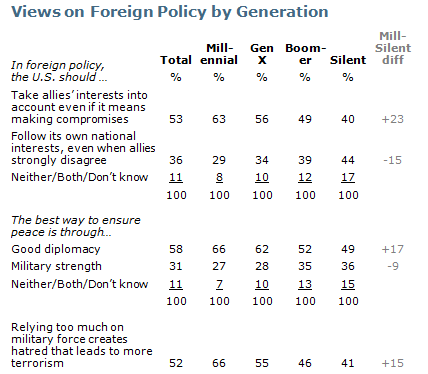
Pew recently reported that younger generations "favor multilateralism over unilateralism and the use of diplomacy – rather than relying on military strength — to ensure peace." Two-thirds of Millennials (66%) say that military force can create hatred that leads to more terrorism, while only 46% of Boomers agree. David Sirota thinks Ron Paul should get the credit:

Paul, of course, is one of the only presidential candidates in contemporary American history in either party to overtly question our nation’s invade-bomb-and-occupy first, ask-questions later doctrine and to admit what the Central Intelligence Agency acknowledges: namely, that our military actions can result in anti-Americanism fervor and terrorist blowback. … [W]hether Paul eventually wins the GOP nomination or not, the trends embedded in his current electoral coalition will affect our politics long after his candidacy is over — and even if you don’t support Paul’s overall candidacy, that’s a decidedly positive development for those who favor a new foreign policy.

Rumsfeld, to his credit, stumbled onto this truth a little too late. But isn't reality what really moved us? We saw the real consequences of trying to impose our concept of freedom onto a society by force – and it was horrifying. No polemic or argument or speech or book could have changed my mind about interventionism the way Iraq and Afghanistan did. And this first decade of the new millennium – from 9/11 to the euro crisis – has proven more emphatically than any decade in recent times that we in the West cannot act as if we are the only actors in the world any more. The delusions and instincts of the Cold War era, brought back to life as zombie foreign policy in the 2000s, have been brutally exposed in the new world.

America is relatively weaker than at any point since 1945 because our own hubris led to over-reach abroad and massive debt and economic recklessness at home. The next generation has drawn the obvious conclusion. We need to retrench and rebuild at home. We need national defense, not national offense. We need greater global cooperation, not greater global confrontation. We need to see that hard power is often best used in restraint, and that soft power can be thrown away by a few criminals in the White House deciding they know what's best about interrogation methods.

Ron Paul deserves credit for opening the debate on the right about this, making Huntsman possible. But history more so. The Millennials are just boomers who were mugged by reality.

Why Are Old Men Always Naked In The Locker Room? Ctd

The popular thread won't die:

I've come to the conclusion that the change in the men's locker room is a strange brew: increased paranoia by narrow-minded men about being around other naked men and the fright of being compared in our increasingly body-aware society; the effects of over-protective mothers (the so-called helicopter moms) who are over reacting to the sensationalized cable-news driven obsession with each and every adult pedophile; and the almost ubiquitous absent fathers, who by their absence haven't socialized their sons into the fraternity of men.

Another reader:

I also see a territorial aspect to it.  Are you going to squeeze past a naked dude on your way to your locker?  No, you're going to go around or wait until he moves or puts something on.  You notice that he doesn't just keep to their area – he likes to spread out either in front of their locker or in the steam room or the sauna.  It gives him some control over other people in the room.  This is some pecking order ritual from days gone by. 

Another looks to the other end of the locker room:

As a college professor, more often than not, students will pee in a stall rather than use a urinal. 

They're not sitting; they just won't stand at a urinal.  (There would have been no end to the teasing if a guy did that when I was in school.)  I've tried to account for number of people in the bathroom, spacing at the urinals, my presence, etc., but it doesn't seem to matter:  Younger guys not only change clothes under a towel, they avoid urinals, too.

Kids these days are just really uptight about their bodies.

Another:

At the risk of sounding like an old man shaking my fist and exclaiming "Kids today!": What kind of world is it where teenagers are unfazed by the viewing of the most graphic and over the top pornography, but are so puritanical about locker room nudity?

Another:

Leave it to us Dish readers to think too hard about something very simple, and then resort to calling people homophobes or just plain sexist to address it.  Look, I'm a straight guy. But I don't find men unattractive in general; I was openly bisexual in high school and made out with a few dudes here and there.  I've even found myself ogling more than a few guys walking past me on the street, or staring in awe at Jon Hamm's jawline.  But I'm just going to say it: dicks are ugly.  

I don't like looking at them.  I don't like the old-dude-at-the-gym's; I don't like Cillian Murphy's in 28 Days Later; I don't like Ron Jeremy's (but I do respect it); and I don't even like looking at my own.  If dicks were an animal at a petting zoo, parents would shield their children from them.  They would be tested on in laboratories in place of rats and nobody would give a damn.  And its female counterpart isn't anything to write home about, either.  Vaginas, by themselves, look like a sketch H.R. Giger threw away right before coming up with the facehuggers from Alien.  But in a locker room, a dick is hard to miss, while I don't imagine there are that many women sitting down, legs akimbo, wordlessly calling attention to their crotches.  

I love the human body in general, I find it fascinating and on a great body I won't shy away if there's a dick or vagina in the shot.  I'm not squeamish; I'm not afraid of sex; I'm not a sexist/homophobe/Puritan/Santorumite.  I just don't like dicks.  Why can't I not like dicks?

A much less uptight reader:

I am a married straight male who attended college in the '90s.  I was also in a fraternity, in a house that had communal showers.  Nudity was never a big deal.  But we even went so far as to have what we called "shower parties," which basically consisted of bringing in some chairs and cases of beer, and washing (not each other, mind you) in between Bud Lights. We got ready for going out on the town, and got our pre-game buzz on all at the same time.  Hell, sometimes we'd just stay in and get drunk there. 

Sorority girls at the time (all of whom had separate shower stalls in their houses) always gave us strange looks at first after hearing about these parties, and my wife (in jest) still says our fraternity had the gayest bunch of straight guys she ever knew.  And, our response was always, "Hey, don't knock it till you've tried it!" (and, yes, we got the occasional gal to join in, which was always cool). 

My college friends and I still laugh about those days and those parties, and I'd wager if we got together now back in that house, someone would still throw out the idea of having one.  So, I tend to agree with those who think this is only an issue with people who simply were never forced to deal with nudity, like those in the military, fraternities or athletic teams were.

One more:

I've been reading the comments, noticing how many of the younger men seem to think they're objects of my gay affection in a locker room.  They are not.  What I will say, and it's why I love the YMCAs in New York, where communal showers are still the norm, is that being around such a diverse set of male bodies, specifically naked males bodies (the Y is great for that: young, old, fat, bald, hairy – we're all there in the mix) helped me tremendously when I was having body image issues.  I thought I was fat and ugly. It was by being around the old guys who were comfortable in their own, very revealed skin, that I began to accept my own body, to see beauty in the eye of the beholder, and the beholder was me. 

We will all get old if we're lucky, and I say thanks to the old coots who couldn't care less what the guy at the next locker thinks.
How Can Obama Win In 2012?

Ruy Teixeira and John Halpin think (pdf) that Obama needs strong support from white college-educated voters and minority voters. Ryan Lizza goes one step further:

If Romney were the G.O.P. nominee and maintained this strength among college-educated whites he would almost certainly look for a running mate who could help him eat into Obama’s other important demographic group: minority voters, especially Hispanics. And as most political observers know, there happens to be a young, telegenic Cuban-American from Florida named Marco Rubio who is currently serving in the United States Senate. It’s no surprise that a chorus of smart Republican operatives has been arguing that Romney-Rubio is the Party’s strongest ticket. Together the two men could attack the twin pillars of the Obama coalition.

Iran’s New Embassy Crisis

GT_FLAG_111129

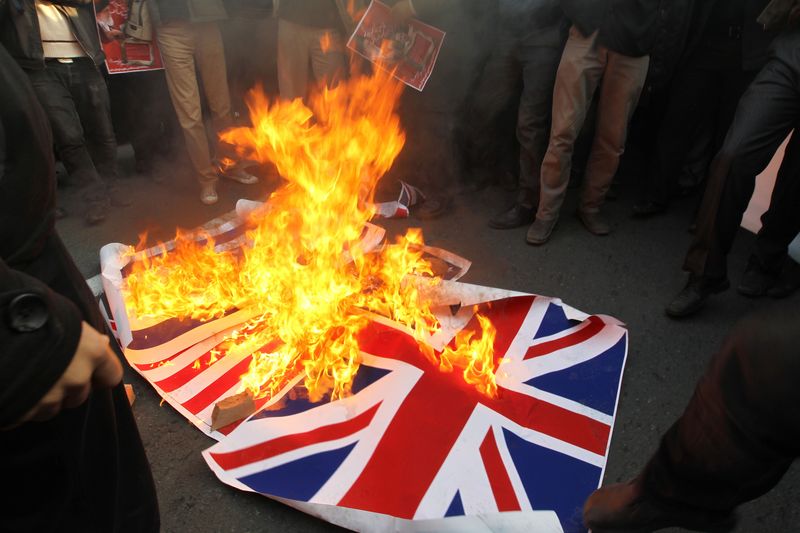
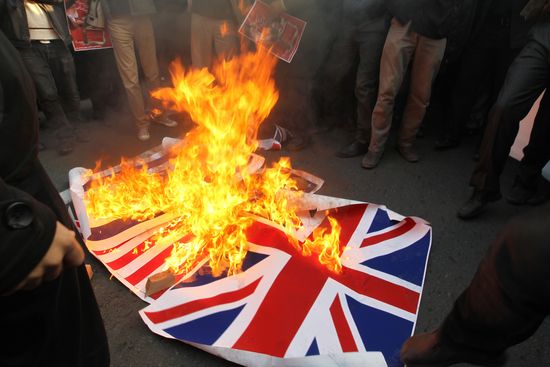
A group of Iranian "students" have ransacked the British embassy in Tehran. Julian Borger situates the attack in context of nuclear tensions:

[T]his is very much part of the Iranian push back against the diplomatic and economic pressure on Tehran following this month's International Atomic Energy Agency (IAEA) report on the Iranian nuclear programme, reporting that there was 'credible' evidence that Iran had experimented with a nuclear warhead design and might still be. In the wake of the report, the UK was the first to take punitive action, cutting off dealings with Iran's central bank. Hence, the call from the Iranian parliament, the Majlis, last week to downgrade diplomatic relations with London.

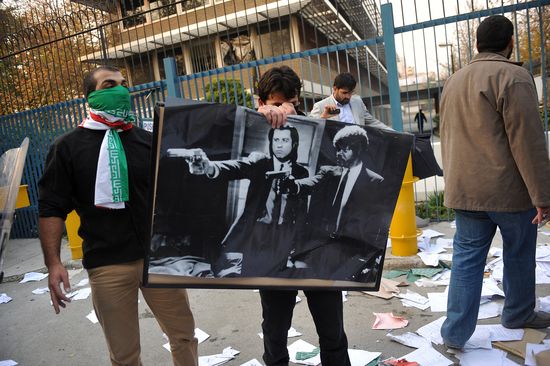
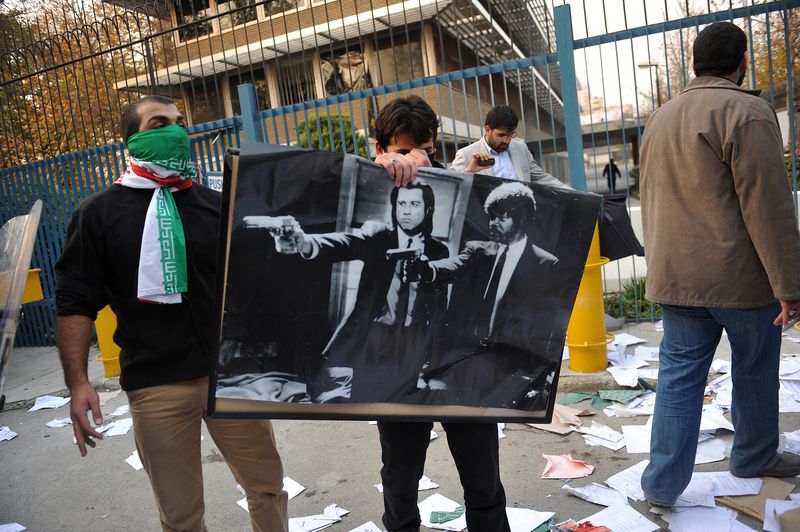
The Guardian liveblog is keeping close tabs on developments. In a photo that's fast becoming iconic, one protestor made off with a Pulp Fiction poster:

GT_PULPFICTION_1111129

(Photos: Iranian protesters burn the British flag outside the embassy in Tehran on November 29, 2011 and a man holds a poster featuring American actors John Travolta and Samuel L. Jackson in a scene from the film 'Pulp Fiction' following a break in at the British Embassy during an anti-British demonstration in the Iranian capital on November 29, 2011 in Tehran, Iran. By, respectively, Atta Kenare/AFP/Getty Images and FarsNews/Getty Images.)

Quote For The Day

"A mere conservatism of the pocketbook deserves that bad name; far from being a bulwark against revolution, its irresponsibility often provokes revolution. More responsible conservatives, like Disraeli or John Adams, defend property, their material base, only when linked with a moral base: service to the community. They distinguish sharply between a traditional, rooted property of service and a grasping, rootless property, not yet mellowed by time. It is only the loose journalistic use of "conservative," not the use by serious philosophical conservatives like Burke, Maistre, or Coleridge, that identifies conservatism with economic commercialism or with the particular position held by America's Old Guard Republicans," – Peter Viereck, conservative philosopher, cited by Scott Galupo.

Today In Syria: Spotlight On Homs

Caitlin Fitzgerald worries that the embattled city is becoming "Hama in 1982 in slow motion:"

[P]eople all over Syria have risen up – and the center of the fight this time seems to have settled on Homs. In this respect, Homs parallels Hama in 1982: it is the center of resistance for its generation, and the place bearing the brunt of the regime's response. … Of the estimated 3,500 protesters killed by the security forces so far, more than 500 have been in Homs (note: the Syrian opposition puts the number killed at 4,200 with fully 1/3 of those killings being in Homs), with many more missing – whether imprisoned or dead only the regime knows. At that rate, it would take ten years for Homs to match the lowest casualty estimates for the Hama massacre, but numbers aren't the only basis for comparison. The point of the scorched earth policy in Hama was not the number killed or tortured or arrested. It was about making an example.

She follows up on the cross-Assad similarities here. The BBC takes an in-depth look at how Syria's neighbors and trading partners are reacting to his repression. Walter Russell Mead thinks Assad is reinflaming Sunni-Shi'a antagonism, while Rime Allaf argues Syria is well-positioned for a democratic transition after the fighting ends. One might imagine this huge crowd in Homs would agree. A newly found video documents the torture of protestors on the streets of the Deir Ba'Alba area:

Finally, this man appears to have been murdered in yesterday's episode of the ongoing Homs crackdown:

Newt’s Coup de Grace

It is beginning to look likely that Cain will soon bow out of the race. There are only so many lies a man can tell in public, and his previous lies keep requiring him to tell more. Only Palin gets away with that kind of thing. Currently, Cain is at 15 percent. Give much of that to Gingrich – as has been happening so far – and Newt becomes the immediate front-runner, with support in the 40 percent range to Romney's ceiling of 25. That changes the whole dynamic.

Meanwhile, Romney is faltering:

There are 13 places PPP has polled the Republican race in October or November where it also did a poll sometime between January and March.  In those places Romney's net favorability has dropped by an average of 15 points over the course of the year.

On average Romney's favorability with primary voters was 54/25 in these 13 places at the begininng of the year. Now it's only 50/35. His problem is partially that his positives have gone down but more than that it's that as his name recognition has increased, most folks moving off the fence have gone into the negative column.

I felt the wind behind Romney disappear in the last debate, and re-emerge behind Gingrich. Now Newt gets the Cain Bounce. And Romney may drift lower. No one likes him. And the more they see him, the less they love.

Barney Frank’s Legacy

Rick Hertzberg lauds the soon-to-be former congressman:

Barney’s total dissimilarity from any kind of Village People stereotype was a big part of what made his coming out in 1987 so powerful. His acknowledgment of his orientation (he was the first member of Congress to leave the closet voluntarily) was a quantum leap in the amazingly rapid evolution of the dominant public conception of homosexuality from some kinda deviated perversion to a “virtually normal” (in Andrew Sullivan’s phrase) aspect of the natural variety of human life.

Amen to all that. Just so long as we don't get carried away and forget that he is often a total asshole sometimes for no reason at all (as above) and sometimes to great and important effect:

The rudeness was of a piece with his astounding intellect and messy personal couture. He was and is unique – in ways that eclipse his gayness, Jewishness, partisanship or any other aspect of his personality. He should have been Speaker, and in a less homophobic world, he would have been. A lot of us are in his debt. He made our lives more possible.