For Veterans Day, a round-up of soldiers' dogs greeting their owners.
Month: November 2011
The View From Your Window

Portland, Maine, 4.33 pm
What Will Be Obama’s Core Argument?
Sargent gets an "official" to explain:
“You start by saying, the high unemployment rate, the inequity, these derive specifically from the policies that Rick Perry or Mitt Romney want to bring back,” the adviser replied. “So, yeah, tough times. Central cause of the tough times? What they want to bring back. The president has done a lot of things: save the auto industry, staved off the worst. We’ve had 20 straight months of private sector job creation. Why on earth would we want to go back to that nightmare?”
My view is that if that is not accompanied by a clear and radical tax reform plan, it will not be enough.
Does “Nudging” Hurt Democracy?
Henry Farrell and Cosmo Shalizi make the case:
While democratic institutions need reform to build in dialogue between citizens and experts, they should not be bypassed. By cutting dialogue and diversity for concealed and unaccountable decision-making, "nudge" politics attacks democracy's core. We should not give in to temptation – and save our benevolent meddling for family reunions.
Where Can Christianists Shop?
A group of 70 major companies signed an amicus brief stating that the Defense of Marriage Act hurts business. Mark Morford dares homophobes to try and boycott them all:
I mean, you can't really call yourself a true American, a real Christian and still openly wear Nikes or Levi's, use Microsoft or Google, or watch Warner Brothers movies, can you? If you really walk your anti-gay talk, well, every one of these companies should be banned from your life, right?
Mental Health Break
A 12,225 mile road trip in five minutes:
Does Our Tax Code Push Jobs Overseas? Ctd
A reader writes:
In response to arguments about our relatively high corporate tax rate, you make the claim that "many companies do not pay anywhere near 35 percent." I have two things to say about your claim. First, it is absolutely correct. Second, it is absolutely irrelevant to this discussion. As economists always say, incentives exist at the margin. The decision about where to locate the next corporate investment does not depend on the "average effective tax rate" (which is essentially total taxes divided by total income, and which is the metric you are looking at). It depends on the marginal tax rate that will apply to profits from that next investment. And the statutory rate is a much better approximation of the marginal tax burden on additional investment than the average effective rate because the latter is mostly measuring the rate on investments already made. CFOs look very closely at statutory rates around the world when planning capital investments. They do not look at their companies' overall average rate.
With that in mind, the United States has the second-highest statutory tax rate in the developed world, after Japan.
But Japan has announced plans to cut its rate (delayed by the earthquake/tsunami), and thus the United States will soon have the dubious distinction of the highest corporate tax rate. And with recent economic literature finding that most of the burden of the corporate rate is borne by workers (through fewer jobs and lower wages), it is becoming increasingly clear that maintaining such a high statutory rate is economically destructive.
What your "average effective tax rate" measure does tell us, though, is that we have an opportunity to lower the statutory rate significantly without increasing the deficit if we are willing to go after all the tax breaks that allow companies to have such a low average rate. A high statutory rate and low average rates is a great argument for tax reform that conservatives and liberals should be able to agree on. Conservatives get lower rates and liberals get to close corporate loopholes.
That is my preferred solution as readers well know by now. But I don't think it's enough to equalize the sheer power of so many new members of the global economy in the developing world offering the same goods and same labor for a fraction of the costs. Another writes:
Your reader writes: "Do some research as to why Microsoft has such a large presence in Ireland." Microsoft pays virtually no income tax in the US or Ireland. There is another tax, higher than 35%, that they pay in the US and nowhere else: health care benefits. In Ireland, as in Canada and most other countries, health care is decoupled from employment, as it should be. Adding an employee in the US costs a premium of something like half his or her salary. That's a hefty penalty – and a huge savings in countries like Ireland, even if wages were otherwise the same.
Another:
As you correctly noted, many companies don't pay the 35% rate. But even if they did, I think there needs to be a closer examination of why, as one of your readers put it, "the 35% tax incentivizes multinational companies to operate from low tax countries."
Much of this debate focuses on competition – corporate taxes must be low in order for American companies to compete. That is a sweeping generalization that ignores the fact that many American companies could afford to pay the 35% tax while still being competitive and profitable. The problem is, they wouldn't be as profitable. And that is where corporate patriotism evaporates. Many of these companies would rather relocate, not necessarily to be more competitive, but to increase their profits.
Is Romney A Moderate?
Wilkinson believes so:
I would expect a Perry administration (as unrealistic as that now seems) to teem with Texans, supply-side ideologues, and socially conservative GOP apparatchiks with southern accents. I would expect a Romney administration to abound in private-sector paladins, go-getting Mormon McKinsey types, and more academically mainstream conservative economic advisers. Messrs Romney and Perry surely have very different Rolodexes, and the most-called-upon people in their Rolodexes also probably have very different Rolodexes. The "real" Mitt Romney is constituted by his extended network of political allies and advisers.
The Newt Narrative Emerges
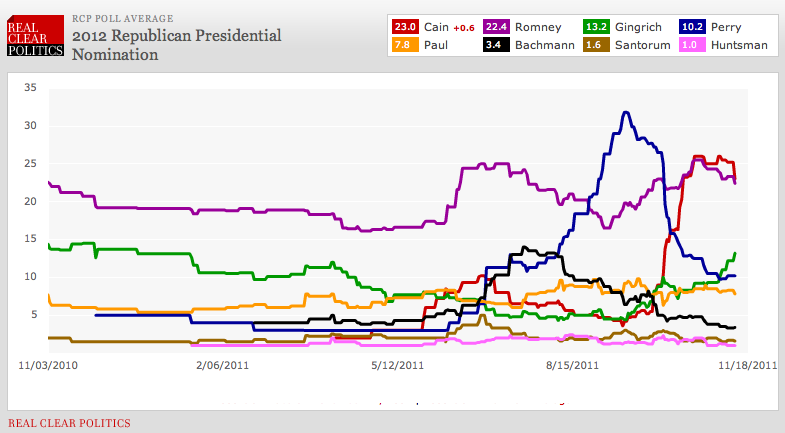
A new poll from CBS shows Herman Cain at 18% support nationwide followed by Romney and Gingrich, both at 15%. Steve Benen is skeptical. Josh Marshall snarks:
Myself I’m looking forward to a thick crop of ‘Newt’s moment’, ‘Did we misjudge Newt’ pieces from the standard pubs. It’s not all a bed of roses for Newt: he currently has a net national disapproval rating of -25%. But, hey, that’s down from about -30% only a couple months ago.
Rich Lowry is more accommodating:
No politician has spent so long saying we need such fundamental change. It is typical of Gingrich that his 21st-century Contract with America is conceived as “a larger and more complex developmental challenge than any presidential campaign has undertaken in modern times.” Cue the eye-rolling. But the country now has such grave challenges even beyond the headline problems of joblessness and spiraling debt that there’s a place for a candidate devoted to upending 20th-century structures in health care, education, and more. Never have Gingrich’s extravagant overstatements seemed so apt.
Michael Brendan Dougherty freaks out:
[Gingrich] has all the admirable qualities of an autodidact. He's energetic and occasionally lobs a challenge at weak intellectual orthodoxy. Unfortunately, he has all the horrible qualities of an autodidact: a tyrannical streak and an egomania that is impervious to the reality of other people. … Please, conservatives, spare yourselves Newt Gingrich.
Doug Mataconis has more. RCP's poll of polls, above, has Gingrich in third.
Dissent Of The Day
A reader writes:
It is probably because I am a lawyer, but I am incredibly disturbed by your (and others in the media) conflagration of fact, rumor, anger and certitude. Most of the time I can excuse this because the issues are (relatively) more trivial. But, as we all recognize, there is nothing trivial about the ongoing matters at Penn State. You wrote:
As one reader noted, if a Nobel Prize winner in chemistry had been found in the showers buggering a ten-year-old, the cops would have been called immediately. But an assistant coach and likely successor to the great Paterno? Immune.
This statement is provocative and yet false. In 2002, when the events identified in the Grand Jury Report took place, Sandusky was a former assistant and had no chance of succeeding Paterno.
There is this assumption in all of your writing (and that of many, many others) that Paterno and the administrators at Penn State acted the way they did to protect the football program because it is "sacred". However, when you take a step back this makes no sense. If the goal was to protect the football program you would turn Sandusky in immediately. As your former colleague Megan McArdle wrote, the biggest mystery in this matter, so far, is why no one at Penn State reported the 2002 incident since it was clearly in the best interest of the football program and the university to do so. This is also where any comparison with the Catholic Church diverges. It's plain to see why the Catholic Church would cover up abuse for the sake of self-preservation, both individually and institutionally. The same simply cannot be said for Penn State.
Now, you may wish to take the position that the reason this was not reported in 2002 was because there is some deeper, sinister conspiracy that was going on, such as that suggested by Mark Madden or by you yourself. You wrote: "It is beginning to look as if many, many people in that community were prepared to allow a child rapist continue his assaults on innocent children because of the cult of a coach." What is your basis for making this statement?
I appreciate the fact that you blog real-time. But sometimes, with a topic as sensitive as this, perhaps you should take a step back and breathe deeply before you type. Today you have accused not just individuals, but an entire university and larger community of protecting a child rapist because of football. Yet you have no evidence whatsoever to support that position. There is a difference between blogging or writing about politics, or budgets, or even wars. Topics such as this require greater restraint, thought, and, most importantly, facts.
So let me correct that. Sandusky was an assistant coach and once likely successor to Paterno. I don't think it changes the point. Sandusky was in in the inner sanctum. He was one of them. Because he was one of them, his grotesque abuses did not seem to grotesque. Loyalty, friendship, the bonds of sports … all probably contributed to the decision to fire him (traumatic enough) but not to send him to the cops. You and Megan are missing the psychological impact of being worshipped and immune in a community, and all the corruption that comes from that.It was surely, rationally, in the Catholic Church's interests to report all these things immediately. Look what damage it has subsequently done. But authoritarian insitutions, based on religion and cults, are not guided by reason, but by emotion.
Knowing, as they did, that he had created access to countless other troubled kids makes it all the more wicked. To my mind, Paterno needs to be prosecuted just as Ratzinger needed to be prosecuted back when he did the same thing in Munich. They are accessories to child rape. The only reason they weren't prosecuted was their status. Another reader delivers:
In another life, where I get to be a sports journalist, I would want to be Joe Posnanski. He's been working on a book about Paterno, and during this football season he's been embedded on the campus of Penn State to work on it. Naturally, everyone has been waiting for his response to the scandal, which he delivered yesterday. Reading it is like reading the wise school teacher who just wants to know the facts. And the truth. To be not only emotionally, but financially, invested in the situation must be a terrible and difficult thing, but I think he's written a beautiful appraisal of the situation. I do not envy his position, but I admire his ability to succumb to subjectivity, while ultimately promising objectivity.
 The Dish