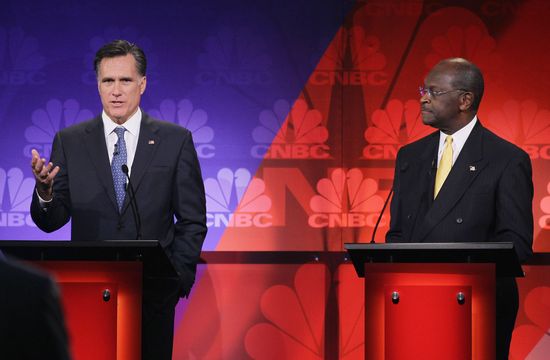
9.51 pm. At this point, I have begun to really lose it watching this crew. There are only two faintly plausible, credible presidents up there, both Mormons. The rest is beyond an embarrassment, and at this moment in history, the sheer paucity of that talent is alarming. Did anyone up there give you confidence he or she could actually lead the world countering this metastasizing debt and unemployment crisis? At best, there were noises about removing burdensome regulation on businesses and a simpler tax code. But who up there could actually bring that about?
Two other things: Romney's claim that Democrats hate profitable companies. It's an absurd statement on its face, but as a comment on reality, it's surreal. Profits are at record levels. If lack of profits is the reason for our employment crisis, there would be no crisis. Second: the boos for questioning a man in power who is credibly accused of sexual harassment and has settled such cases in the past is a sign of real contempt for women in such a situation. Both reveal to me a party hat has completely lost its way.
I'm beginning to wonder if these debates are helping Obama more than his own primary debates did in 2007 and 2008. Next to these doofuses, he seems reassuring. The losers of this debate: Perry and Cain. The winners? Gingrich and Obama.
9.47 pm. Cain is so out of his league on the economy it's painful. But he can remember three things and a punchline. But notice no ability to address the abuses on Wall Street. Then Perry actually criticizes crony capitalism. Yes, Perry. A reader writes:
As a moderately conservative Texan, I am absolutely ashamed that my state would ever elect such a fucking moron. Thank God that the office of Governor in the state is largely ceremonial and with minimal power. Furthermore, what in the world is a blended program between wage and cost? What does that even mean and how is it a solution to social security's deficit problem? How does it even answer the question asked?
It was one of the weirder digressions, but it had competition.
9.40 pm. Romney's anti-China passion is consistent and a little strange. Huntsman is right about the pandering. "We're not going to let them steal our jobs" is a sentence you don't normally hear at a GOP debate.
9.38 pm. Cain's response to Harwood should be disqualifying. He actually says that the tax code is why American companies outsource. Now I agree with him on scrapping the current tax code. But the notion that under any tax code, American workers can compete with Indians and Chinese earning one tenth of the salaries is bizarre. Cain jumped his own shark here a bit.
9.34 pm. Trying to be objective here, I suspect Gingrich's nutso diatribes are going to work with this bewildered base. Perry will surely crater after tonight. Cain sure should, given the mounting evidence that he is a liar. Bachmann has also effectively evaporated in this debate. Ron Paul's foreign policy views make him a poor fit to win over these voters. Gingrich could well emerge from this stronger. None of which, I suspect, is good news for the GOP.
9.29 pm. Ron Paul argues for total privatization of college education and an end to student loans; and Perry would abolish the Department of Education. Gingrich says that government student loans are an "absurdity". The complete indifference to the questioners was striking. Perry is now an extra in The Walking Dead. But less articulate.
9.26 pm. If Jon Huntsman believes the WSJ editorial page is the most respected economic authority in the world, then we have a problem. But his tax plan is bold and feasible; and it's amazing that because of his attachment to reality on climate change or civil unions makes him anathema to the GOP at this point in time.
9.26 pm. A reader writes:
Apparently, Perry hasn’t learned the “write the crib notes on the hand” trick from you know who.
9.22 pm. Harwood gets both Gingrich and Romney to endorse a core part of the Obama administration's American Jobs Act. Nice job. But remember: Romney's view is that he should always favor the opposite of what Obama does or proposes. So on this one, he's a little stuck.
9.18 pm. Perry collapses. Cannot remember a list of three federal government departments he wants to abolish past the first two. Seriously. And then he says "oops." He has all but disappeared inside his suit in this debate and is now basically done. And notice the casualness with which he intends to abolish whole government departments. Has he thought through the consequences? Or is he just a bad performance artist?
9.15 pm. Romney's old alliance with Ted Kennedy comes to the fore. It should be an asset, as John Harwood notices. Romney says that Obama is only interested in his own political career and has no interest in helping the country as a whole. The sheer intensity of the attack – from a man hardly renowned for non-careerism – is what strikes me.
9.13 pm. Santorum is asked how he could compromise with Democrats when he refuses any tax increases at all. His answer is: they will agree with us. Seriously.
9.08 pm. I cede my time to another reader, as the commercials run:
Another reason why Cain is the flavor of the moment: He makes the base feel good about not knowing what the hell is going on and still be empowered to affect changes in the outcome. He doesn't know what the hell he's talking about, but he can articulate just enough reassurances that he'll "feel" his way through the situation to put the pearl-clutching mind at ease.
On the other hand, Mitt Romney knows what the hell is going on, but he doesn't do a good job of faking like he doesn't. Mitt Romney is the oily-smiled student council president-that's-secretly-a chess-club-nerd, loudly proclaiming just how much he loves watching the Tuesday night football league matches so he can sit at the table with the jocks.
I find the sheer display of repeated platitudes about the "heavy hand of government" and "picking winners and losers" and putting a flag in the middle of the country with the words "Open For Business" on it … well, discouraging. It seems to me that the crisis is a little too big for this kind of treatment. So far: only Huntsman and Romney seem capable of mastering these complex questions at all. Gingrich, once again, is a massive fraud. Ron Paul a wonderful purveyor of appealing abstraction.
9.05 pm. A reader writes:
On one end of the spectrum of political discourse we have your readers contributing to a ongoing, comprehensive analysis of the cause of the financial meltdown. On the other end we have Michelle Bachmann's response in the debate tonight, which I'll paraphrase as: "Duuuuuuh… Freddie bad… duuuuuuh Fannie bad… duuuuuh. [applause] " I don't know how you fucking watch this for more than two minutes.
They pay me.
9.01 pm. Gingrich is revealed as an emperor with no clothes on healthcare. His first response to what he would replace Obamacare with was he'd return to a relationship between a patient and a doctor. Then Medicaid to the states. Then some kind of crazy riff on brain science. Seriously, this is truly a pathetic spectacle, interspersed by occasional dogged attempts by Bartiromo to get them to address the reality outside their closed ideoloogical cocoon.
8.59 pm. Don't you think that someone with so many allegations of sexual harassment and assault against him might not belittle a former speaker of the House as "Princess Nancy"?
8.55 pm. So far, I have heard nothing specific on how to grapple with the uninsured – except pass the problem back to the states. Like Texas.
8.52 pm. Cain is a master of using any question to repeat his core message. Only then does he concede he would abolish the GSEs. Huntsman meanwhile wants more regulation for the banks, requiring them to increase collateral to protect the taxpayer from possible future crashes.
8.50 pm. I didn't know Freddie Mac paid Gingrich $300,000 for his advice, did you? I wonder what officials there remember about his advice?
8.48 pm. A reader writes:
A big cheer for bigger profits. I suppose Romney and this audience must love Obama since corporate profits are at an all-time high now.
No, because, as Romney points out, Democrats hate profitable businesses.
8.42 pm. So far, the dynamic is, to my mind, much less vivid and interesting than in the other recent debates, despite a strong crew of questioners. Why? Because many of these issues are complex and difficult and these candidates, even if they were capable of grappling them, respond with cliches and slogans. And the huge question hovering over this debate sits there like a suspended giant elephant no one wants to talk about.
And then Romney sums up his message: just do the opposite of whatever Obama has done.
8.41 pm. A heads up to my colleagues Howie Kurtz and Michelle Goldberg live-chatting the debate here.
8.37 pm. Ron Paul wants to reboot the economy by cutting demand immediately by over a trillion dollars. And he warns of spiraling inflation. As I said, good times.
8.35 pm. Romney puts the entire blame of the recession on Obama. All of it. Nothing existed before 2009. Not even the recession.
8.33 pm. And if you want to know why Cain has caught fire, listen to him on tax simplification. He gets the need to junk the current system and start over. He understands why simplicity and transparency matter. And how they interact with clear political accountability. His solution may be flawed, but his arguments are real and vital. If Obama doesn't get that, he's missing this moment.
8.29 pm. Gingrich is running against the media. Bartiromo calls him on it. He has no real answer, except that he'd rather have seen someone in the media ask OWS the right questions. Bartiromo is easily the best interrogator of these debates so far – because she refuses to accept the premises of some of the answers. Gingrich speaks as if there is no inequality problem, and no social mobility problem. They don't exist. Like the victims of Herman Cain's sexual harassment.
8.27 pm. Romney says that Democrats are against profitable companies. Seriously. Then he says that Obama doesn't like business. Because he bailed out the auto companies. Successfully.
8.22 pm. Loving Maria right now. And the crowd is roaring support for Cain. It was the perfect moment to raise the question. And Romney, given a chance to double down, whiffs. From this debate and this crowd, Cain is doing fine. I find the dismissal of sexual harassment allegations to be disgusting. But denial is a powerful thing; and cowardice is Romney's second nature.
8.20 pm. So Gingrich would fire a fixed term appointee at the Fed and Bachmann says she alone can repeal a law. Good times.
8.17 pm. Perry matches his basement-level expectations. Gingrich doubles down on demonizing Bush appointee Ben Bernanke and repeats that he should be fired. Which he cannot. Gingrich then delivers a classic piece of crazy about evil Alinsky communism versus America. He's playing direct to the talk radio base.
8.13 pm. Romney tries to parse his various positions on rescuing Detroit. He almost slipped by using the word "bailout". He then parries a question about his political shape-shifting by citing his long-term attachment to institutions, like his Church, his wife and his company. A non-sequitur. And a weak questioner.
8.10 pm. Cramer gets real antsy about the notion of allowing a global financial collapse. Ron Paul talks of the benefits of full liquidation. Cramer – who is starting at a volume and intensity level of 11 – is aghast. Huntsman argues, I think, in favor of breaking up the big banks.
8.06 pm. Cain is asked about how to insulate the US from Italy. He has no idea and no answer. Romney insists on no efforts to help Europe help itself. He's an economic non-interventionist.
8.05 pm. Jim Cramer is on the panel!
8.04 pm. A big cheer for Herman.
(Photo: Scott Olson/Getty.)
 The Dish