Yoga and breakdancing are more of a fit than you might think:
Month: November 2011
The Self-Obliteration Of Parenting, Ctd
A reader writes:
Your remarks about not choosing to have a child make sense; I think that there are a lot of people who feel as you do, and if the world must be peopled (as Benedick said), well, it doesn't have to be peopled by everyone! However, the response of your reader bothers me. As a mother of two, I never felt "obliterated", even when they were young. Having children means adding to the personality through a new loving role, not obliterating it in any sense. Or perhaps the reader, and the author s/he quotes, means "self-denial" – there certainly is plenty of that when the children are small.
But as the children grow, the parents don't have to deny themselves, much less obliterate themselves, quite so much. And by the time the children reach their late teens, early adulthood (mine are 23 and 19), there is very little self-denial required. Most children and parents become dear friends, with different life experiences and the willingness to share them, accompanying each other on the journey.
Another is on the same page:
"Self-obliteration"? Sounds like a description but it's actually a judgment – and a fairly harsh one. I would make the opposite case – parenting is self-expanding.
Yes, some things are given up (temporarily) when one becomes a parent – in the same way, for example, a child gives up quite a lot when they enter the school system. It's
called growing up. We are born with love for our parents. In adolescence, we discover a love even more powerful (aka romantic love). I believe that having children unlocks a third kind of love – one far more fierce than anything that has come before it.
And as much as I hate it when people say things like this, I believe you really have to be a parent to truly understand. I was an uncle several times over before I had my own children. I loved my nieces and nephews deeply and would have happily laid down my life for all of them. But that is not this third love. I believe this third love is unlocked by the direct nurturing that occurs from having one's own children – however they may come your way. It is probably an evolutionary response. Whatever it is, I believe it is deeper and more profound than … well, than anything else the universe may throw at you.
Our reader sends the above photo as a P.S. Another reader:
Look, children are important, and as a parent you take on an awesome responsibility in caring for them. But that doesn't require that you sacrifice everything for them. It doesn't. Even if everyone else seems to be doing so, even if that's the model of parenting we're sold, it doesn't have to be that way. (Notably, my wife has the occasional pang of guilt about not giving more to our daughter, a hangover from the obsessive culture of parenthood that we encounter everywhere).
You don't have to spend every free minute with your child. You don't have to read to them every night, or choose the optimal diet for your 18-month-old. There may be benefits to striving for such optimization, but they might not be worth it (and the benefits themselves may often be speculative).
Kids are resilient. They can entertain themselves. They benefit from others taking care of them. Are they fed? Are they safe? If you can answer yes to these two questions, and maybe a few others, you've probably done enough.
The Evangelical Soul
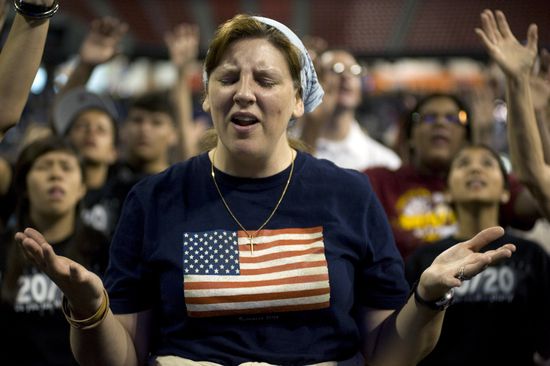
Christopher Benson reviews historian Darryl Hart's From Billy Graham to Sarah Palin: Evangelicals and the Betrayal of American Conservatism:
[Hart] turns to traditionalist conservatives (Russell Kirk, Roger Scruton, Michael Oakeshott, Mark Henrie, Patrick Deneen) for an alternative to the "redemptive utopianism" that prevails among evangelicals. In Hart's account, latter-day evangelicals, for all their internal differences, closely resemble their revivalist ancestors, stitching a patchwork quilt of American exceptionalism and providential benediction, patriotism and piety, evangelism and social action. "Deep within the soul" of members of the Religious Right, Hart observes, beats "the heart not of a Burkean conservative but of a Finneyite activist."
Along the same lines, David Gushee bemoans yet another presidential race turned "piety contest":
[A]s a Christian, I call for my fellow Christians to try an experiment. For lack of a better term, let's normalize, even secularize, our approach to the next election. Ask all candidates to drop the God talk. Recognize and reject all forms of religious pandering. Punish candidates who make base appeals to religious tribalism. Evaluate candidates according to their past performance and current policy proposals related to the major challenges facing our nation. Read the Declaration of Independence and Constitution for a refresher. Pastors, stay home and preach the Gospel rather than being precinct captains. If you want to engage in relevant political reflection, wrestle in your sermons with how constitutional democracy and broad Christian moral principles relate to each other.
(Hat tip: Joe Carter. Photo: Lucy West of Kileen, TX, participates in the opening worship ceremony during the non-denominational prayer and fasting event, entitled 'The Response' at Reliant Stadium August 6, 2011 in Houston, Texas. Thousands attended the event organized by Gov. Rick Perry in order to pray for God to help save 'a nation in crisis' referring to America. By Brandon Thibodeaux/Getty Images.)
Blame Berlusconi?
Kevin Drum prepares for the worst. Daniel Gros faults bad governance:
Italy’s growth fundamentals are all in pretty good shape, except one – good governance. Worldwide Governance Indicators show a dramatic worsening during the Berlusconi governments especially when it comes to the rule of law, government effectiveness, and control of corruption. Progress on improving these might in the end be more important for growth than the reforms the EU demands.
Can The Fed Save The Economy?
Bruce Bartlett begs Bernanke to take further action:
With fiscal stimulus off the table and Republicans gambling that continued economic stagnation will hurt Democrats more than them, the Federal Reserve is the only institution with the freedom of action and power to stimulate growth. But it is constrained by conservatives who charge that it is fostering inflation whenever it tries to provide monetary stimulus. The fact that conservatives have consistently been wrong about this for the last three years has done nothing to diminish their confidence. They are like the French Bourbons, who learned nothing and forgot nothing.
Richard Posner, on the other hand, believes we can't afford to devalue the dollar:
Greece cannot devalue its currency because it doesn’t have its own currency; in that respect it’s like a U.S. state. The U.S. has the capability of devaluing its currency simply by selling dollars abroad, but would be reluctant to devalue substantially because the dollar is the major international reserve currency (the currency used in international transactions between companies that don’t trust their local currencies), which creates a large demand by foreign central banks for U.S. dollars even when those dollars don’t buy U.S. goods, and so is a source of wealth for the United States, in part because dollars cost nothing to produce. Its status as the major international reserve currency would be imperiled if its value fluctuated as much as local currencies in many countries do.
Who Will Lead Europe?
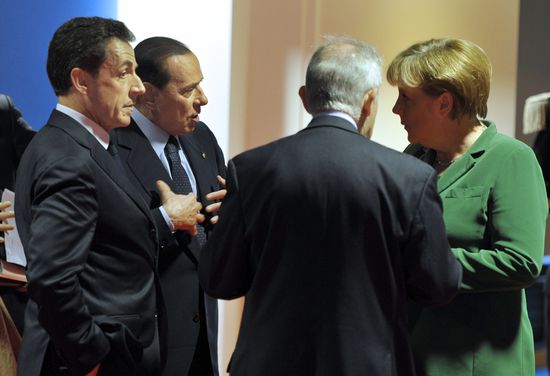
Felix Salmon sizes up the heads of state:
Europe has a leadership problem raised to the 17th power. One weak or bad leader — Papandreou, or Berlusconi — can suffice to hole the euro project below the waterline. But parachute in the best of all possible leaders into Greece and Italy, and you still have a problem. There’s Germany, and France, and the ECB, and even the likes of David Cameron and Tim Geithner meddling where they’re not really welcome. And the only way that this crisis can work itself out effectively is if they all agree on the same solution.
(Photo: French President Nicolas Sarkozy (L) speaks with German Chancellor Angela Merkel (R), Italian Prime Minister Silvio Berlusconi (2ndL) and European Council President Herman Van Rompuy upon their arrival for a bilateral meeting before the start of the G20 Summit of Heads of State and Government in Cannes on November 3, 2011. By Dylan Martinez/AFP/Getty Images)
An Ugly Entrepreneur’s Advice
Worth taking in these times:
It’s horrible to have no money. It’s horrible to have no money and then lose it. It’s horrible to have money and be constantly afraid of losing it. It’s horrible to have money and to be envious of the people who have more money. It’s horrible to have so much money you can’t possibly be envious of anyone and yet you get sick and it was all for nothing. On top of it, the process of making money can be torturous. I’m not good at dealing with people I don’t like. Pretending to like them. Paying their bribes. Listening to their stories. Laughing at their jokes …
None of it matters. The only goal is freedom. And then happiness. Happiness compounds. I know that today, if I focus on it, I can be a little bit happier than yesterday. I can do the Daily Practice. I can watch a movie that makes me laugh. I can avoid all the people who bring me down. I can be creative.
I can be a little happier each day. Until one day I love all the people who twisted me into the pretzel I still am.
The View From Your Window

Boston, Massachusetts, 4 pm
The Tea Party’s Fatal Delusion, Ctd
The defeat of the anti-union law in Ohio and the personhood law in Mississippi appears to have sent progressives into a tizzy. Harold Meyerson gives voice to the collective hope:
[Y]esterday’s elections were a rejection of a party that’s been defined for the past few months by Michelle Bachman, Ron Paul, and Herman Cain. So can Democrats take some hope from last night’s results? Provisionally; sort of. If Barack Obama can make next year’s election a choice between his ineffectual moderation and the Republicans’ wacked-out lunacy, the Democrats should do well. If next year’s election is a referendum on his stewardship of the economy—and none of yesterday’s contests were anything close to that—the Democrats will likely get clobbered. It’s clear that Americans have had it with Republican extremism. Whether that will be a decisive issue in 2012 is not yet apparent.
The Economist's J.F., who thought personhood would pass, now believes the idea is a giant, counterproductive overreach for the pro-life movement. Chait's takeaway from Ohio:
The Ohio result actually reflects a failure of conservative activists to understand what motivates the electorate. The conservative movement holds an ideological and generally principled opposition to government. Most Republican voters don’t share that. They oppose government programs that seem to benefit people other than themselves.
John Hood, noting a number of election results that broke in the right's favor, wants the left to put away its champagne.
Assad’s Victims Mount
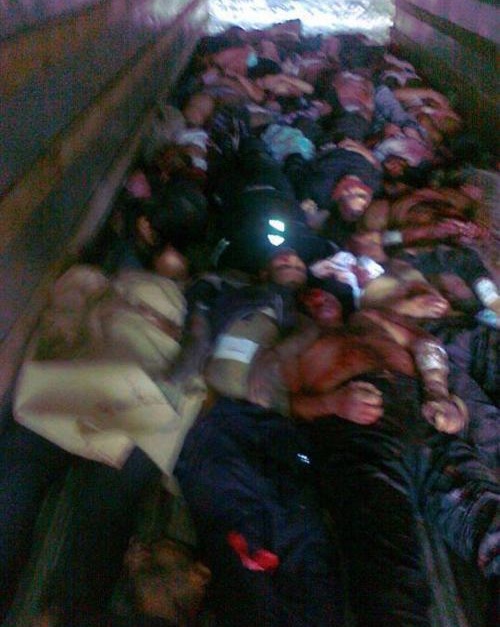
The brutality of Assad seems to know no bounds – and his strategy for survival is dependent purely on lies, media suppression and mass, organized violence against civilians. Above is a video capture of the dead lying in a Homs hospital, were many were torn from respirators by Assad thugs, determined not just to terrorize but to kill even in places where the sick are treated. Below is a video of a young girl in Homs, killed by the Assad forces:
Mary Casey and Tom Kutsch summarize the state of the conflict:
Clashes have intensified between government troops and armed defectors in Homs in what the New York Times states may be one of the "most violent episodes" since the start of the uprising. Alongside Homs, violence has erupted in the country's fourth largest city of Hama where government forces have surrounded a medical complex and the Baath Party headquarters. The escalation has come a week after President Bashar al-Assad committed to an Arab League plan calling for the end of regime attacks, withdrawal of forces, and release of political prisoners.
In the face of this reality, there is some evidence that the Syrian resistance, heretofore amazingly non-violent, is turning to arms after brutal assaults like the one on the neighborhood of Baba Amr. The critical factor in causing the regime's collapse – military defections – is happening, but have yet to reach a breaking point.
There won't be NATO military intervention, which means we in the media and civil society need to do what we can to air the evidence of these atrocities. When hospitals are war zones, when the bodies of torture victims are returned to their families up to two weeks after their deaths, we can at least communicate and underline the grotesque reality. And we can put pressure on those in the West lending support to the dictator, notably an Italian company, Area SpA, that is installing a state-of-the-art web monitoring system "with the power to intercept, scan and catalog virtually every e-mail that flows through the country".
Syria advocates are tweeting around a petition to stop this effort, which may be having some effect. Please add your name. Mercifully, Brooke Anderson reports that new sanctions also appear to be hurting Assad. This is going to be a long and bloody struggle. We need to remind ourselves whose side we are on. And remind the peole of Syria that they are not forgotten, and that their day will come.
 The Dish