Another ominous portent from the Walker administration in Wisconsin.
Month: November 2011
Newt’s Dissertation … Not That Bad?
Robert Paul Wolff read the whole damn thing:
[Y]ou will want to know right away whether this bit of juvenilia, as it were, shows signs of the mature Newt in full bellow, bombastic, pleased to the point of ecstasy by the sound of his own voice, a Larry Summers without the becoming modesty, if I may put it that way. Not a bit of it! The dissertation is written in a pedantic, serviceable prose, giving no evidence of the Newt that was to emerge as a fully formed Toad. Although the dissertation is written entirely in English, the footnotes give evidence that Gingrich had a quite adequate command of written French.
He better keep that quiet.
The View From Your Window Contest: Winner #78
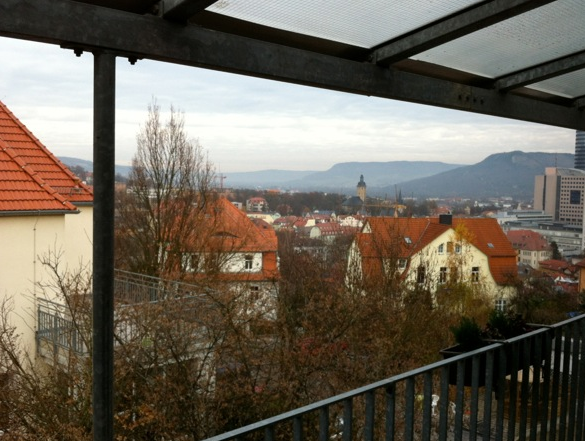
A reader writes:
That large building (or buildings) to the right is really frustrating me, as I can't seem to find it anywhere. I'm going to try using a different clue: the ridgelines in the background. It looks like the central Appalachians, but this is obviously not central Pennsylvania. The Alps do have a ridge and valley system running to the northwest of the main mountain chain, and the largest city in that region is Grenoble, France, so that's what's going to be my shot in the dark.
Another writes:
Basel, Switzerland? The modern building on the right looks like the headquarters of the Bank for International Settlements.
Another:
The red roofs seem to be mostly in Croatia, Serbia, and Bosnia. (The style of church in the background seems consistent with Serbian Orthodox churches.) There's only a handful of cities in those countries that are large and near the mountains. My best guess is Sarajevo, which seems to be about the right size, full of red roofs, and located in a mountain valley. I was unable to identify the office building or church in the picture, though.
Another:
I googled around for roof types and orange roof and found Dubrovnik. This was clearly not the right answer, but the roof style was accurate. I then began to look at topographical maps of Croatia for cities that were on the borders of large mountain or hill ranges but there really wasn't much in Croatia. So, I looked north to Slovenia and saw tons of mountains and cities on the edges of them. I also figured that because the two were likely combined at some point or at least are neighbors, it would be likely they would have similar roof styles.
I started looking at a few different cities in Slovenia and, as far as I can tell, the only one that comes close is Maribor. Looking on Google Earth, there is a church with a similar steeple to the one in the picture, and there are hills in the background. I don't think I have the exact right answer, because the mountains don't match up perfectly, but I have to get back to studying and so this is where I leave. My best conjecture – Maribor, Slovenia.
Another:
This is Stavanger, Norway.
An old friend of mine is from Stavanger. Shortly after we met he told me about a ferry route that sailed between Stavanger and Newcastle. Years later, on my (roundabout) way back to the States from living in Russia, I passed through Stavanger and took the route he had told me about. After we arrived in Newcastle, as I waited in line for passport control, I watched the cars unload from the ship. One by one, northern European sedans poured out of the hull, themselves queuing to get checked into Britain. And following all of these nondescript cars, there came an SUV pulling a reduced scale Viking ship. Of course.
Another:
Thank you for not doing another photo of a port. I've spent the last couple of weeks looking up port towns in Scandanavia and the Mediterranean on Google maps. I've discovered a lot of nice looking places, but got neither Sweden nor Morocco right.
I spent a few years living in Germany and this photo looks like many German towns I've been to. However, I don't have the time, energy or Google maps expertise to figure out exactly where it is. So I'll just say it's a medium-sized town, probably in the western part of Germany. And hopefully by sending in my answer today that will stop me spending the next two days trying to do a Google maps search of all medium-sized towns in Germany.
Another:
This week's contest was pretty difficult, the only clues I could see was the geography and style of the buildings. Now I'm pretty much casting out a line that I've picked the right town, Tübingen, Germany. The homes look pretty authentically German, the beautiful hills look like Southwest Germany. I'm also guessing that this is probably a picture that someone took on an Oktoberfest bender and just managed to find in the last few weeks. Hopefully they ventured farther from Munich that I probably would have.
While I have very little hope in getting this right, it does make me forget for a moment what it took for my ancestors to leave a similarly beautiful town in southern Germany for the US in the 1800s. Then I remember the religious persecutions and upheavals of the time and remind myself that my kinfolk had it pretty sweet in America, too, even if the beer wasn't as good.
Another gets the right German city:
The yellow villa is typical German style circa 1900 – I lived in one in Hamburg. But the hills mean it can't be the north, this must be central or southern Germany. The stripey building at far right looks like the Jena University tower, which was something of a socialist status symbol for the old regime. I can't give the exact street, but it's definitely Jena, Germany.
Another who correctly answered Jena:
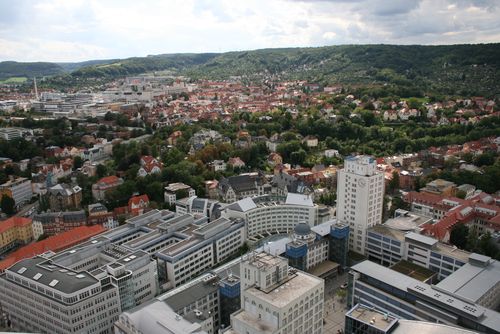
This was an especially exciting view for me, having spent a number of summers in Jena, where my now-wife studied. Besides the recognizable hills in the distance, the giveaway is the sliver of the Intershop tower on the right. Finding the exact house is a bit more difficult, though I admit I was tempted to hop on a train and go searching! Glancing at Google Maps I would guess around Johann-Friedrich-Str. 13, though I am not at all positive.
In any case, attached is a photo from the Intershop tower looking back toward where the original picture was taken. It's a beautiful little university town in Thüringen, well worth a visit.
Another:
You must have been following the news reports about the neo-Nazi terrorist cell of Zwickau, Germany: all its members hailed from this city, Jena, former hi-tech and academic center of the German Democratic Republic.
This is the fourth time you have a city in the contest where one of us has lived, after Kiev (twice) and Madrid. We missed them previously, but this time, we are sure. We lived here for more than three years before moving to the US eleven years ago. Although Jena suffered a lot under GDR urban development and industrialization, it is still a pretty and quite livable city, surrounded by a beautiful topography of steep limestone cliffs.
Another:
After two days of googling and being confused by the Dutch gambrel roofs in the foreground, I recognized the romanesque style of St. Michael's church tower in Jena, on the west bank of the river Saale. The building on the far right with the dark center is part of Ernst-Abbe Platz near the Intershop Tower, a sliver of which is visible behind the first building (another angle). Then I found this panoramic image and I think the building our view was taken from is one of the 10-15 houses I have narrowed them down to in the red box:
Its address is either Johann-Friedrich Straße or Schroeterstraße. That might possibly be the most anyone who has never been to Jena can do under the circumstances, I think. Thanks for the challenge, it was exciting and frustrating at the same time.

Another gets the right street:
Everything in this picture points to Germany. The characteristic roof tiles. The casement windows, the style of the pre-war villas in the foreground. The topography really only allows for one conclusion: Jena, Thuringia's second largest city. The church in the center is the Friedenskirche, and the modern building on the right is the former research building of Zeiss Optical Systems (built 1959-65, but modernized in 1993).
The tricky part was the location from which the photo was taken. After wasting nearly an hour searching for identical roof patterns, I am willing to make an educated guess: this photo was taken from a building on Schroeterstraße 8. The building with the terrace seen on the left is Schroeterstraße 10, a residential building owned by the Jena-based Max Planck Institute for Chemical Ecology. Could it be that our anonymous photographer is associated with the institute?
Yes indeed (see below). Another nails the right address:
Apologies for the multiple emails. I have another correction. The picture was taken from a building on Schroeterstrasse. It's the building with the overhang in the center of the photo:
If I knew how to photoshop I could even circle the window, etc. The photographer was standing on the top floor of the building underneath the overhang. It's hard to tell the exact address from Google Maps. I'm going for Schroeterstr 6.
Yet another update from that reader:
I was curious about the name of the street: Schroeterstrasse. I'm guessing that it is named after the astronomer Johann Schroeter. Jena is known for its contributions to astronomy and lenses. Is the contest linked not only to Germany, but also to NASA's latest mission to Mars? A crater on Mars was named after Schroeter.
Of the four readers who correctly answered Schroeterstraße 6, only one has gotten a difficult window in the past without winning and thus gets the prize this week:
Wow! This is the second week in a row where I saw the view and knew exactly where it was right away. I spent a few weeks in Jena, Germany back in the late 1990s. It was (and still is, I hear) one of the coolest university towns in the former GDR. Whereas my visceral reaction to last week's image of Casablanca was rooted in a miserable travelling experience, the sight of Jena instantly evoked warm memories from my university days.
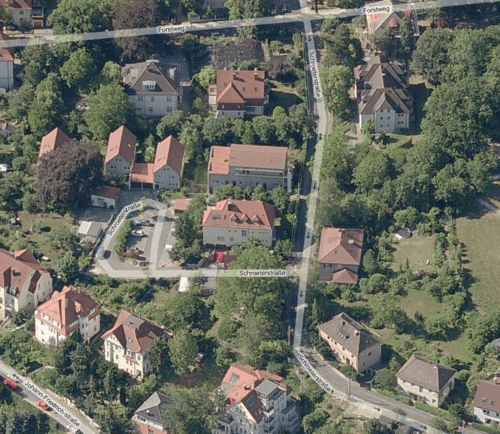
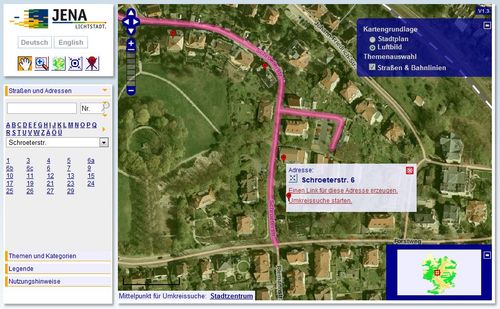
The picture shows a view from the Jena-Süd neighborhood of Jena, Germany facing north/north-east towards the city center. At the very edge of the picture (to the right), you can see the distinctive Jen-Tower (formerly known as the Intershop Tower), the tallest building in the former East Germany. Next to the Jen-Tower is the Bürohochhaus am Leutragraben. Michaelskirche is also visible in the center of the frame. The photograph was taken from what appears to be a residential building on Schroeterstrasse. According to Jena city maps, the building's address is Schroeterstrasse 6. The picture was taken from what appears to be a covered balcony on the top floor (third story). I've attached aerial images pinpointing the spot where the picture was taken, with the other residential structures in view, as well as a screen capture of the Jena Stadtplan (city map) identifying the actual street address:
I've been a longtime Dish reader, but never felt like part of the club until I submitted a correct answer last week. Now that I've lucked out two weeks in a row, I feel like it's destiny for me. This is my one chance – the culmination of a life's journey. I sure hope I'm the one this week!
From the VFYW's owner:
I'm in Jena, on a four-month sabbatical working at the Max-Planck Institute for Chemical Ecology (M-PICE). The photo is taken through the window of the front door of my flat, which is owned by the M-PICE (the Institute, though, is housed on the Beutenberg Campus, about 2 km away). The flat is on the third (top) floor of the building (there are six flats in total), and the view from my window looks down into the Jena city center. The address of the flat is Schroeterstraße 6. It is located in a very charming part of Jena, with lots of turn of the century houses, plus a few modern houses. The tall silver building is the Jen-Tower, which until January 2005 was the "Intershop" Tower, and next to it is the Jenoptik Tower (the white building). The beige tower, with the grey top (in the center of the photo), is a church called Friedenskirche
Jena has a number of important research institutions, and the Friedrich Schiller University (Karl Marx was awarded his PhD here). It is also home to the world famous Carl Zeiss Jena Company, which specializes in optics and glass making. Finally, Jena is the home of the first ever planetarium (Zeiss Planetarium).
Please let me know if you'd like any additional information. And Happy Thanksgiving from Germany!
(Archive)
The Study Of Intelligence, Ctd
TNC goes another round:
On the broad question–Should researchers be free to explore the nexus of race, IQ and intelligence?—Andrew and I are in harmony. Onward, indeed. Where we differ is the following: Andrew, like most conservatives who write about race, is more concerned with a vague p.c. egalitarianism than the forces that birthed such things. (Unlike "political correctness" those forces can actually be quantified, and their impact demonstrated.)
Well, yes, I do tend to get concerned when politics cramps research and when certain facts are suppressed. And the subtle but clear differences in IQ between broad racial groups are a reality – across country and continent and world. They do not only persist when controlling for economic class, on some measures, they increase. Now, this is only the first baby step in the discussion, but it strikes me as the most important one. And it is this finding – staring right out at us from vast amounts of data that no one disputes – that prompts the question: why? At least that's what I can say for myself. I had no interest in this subject until I saw the data in Murray's and Herrnstein's book. I was, frankly, astounded by it. As a highly educated person, I had never been exposed to this data. And yet, it turned out it was undisputed. Merely the interpretation of it was open to real and important debate.
My own empirical inquiry was birthed not because of some long legacy from slavery, or some racism, or utter indifference to the experience of African-Americans and foul claims about their inferiority. It was provoked by empirical data acquired from the measurement of intelligence in the 20th Century – and immediate liberal hysteria denying that race as a biological construct existed at all. Piffle. And note that there are many interesting ways to debunk this or interpret it non-genetically: IQ is culturally biased against African Americans; IQ is meaningless outside the needs of modern, technocratic societies; IQ does not exist; race as a category is far too muddled and vague a term to be a part of this debate – and that shift is accelerating with more miscegenation; IQs improve with training; and so on and on. But surely they are worth investigating without the fear of p.c. reprisal. Let's say, for example, that we discover that cultural differences in bringing up infants plays a big role in creating this gap. Isn't that worth knowing? And yes, as one reader who is a doctoral student in genetics explains, some of the motives of the research can be and often are suspect:
Many of the scholars who open study IQ differences amongst races are racist and shoddy in their scholarship. But that's because there's a selection effect: only they have the motivation to continue this research. Respectable and normal scholars avoid it. Who wants to be rude? How many people noticed that James Watson endorsed Obama and is a conventional liberal otherwise? E. O. Wilson has the same views as Watson on IQ and race, but keeps quiet about it, and is greeted with acclaim in his dotage because he does keep quiet (his views are clear if you go to Google Books and look up "E. O. Wilson" and "Rushton").
More broadly the silence of scholars due to social norms means that most educated people are totally ignorant of the 1 standard deviation IQ difference between blacks an whites, and that the average black American scores at the 15th percentile in relation to the average white American. Perhaps these facts should be suppressed, I don't know. But they sure have been. I've been in rooms where graduate students argue about the underrepresentation about blacks in their field, but have no idea that their GRE scores are just far lower (this does not speak to why "the gap" exists, just that it exists, but many people are unaware of its existence because of its shocking impoliteness).
Freddie DeBoer joins the fray:
The rush to find genetic origins for any and all human phenomena has become so popular, particularly with the press, that the standards of evidence have eroded everywhere. Genetic or evolutionary speculation has become an obsession of our media, frequently undertaken without a shred of scientific credibility, and defined by faddishness and imprecision. Take homosexuality and genetics. I find it remarkable the number of educated people who I meet who assume, quite confidently, the homosexuality (in both men and women) is purely and straightforwardly the product of genetic predisposition. This is a politically palatable idea– one might call it PC– but it can't yet be proven, even conditionally. There are complications, such as the (controversial) older brothers hypothesis, which is important because it posits a mechanism that is non-genetic and yet nonetheless physiological in origin (and thus not "chosen"), as well as other evidence contrary to the assumed genetic origins of homosexuality.
But as it became politically important for people to insist that homosexuality is genetic, that insistence became more and more prevalent. Never mind that the dichotomy between "homosexuality is purely genetic" and "homosexuality is a choice" is flagrantly false, or that "they can't help it" is not a stirring cry for equality.
For the record, I have never argued that homosexuality is genetic, since we simply do not have the data to show it conclusively. For the record as well, the second chapter of Love Undetectable plunges into identical territory with respect to some of the hoariest psychological theories behind homosexual orientation: absent father, domineering mother, etc. Many of these theories caused incalculable harm to countless homosexuals in history and still do. But that is a different question as to whether they are true or not. And our absence of a better understanding of homosexual orientation is inhibited by the same impulses that chill discussion of racial differences in IQ. I am no more motivated by racial animus in understanding the dynamics of race, evolution and IQ than I am by homophobia in understanding the dynamics of genes and the environment in homosexuality.
The p.c. left did to Love Undetectable what they did to Virtually Normal: ignore its arguments and demonize its inferred motives. I know whereof I speak. Most people subscribe to general liberal principles. It is harder to live by them.
Was DSK Set Up? Ctd
Amy Davidson takes aim at Edward Jay Epstein's theory. She homes in on a "fairly important juncture" in Epstein's account:
What took place between DSK and the maid in those six to seven intervening minutes is a matter of dispute. DNA evidence found outside the bathroom door showed her saliva mixed with his semen. The New York prosecutor concluded that a “hurried sexual encounter” took place and DSK’s lawyers have admitted as much, while claiming that what happened was consensual. The maid has brought a civil suit claiming he used force. It is not clear when she left the room since key card records do not show times of exit. What is known is that DSK called his daughter on his IMF BlackBerry at 12:13 to tell her he would be late.
Isn’t this “matter of dispute” the crucial one? And yet it is treated as a sideshow. Epstein seems to have very good access to D.S.K.’s circle; he says he has seen documents that were given to his lawyers. He knows that, after the “encounter,” Strauss-Kahn put on “his light black topcoat.” But in terms of the event at the center of the scandal, what we get is that his “lawyers have admitted as much”—as much, in effect, as the D.N.A. showed—“while claiming that what happened was consensual.” Is that the best Epstein can do? What did or did not happen to Nafissatou Diallo may simply not have been Epstein’s concern: the title of the piece, after all, is “What Really Happened to Strauss-Kahn?”
And ask yourself this: how many consensual sexual encounters with perfect strangers take only 7 minutes? Maybe in a gay male bathhouse or sex club. But in a hotel room between a naked, creepy old man and a young cleaning maid? Blood?
Ask Me Anything: Why No Comments Section?
Are We “Offshore Balancing?”
Beinart dubs Obama's grand strategy:
There’s a name for the strategy the Obama administration is increasingly pursuing from the Persian Gulf through the Hindu Kush to the South China Sea: offshore balancing. It’s the idea that America can best contain our adversaries not by confronting them on land, but by maintaining our naval and air power and strengthening those smaller nations that see us as a natural counterweight to their larger neighbors.
Dan Trombly is not impressed:
One of the consistent errors of offshore balancing discussion has been the tendency to believe that it necessarily demands there be no military engagement with the world beyond dealing with great powers, and that this military engagement must necessarily not include the use of ground forces, especially outside the core areas of engagement…if we recognize Britain as a prime example of a great power using an offshore balancing strategy, we can recognize that offshore balancers frequently commit ground forces to wars, and very often outside of the context of great power politics.
Previous discussion of "offshore balancing" here.
Yglesias Award Nominee
“Let’s turn to taxation of the top 0.1 percent, and focus on these CEOs. If the tax rate on their income/capital gains goes up, the firm will compensate by giving them more equity/options, to keep them working hard. In other words, the tax rate on the top earners can be hiked without much effect on CEO effort because there is an offset internal to the firm,” – Tyler Cowen.
The cost of this, of course, is still carried by the shareholders. But not quite so much by the tax-payer.
Chart Of The Day
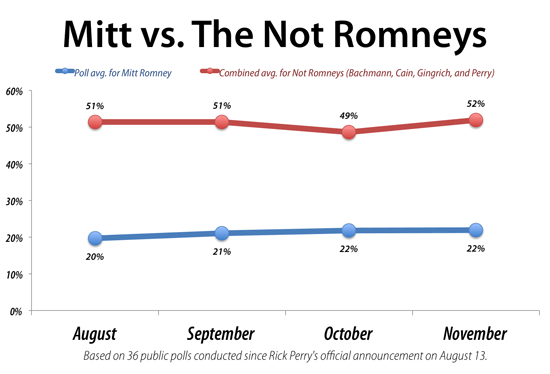
(From Jed Lewison. Hat tip: Ben Smith)
Quote For The Day
“[The Republican Party] consists half of people who think like Michele Bachmann and half of people who are afraid of losing a primary to people who think like Michele Bachmann and that leaves very little room to work things out,” – Barney Frank, the witty Speaker of the House we never had.
 The Dish