You can say that again:
Month: November 2011
Cain’s Loss Is Newt’s Gain?
In response to polls suggesting we may be about to see a Gingrich surge, Chait voices his shock:
It has simply never occurred to me before today that there would be even the slightest chance of the Republican Party nominating Newt Gingrich – not even in the nineties, at the height of his powers, when such speculation was rampant. Parties don’t nominate people like that. You nominate a telegenic front man, not an erratic, overbearing, morally repulsive tub of goo like Gingrich.
He concludes that it's "probably time for me to stop making predictions of any kind about this race." But some desperate partisans are already making the case. And desperate is the appropriate word. Nate Silver says Gingrich's chances remain slim:
Overall, I would read three of these factors, establishment support, personal liabilities, and (especially) fund-raising, as being clearly negative for Mr. Gingrich. This contrasts against one, ideological positioning, which is potentially favorable for him. He has both strengths and weakness in the key early-voting states, meanwhile. That balance is unfavorable enough to suggest that his chances of winning the nomination are weaker than his polls alone would imply.
Block Head
Just when you thought the Cain campaign could not get more chaotic or reckless, we get this bizarre claim from Mark Block that Josh Kraushaar is a) working for Politico and b) Karen Kraushaar's son. Both a) and b) are incorrect. But Block didn't think to check before opening his wonderfully smoke-filled mouth. (Apologies, by the way, for getting the spelling of Karen Kraushaar's name wrong yesterday.) Ed Morrissey wants Block fired for his disregard for facts:
After last week’s aborted accusation against Rick Perry as being the leaker of this story and now this “epic facepalm,” as one of my Twitter followers called this, Mark Block has to go. If he’s not gone by tomorrow, no one will take this campaign seriously again — nor should they.
Weigel asks how much Cain's supporters will endure:
There's got to be a breaking point for the conservative base's dislike of the media. How about we start with outright lies?
“A Modest Reelection Victory”
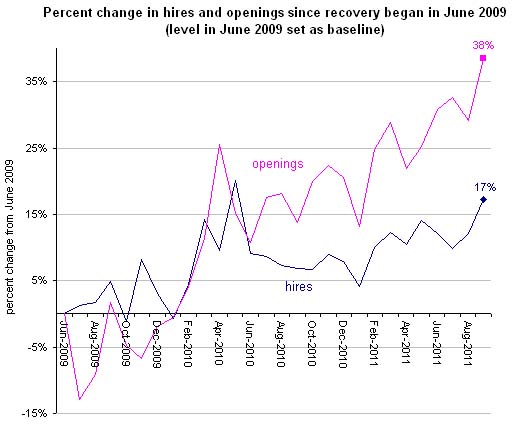
The new employment report is the most hopeful in a long while. Which gives some context for Noah Millman's prediction for the president:
From November 1991 through July of 1992, the unemployment rate increased with every reporting. Obama’s situation may be more comparable to the situation under the second President Bush, when unemployment inched its way down from its peak in July, 2003 through just before election day.
Now, obviously, the absolute level of unemployment is going to be way too high on election day for a majority of people to be satisfied with President Obama’s performance. But the trend probably matters more at the margins. A strong positive economic trend led to an overwhelming reelection victory even though no sitting President since World War II had been reelected with such high prevailing unemployment rate. A weak but positive economic trend in 2004 led to a modest reelection victory even though the absolute level of unemployment was much better than it was in 1984. That’s what I expect for President Obama in 2012: a modest reelection victory based on weak but improving fundamentals.
The Kraushaar Factor, Ctd
The AP now goes through her employment history. She subsequently complained to another employer that she was not allowed to work full-time from home after a serious car accident, and complained about a politically incorrect email comparing men and women to computers. This was not a complaint of sexual harassment.
Bibi’s US Spokesman
Well, we knew Jackson Diehl has a direct line to the Israeli prime minister, but today he out-does himself. How is this piece of "journalism" not simply Israeli government propaganda?
Should We Force Citizens To Vote?
Room For Debate asks. Jason Brennan is solidly against the idea:
The median voter is incompetent at politics. The citizens who abstain are, on average, even more incompetent. If we force everyone to vote, the electorate will become even more irrational and misinformed. The result: not only will the worse candidate on the ballot get a better shot at winning, but the candidates who make it on the ballot in the first place will be worse.
The Dish covered similar ground recently.
Party Rock: “A State Of Mind”
Mark Lee deconstructs a mega-hit:
LMFAO, a dance pop music duo, is boldly advancing its "party rock" music, one that is devoid of any musical aspects of rock but seems to be channeling the broader culture of rock. It’s easy to write this off as a careless misappropriation of one art form into an highly dissimilar form. Like evoking nineteenth century impressionist oil paintings when talking about a crayon drawing just because they’re both renderings of a tree.
I don’t entirely disagree with this statement. But do give LMFAO credit for boldly defying the commonly accepted use of the word "rock" in music. And lest we forget, rock music was born out of defiance of social and musical norms. So perhaps it’s only natural that once "rock" itself has become a norm, "rock" will come along to challenge it.
Official music video here. Update from a reader:
The excerpt from Mark Lee's article is egregious. LMFAO aren't rock 'n rollers, but rather are claiming an ancient hip-hop tradition of "rockin'" a party, as either DJs or MCs. I hope this video clears things up.
Another:
I'm glad to see the site carrying Mark Lee's post is called "overthinking it." Slapping a label on something does not change its essence or its meaning (or lack of meaning). I realize marketers and advertising people believe otherwise, and I suppose I also realize that if the relabeled product is shoved down our throats aggressively enough it takes on a life of its own. But a sham is a sham.
I was subjected to a visual-only assault by "Party Rock" while I was at the Y a few weeks ago – flailing dancers, someone wearing a box over their head, closed captioning that said something like "If you're sexy and you know it clap your hands, party rock." That was enough to make me want to smash the television.
The use of the word "rock" in the title of that "song" title ought to have no significance; I would be willing to bet that its "writers" have no concept of what rock music is. Let's just call it what it is – a crass grab for attention and dollars foisted on an audience that has been conditioned to expect nothing better.
And you kids better stay off of my lawn.
Super-sizing Status
Jonah Lehrer ponders a new study that suggests "one of the factors causing us to consume too much food is a lack of social status, as we try to elevate ourselves by supersizing meals":
Think, for instance, of the alpha males in those David Attenborough specials on television – the most powerful animal is the one who eats the most, getting access to the felled antelope before anyone else. Or think of all the cultural norms that associate larger products with increased status, from the screen size of televisions to the square footage of houses. In category after category, bigger isn’t just better – it’s also far more prestigious, a signal that we can afford to splurge on spare rooms we’ll never use.
Erica Grieder is skeptical:
People with huge houses typically have more money than people with modest ones, Warren Buffett aside. With food, it's often the opposite. A more intuitive explanation of the phenomenon Galinsky et al describe, I think, would be that the people who are reminded about a time when they felt powerless are therefore feeling sad or self-indulgent or trying to comfort themselves with food (the kummerspeck the Germans talk about.)
Christianist Watch
"The evil dark side that exists in this world is taking hold. And they’re saying, what we want you to be able to do is continue to extinguish innocent life. You see, if we could do that, Satan wins," – Mississippi Lieutenant Governor Phil Bryant, on the fight over the state's proposed personhood amendment, which failed last night.
 The Dish