Face Of The Day

131729880

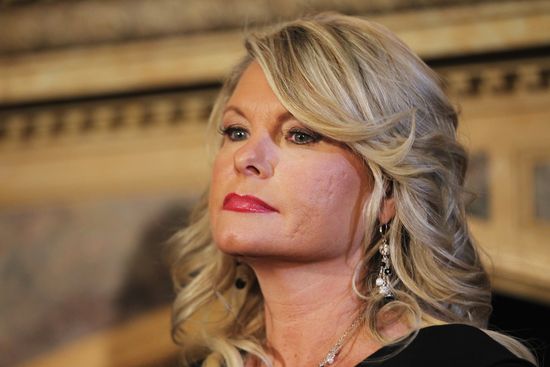
Sharon Bialek attends a news conference to accuse Republican presidential candidate Herman Cain of sexual harassment more than a decade ago on November 7, 2011 in New York City. Bialek is the fourth woman to accuse Cain of inappropriate behavior when he was while CEO of the National Restaurant Association. She stated she is speaking out because she wanted to give 'a face and a voice' to support the other accusers who have remained anonymous. By Spencer Platt/Getty Images.

My live-blog of the presser is here.

The Indispensable Minority

GT_CHRISTIAN_111104

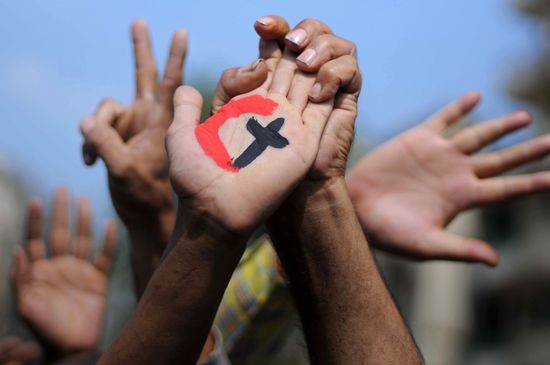
Daniel Philpott gives a primer on the possibilities and pitfalls awaiting Arab Christians after the Arab Spring:

[I]t is understandable that they have allied with secular dictators: a pragmatism of survival. But the strategy is no longer reliable. While the present period’s flux creates danger, its complex and shifting factions also beget opportunity. “Christians could be among the most important architects of a new order in the Arab world,” the National Catholic Reporter’s John Allen wrote this past August in a powerful column on Christians in the Arab Spring. As vocal defenders of religious freedom, the region’s Christians could become a powerful and credible force not only for human dignity but also for the kind of regime in which they – and all minorities – are most likely to find protection in the new Arab order. But they need help. To be the architects that Allen envisions, Christians require solidarity from sympathetic governments, Christians outside the region, and like-minded Muslims.

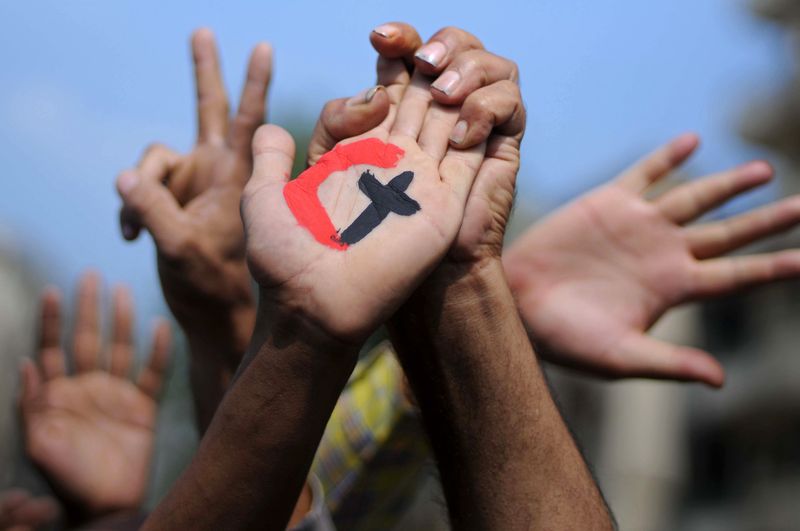
(Photo: A cross and a crescent are painted on the palm of an Egyptian demonstrator holding the hand of a fellow protester during a rally in support of national unity in Cairo's Tahrir Square on October 14, 2011, days after 25 people, mostly Coptic Christians, were killed in clashes with Egyptian security forces. By Mohammed Hossam/AFP/Getty Images.)

The 100%

GT_KANYEOCCUPY__111104

Brad DeLong reframes the debate:

The Republicans are not just acting against the interests of the 99% and for the interests of the 1%. The Republicans are acting in the interests of nobody at all. The 1% have an interest in full employment, high capacity utilization, and general prosperity just as the rest of us do.

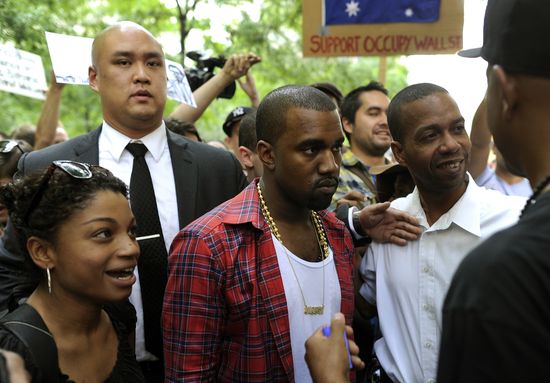
(Photo: Kanye West visits demonstrators with 'Occupy Wall Street' on October 10, 2011 in New York. According to a report, "West politely tucked the majority of his gold jewelry into the front of his undershirt while touring the grounds, and Russell Simmons, handed out $20 bills to the protesters while declaring, 'I'm part of the 100%. If those people suffer, I suffer with them.'" By Timothy A. Clary/AFP/Getty Images.)

Quote For The Day II

"When I saw the numbers and realized Republicans weren't embracing my message, I breathed easily for the first time in months. They're terrifying. We're talking about people who blame the unemployed for their own predicament and literally applaud the idea of letting those who don't have health insurance die. What would it say about me if they gravitated toward me personally or approved of my political principles?" – Jon Huntsman in The Onion.

Live-Blogging Gloria

2.16 pm. Absent any more details, all I can say is that, at the very least, Cain needs to respond to this specific allegation. I believe the woman, but I tend to believe most professional women who give credible evidence of abuse of power by bosses.

2.12 pm. CNN is covering this story by talking over the press conference and switching to the Michael Jackson verdict. MSNBC's "Breaking News" is that NBC News has been unable to confirm the allegations outlined minutes ago. Now I can't find any cable news coverage of the press conference. Seriously: Jon Stewart is right. These channels are worthless.

2.07 pm. Cain has countered with a statement denying any sexual harassment of anyone. So these four women are, according to him, lying. Including the latest who was, at one point, a fervent Cain fan and subsequently attended a recent Tea Party event. It will be hard to turn Bialek into a liberal tool. On the other hand, it wasn't clear to me if she was actually employed by the NRA when Cain allegedly tried to grope her and force her head down to his dick. It doesn't make his behavior any the less gross, but it does make it more of an ethical than a legal issue.

2.01 pm. A pretty ugly physical account: pushing his hand up her leg toward her genitals, and pushing her head down toward his crotch. "You want a job, don't you?" is a pretty horrifying invitation to have sex. But these details were not conveyed to her boyfriend or second witness, so far as I can tell. From this account, I can only say I find her persuasive. And his alleged attempt to push her head toward his crotch may cast some context on his previous remarks about women being shorter or taller than his wife.

1.59 pm. Her account underlines her previous admiration of Cain. She called his speech which she witnessed "incredibly inspiring." She then asked: "When are you running for president?"

1.57 pm. Allred then gets the wind in her sails, accusing Cain of lying and abusing power, calling him a serial sexual harasser. Allred also has two contemporaneous affidavits of Bialek's complaints. No details yet, as we await Sharon Bialek.

1.54 pm. So we have a firing without apparent good reason. And then a request from Ms Bialek to Mr Cain to help her find another job. Instead, allegedly, he offered her in the classic Allred phrase: "his own version of a stimulus package."

1.51 pm. The first thing to note is that, according to Allred, the accuser is a Republican, an accomplished professional and white.
Our Enemy, Pakistan

Jeffrey Goldberg and Marc Ambinder have an expose on Pakistan's nuclear program. Money quote:

The Pakistani government is willing to make its nuclear weapons more vulnerable to theft by jihadists simply to hide them from the United States, the country that funds much of its military budget.

Goldberg flags a subsequent report that Pakistan is increasing security on its nuclear weapons. Eli Lake fits Ambinder and Goldberg's  article into a broader pattern of evidence suggesting "Pakistan’s national security establishment is at war with the United States, while its elected leaders are putative U.S. allies." C. Christine Fair goes further [pdf]:

Ten years into the most recent engagement, in the wake of the 9/11 attacks, it has again become abundantly clear that Pakistan’s strategic interests diverge starkly from those of the United States. Most observers of the U.S.-Pakistan relationship admit that Pakistan’s allies—such as the Haqqani Network, the Afghan Taliban and Islamist militant groups such as Lashkar-e-Taiba, among others—are America’s foes. It is equally clear that America’s ascendant ally in the region—India—is Pakistan’s nemesis. Thus what bedevils U.S.-Pakistan relations is not pervasive distrust but rather a surplus of certitude: certitude that, for the foreseeable future, U.S. and Pakistani strategic interests have only a small—and quickly vanishing—area of overlap. 

Spencer Ackerman reacts by getting angry about America's relationship with Pakistan. Amitai Etzioni is pessimistic that Pakistan can be part of the solution in leaving behind a semi-stable Afghanistan. 

Ask Me Anything: Is Psychoanalysis Worth Trying? Ctd

A reader writes:

I just wanted to say thank you for that video. I had a very traumatic childhood; I grew up in a British-style boarding school in India where I dealt with homesickness, arbitrary cruelty of teachers, even sexual molestation by other boys – standard boarding school fare, I think you'd agree, but nonetheless deeply scarring for a sensitive kid.

99% of the time, I am quite normal, highly functioning, deeply compassionate and so on. 1% of the time I'm a complete fucking maniac. Depending on the cause, I either have a debilitating panic attack or fly into a rage. Recently I got so angry over some pile up of pent-up frustrations that I completely destroyed an old laptop. It was just lying there. This was the first time I have done something really outwardly destructive (until then I would scream my head off, give myself a near-aneurysm, and then stew for hours). Thank God I don't have kids – talk about paying the trauma forward.

My long-suffering wife has now demanded I seek psychoanalysis to work through those childhood issues. I woke up [Friday] morning resolved not to do it, but open for signs from the universe, so to speak. Then you showed up on my screen. Your candor and warmth totally removed my trepidation. My first appointment is next week. Wish me luck.

You'll need the luck about a month in. Prepare for pain. And relief.

Dish Check Update: Who Caused The Financial Crisis?

129214947

A reader manages to compress the complicated truth into a compact email:

high-risk loans –> mortgage-backed securities –> collateralized debt obligations –> credit default swaps –> synthetic collateralized debt obligations

This is the supply chain that inflated the bubble and eventually caused the collapse. Because many different people and organizations were involved, you can make a credible-sounding case that any of them was responsible – from AIG to Lehman Brothers to Standard & Poors to Countrywide to the immigrant fruit-picker with the liar's loan.  Of course, we hear all of these various players blamed at various times by various people.  And of course, in precipitating the collapse each did play a critical role – probably a necessary role in its unfolding as it did.  But that doesn't mean that each is equally responsible, any more than your employer is responsible for your car crash – if he hadn't decided to rent that specific office space, you wouldn't have been in that exact spot on the highway at the exact time the guy next to you swerved while trying to text his mistress.

Then who is responsible?  I think there are a few factors to consider:  1) where was the real scale and risk created in the chain?  2) where was the real impetus – who was creating/accelerating the "pull?"  3) who should have known better?  I think the answers to these questions point squarely at Wall Street and AIG, and to a lesser extent the ratings agencies.  Sub-prime lenders were dirtbag cheats, and many high-risk borrowers were foolishly irresponsible, but that doesn't make them responsible for the collapse, just among those morally at fault – a subtle yet important distinction.

1)  There were a lot of high risk loans issued during the 2000s, but Wall Street took something big, made it enormous, and connected it into the fabric of our economy.  

Wall Street firms were regularly leveraged 30:1 or more making big bets on their MBS/CDO factories, putting at risk their legitimate function of supplying credit to Main Street (the legitimate part being a miniscule fraction of their overall profits).  Furthermore, vehicles like synthetic CDOs allowed the scale of the bubble to be increased by orders of magnitude – the equivalent of having 50 homes in a fire-prone neighborhood, but with 100 insurance policies on each and a lively market of bets on which will burn down first.  If this were just a sub-prime housing crash, it would have hurt (think dot-com crash), but it wouldn't have brought the global financial system to its knees.  That required Wall Street and AIG, with the ratings agencies helping along the way (by convincing institutional investors that all was safe).

2)  It's a little counter-intuitive, but Michael Lewis describes it well in The Big Short.  This wasn't a bubble driven by the front of the supply chain – borrowers and lenders – but instead pulled from Wall Street.  If Wall Street weren't buying all these bad loans, the bubble would have been pretty short-lived and small.  It was the ability to buy a pile of shit and sell it as gold that drove the entire chain – Wall Street alchemy enabled by the ratings agencies.  You could buy sub-prime MBSs low and sell them high as CDOs to unsuspecting investors (and even better, insure them for cheap with AIG).  This created an insatiable appetite for trash loans, which created a frenzy by sub-prime lenders to do anything and everything to feed them, including ever-lower standards and outright fraud.  The demand for loans also helped drive up the housing market, which reinforced the cycle and hid the risks in the alchemy.  You could argue that the ratings agencies were most at fault here, but a closer look reveals that they were full of second-rate analysts (always have been) duped by first-rate quants at the Wall Street firms, and pressured by those firms to stay in line or else lose their business (credit to Lewis here again).

3)  Some have argued that borrowers should have known better than to sign up for loans they couldn't afford.  I agree, but this argument should be strongly tempered by the realization that each time someone risked their home and credit rating there was a lender putting up hundreds of thousands of dollars on the same deal.  Is it really fair to expect that the poor schlub should have known better than the broker, the underwriter, and the institutional investor?  And when the quants and sales desks at the big Wall Street firms created and hyped these financial vehicles of mass destruction, duping ratings agencies and institutional investors alike, is it really fair to say that they were just making markets and all the counter-parties should have known better?  In this respect, only AIG rises to the same level of blame as the Wall Street "wizards" – not just for issuing insurance policies on assets they clearly didn't understand, but for issuing so many for so much.  At a certain point, you've got to take a closer look.

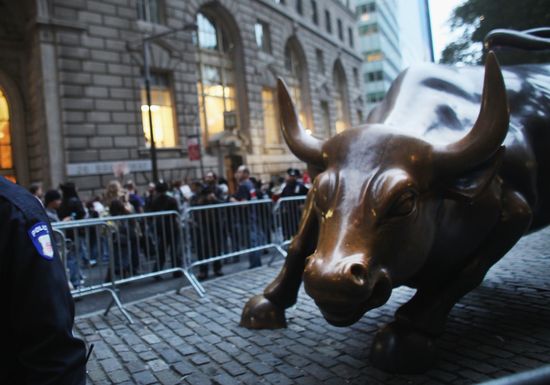
(Photo: A police officer guards the Wall Street bull as demonstrators associated with the 'Occupy Wall Street' movement face off with police in the streets of the financial district after the deadline for their removal from Zuccotti Park was postponed on October 14, 2011. By Spencer Platt/Getty Images)