The Real-Life Hurt Locker

GT_EOD_IRAQ_111104

Captain Nawa Salah Ahmed is part of the Iraqi Explosive Ordinance Disposal unit, referred to by its English acronym, E.O.D., and known to Americans as “the Hurt Locker guys.”

While the Americans in The Hurt Locker relied on a sophisticated array of equipment and protection—the suits with magazine pouches and drop-leg holsters; the state-of-the-art detection devices—the Kirkuk bomb squad’s weapon of choice is the Dragunov sniper rifle. It was designed in Soviet Russia and has a distinctive D-shaped stock, made of wood. After securing the area around a suspected bomb, the officers will open fire with the Dragunov. With any luck, the damage from the rounds will reveal what type of device they are dealing with. If the detonator is exposed, they may continue firing to dislodge or destroy it. Prior success as a sniper is a good predictor of success in this unit.

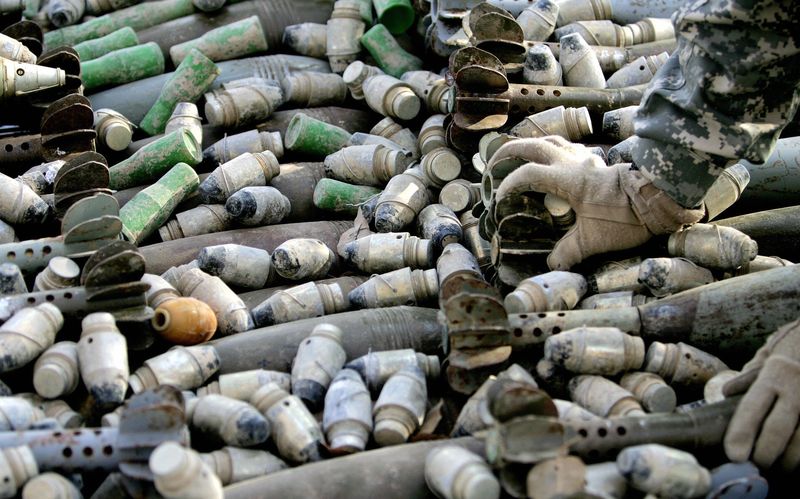
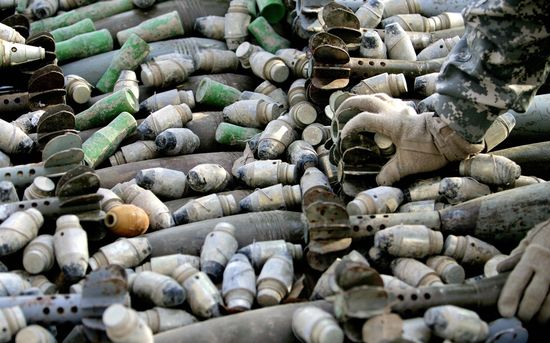
(Photo: A US soldier of the Explosive Ordinance Disposal Special Unit stacks bombs, mortars and shells, part of a big cache found in the countryside of the northern Iraqi city of Hawijah, 27 December 2005. By Filippo Monteforte MONTEFORTE /AFP/Getty Images)

Was Buckley’s Real Legacy Charm?

That's Terry Teachout's take:

William F. Buckley Jr. founded and spent thirty-five years editing National Review, published some fifty-odd books, hosted 1,429 episodes of Firing Line, and wrote a syndicated newspaper column from 1962 until the day of his death in 2008. Yet anyone who seeks to explain the nature of his contribution to American political life must start by pointing out something else that those who knew Buckley took for granted, which is that he was an irresistibly charming man. Whatever your political beliefs, you couldn't spend five minutes in his company without liking him, or feeling that he liked you (if he did). It was this charm that made him socially palatable at a time when conservatism was widely looked upon by the liberal establishment as one step short of outright bigotry.

How Can We Make Moving Easier?

Mobility across the US is down [NYT]. A paper last year proposed the creation of a "mobility bank" to help finance the residential moves of American workers. Reihan offers qualified support for the idea:

Basically, this "mobility bank" will step in and play the role normally played by one’s extended kinship network. The poor tend to have weaker family ties, which makes borrowing the money you need to move to a more economically viable region difficult if not impossible. … I see it as a cheaper and more effective alternative to government programs that try to keep people in economically-depressed regions …

Earlier discussions of how expensive moving is here and here.

The Border’s Archaeologist

Screen shot 2011-11-02 at 11.50.13 AM

Eric Wagner tags along with Jason De León:

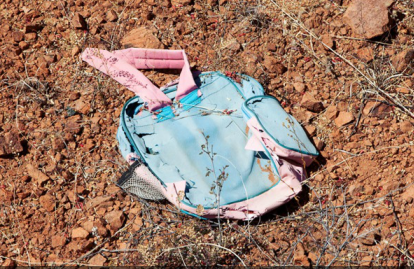
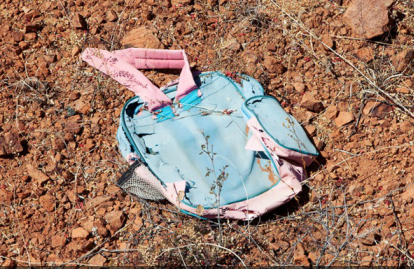
As we make our way through the desert, we come across countless empty packets of ephedrine pills and cans of energy drinks along with the water bottles. These are provided by coyotes (smugglers of migrants) in order to hurry people across the terrain. The water bottles are black, because migrants think that black will make the containers harder to detect. “There’s a real lack of understanding of the true capacity and practices of the Border Patrol,” De León says. “Agents use ground sensors now, aerial drones, thermal imaging — and the migrants still paint their bottles black.”

Caffeinated Napping

A counterintuitive combination does the trick:

[S]leep researchers in England found that drinking a cup of coffee and then immediately taking a 15-minute nap was even more effective [than either on its own]. … This method is believed to work because the short power nap helps clear the brain of the sleep-inducing compound adenosine. Caffeine, meanwhile, takes about 20 minutes to have its physiological effect — kicking in just as the napper is awakening.

Crap Technology That Isn’t Crappy

Thomas Hayden writes in praise of functional low-end technology. Maggie Koerth-Baker is right there with him:

Granted, crap technology can be dirty if it's actually crap—something you're going to have to throw out and replace every year. But it's nice to get this reminder that there's a lot of room between crap-that's-actually-crap and the-newest-most-expensive-thing. That grey zone is home to Hayden's Coby. It's also home to the Sansa Clip my husband and I have shared for half a decade. It's now outlasted two iPods—one that was lost/stolen and another with a faulty battery. Where those more-coveted gadgets failed, the Sansa came through. And it's stuff like this that brings up an important question I need to ask myself more often: What makes "crap" crap?

Should You Bring An Umbrella?

A future app, trying to get funding through Kickstarter, promises to give you short-term weather predictions for your exact location:

It might tell you that it will start raining in 8 minutes, with the rain lasting for 15 minutes followed by a 25 minute break. … [T]he catch is that it only works over a short period of time: a half hour to an hour in the future. But, as it turns out, this timespan is crucially important. Our lives are filled with short-term outdoor activities: Travelling to and from work, walking the dog, lunch with friends, outdoor sports, etc.

(Hat tip: Kottke)