Everything Is A Poison

Even water can be dangerous if you drink massive amounts:

If a compound is made by Nature, we assume it must be good for us. If it’s artificial or it has a long unpronounceable name, on the other hand, we assume it must be toxic, and it’s only a matter of time until scientists figure that out. Alas, the truth is more complicated than popular culture would have you believe. Nature makes poisons more vicious than any chemists can invent. And nearly anything can be toxic if you consume too much.

(Hat tip: The Browser)

The World’s Biggest Employer: The Black Market

Former French colonies call the black market "System D". And it's expanding rapidly:

By 2020, the OECD projects, two-thirds of the workers of the world will be employed in System D. There's no multinational, no Daddy Warbucks or Bill Gates, no government that can rival that level of job creation. Given its size, it makes no sense to talk of development, growth, sustainability, or globalization without reckoning with System D. 

On The Vastness Of DNA

2759536159_20cd8e045d_z

Richard Dawkins writes in his book Unweaving the Rainbow:

We are going to die, and that makes us the lucky ones. Most people are never going to die because they are never going to be born. The potential people who could have been here in my place but who will in fact never see the light of day outnumber the sand grains of Arabia. Certainly those unborn ghosts include greater poets than Keats, scientists greater than Newton. We know this because the set of possible people allowed by our DNA so massively exceeds the set of actual people. In the teeth of these stupefying odds it is you and I, in our ordinariness, that are here.

Adam Lee marvels at the evolution of his own genetic makeup:

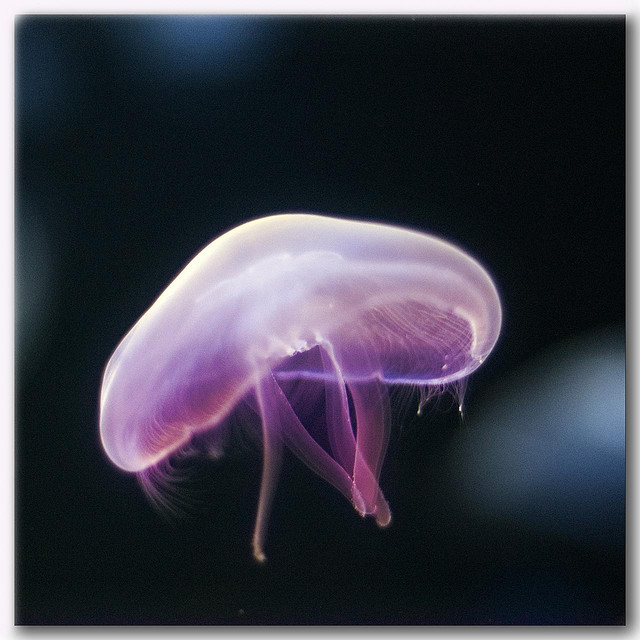
Unlike the believers who explain in all sincerity that their myths are "true but not real", our origin story is both true and real. And it's far grander and more majestic than the small, unimaginative, human-centered myths of antiquity. Just think of what it implies about our interconnectedness: the pulsing of a jellyfish's bell, the coordinated swerve of a school of fish, the dapple of sunlight through a redwood's vast green canopy, the explosive colors of a coral reef, the hidden biospheres in sulfuric hot springs and frozen Antarctic lakes – all of them are kin to me. 

(Photo by Flickr user Giorgos)

Iowa Is A Must-Win For … Romney?

Pivoting off John Heilemann, Ed Kilgore makes the case:

[A] long primary season is a very bad thing for the Republican Party. At this point, Barack Obama’s best, and perhaps only, strategy for re-election is to make this a "two futures" choice, in which the extremism of the GOP gets as much attention as the current state of the economy. Nothing will play into this strategy quite like months of Republican candidates barnstorming through Tea Party-dominated state primaries accusing each other of being reasonable instead of right. The "quick-kill" scenario may be the only way out of this trap, and only Mitt Romney can trigger it by hunkering down for an intense holiday-season drive through the right-to-life fundraising banquets and local-supporter potluck dinners of Iowa. We’ll soon know whether he has the stomach for it.

“What Are We, Farmers?”

Suddenly, I feel a strange affinity with Ricky Gervais:

His office is a modest suite of rooms one floor above shop level, bare but for a desk, a chair and a rash of Post-it notes on the wall outlining episodes for his forthcoming show, Life's Too Short. When I walk in, Gervais is staring at his computer in a way that comes across as a little nervous. He lives around the corner and can be out of bed and at work in no time, which is why, though a workaholic, he gets up at 9.30am and schedules his first meetings for 11. "I'm a toddler. I need 10 hours' sleep. I'm the opposite of Margaret Thatcher." He issues his trademark laugh, that incredulous, high-pitched cackle, exposing sharp incisors in a newly lean face. "Yeah – I'm a workaholic between the hours of 11 and 3." Except when he's filming, when he starts at the impossibly early hour of 8am. "Why? What are we, farmers?" And he cracks up again.

We Were 1 Billion In 1804

Adam Cole examines how the global population grew to 7 billion today and where it's going in the future:

Population expert Joel Cohen points out that, in 1950, there were nearly three times as many Europeans as sub-Saharan Africans. If U.N. estimates are correct, there will be nearly five sub-Saharan Africans for every European by 2100.

MRI Memories

Bryan Appleyard volunteered for a brain scan and, while inside, recounted finding out about his father's death:

During my account of his death, my proprioceptive system was very active. Proprioception is all to do with body position and movement and is, in fact, a kind of sixth sense that allows us, for example, to know where our arms are in the dark. The finding suggests some strong movement component in the memory, which puzzles [the neuroscientist]. It does not puzzle me. The scan, I decide, picked up my feeling of jumping out of my body at the moment I was told of his death. Suddenly I am impressed by what a giant magnet found in my head.

In response, Frank Wilson compares the brain to a telephone receiver:

To think there must be a "you" inside the brain seems to me to be somewhat on the order of assuming there is a "you" in the telephone receiver. The telephone is a device that enables me to hold a conversation with someone else who is someplace else. Neither of us is in the receiver. Perhaps the brain – perhaps the body – is a communications device, both receiver and transmitter, and that what the scan reveals is the pattern of its activity, not the source of it. 

Facing Autism

Danielle Cadena Deulen examines her brother's condition:

I have seen my brother’s eyes very few times. Eye contact is brief—he tries to escape it whenever possible. Merely glancing at him is an offense. Looking at him intently could result in a tantrum. His tantrums are huge, vocal, physical attacks. He is the unstable element: eyes like lithium. Just look at it and it will explode.

60 Minutes recently explored how the iPad has helped autistic kids and adults who prefer to interact with machines rather than humans. Psychologist Simon Baron-Cohen puts forth a somewhat controversial theory that adults who work in science and engineering may have an increased risk of having children with autism:

According to a theory he has been building over the past 15 years, the parents of autistic children, and the children themselves, have an aptitude for understanding and analysing predictable, rule-based systems — think machines, mathematics or computer programs. And the genes that endow parents with minds suited to technical tasks, he hypothesizes, could lead to autism when passed on to their children, especially when combined with a dose of similar genes from a like-minded mate.