
New York, New York, 9.42 pm
New York, New York, 9.42 pm
It could be an unintended consequence of the rise of sex selection, according to Mara Hvistendahl:
Several Indian sociologists I interviewed mentioned that perhaps the one silver lining in this disaster is the fact that dowries are decreasing in the northwestern Indian states where sex selection has left many more men than women. But what has replaced dowry is bride-buying, which is hardly ideal, either. … And dowry still persists symbolically in northwest India. One sociologist told me locals have simply adapted it to the times. A man might slip the parents of the woman he’s buying a little extra money—and then the parents hand the money back to him as dowry.

"Fire Graffiti" by Tomas Tranströmer:
As the firefly ignites and fades, ignites and fades, we follow the flashes
of its flight in the dark among the olive trees.Throughout those dismal months, my soul sat slumped and lifeless
but my body walked to yours.
The night sky was lowing.
We milked the cosmos secretly, and survived.
Robin Robertson analyzes Tranströmer's voice:
There is a profoundly spiritual element in Tranströmer’s vision, though not a conventionally religious one. He is interested in polarities and how we respond, as humans, to finding ourselves at pivotal points, at the fulcrum of a moment.
Celia Farber has more.
(Image: A sculpture by Tony Cragg, via Colossal)
After failing to learn French during five years of school, Sanjoy Mahajan taught himself the language in three months:
If we learned our first language like we usually learn second languages, it might look like this. A young child says, "I am hungry." The parent replies, "Wait! Before saying am, you first must learn to conjugate to be in all persons and number, in the indicative, imperative, and subjunctive moods, and in the past, perfect, and future tenses." After a few months, or maybe weeks, of this teaching, the child would conclude that it has no aptitude for languages and become mute. And human culture would perish in a generation.
Allison Gopnik is also skeptical of formal schooling:
The traditional way of thinking about learning at a university is: there’s somebody who’s a teacher, who actually has some amount of knowledge, and their job is figuring out a way of communicating that knowledge. That’s literally a medieval model; it comes from the days when there weren’t a lot of printed books around, so someone read the book and explained it to everybody else. That’s our model for what university education, and for that matter high school education, ought to be like. It’s not a model that anybody’s ever found any independent evidence for.
Even jaded me has to admit: some of these are very good. By NYC designer Ji Lee. Lee works for Facebook, and used to work at Google Labs. Talented fucker.
A tricky little quiz.
David Benedict defends the genre:
What thrillers did for fear musicals did for happiness. But 20th-century culture was all about lionising isolation, fracture and breakdown, so happy endings and happiness itself were all but banished from serious consideration. What place, then, for [Gene] Kelly’s rain-soaked jubilation or [Judy] Garland’s pleasure? Or the rip-snorting “Barn Dance” in Seven Brides for Seven Brothers or Ann Miller, tapping fit to burst and extolling her lust life, in “Tom, Dick or Harry” in Kiss Me, Kate (in 3D, no less). Freeing themselves from the constraining expectations of naturalism, those moments embody the culturally confrontational fact that compared with all other art forms, musicals have the greatest vocabulary for sustained joy.
Must be all that subtext.
Jessa Crispin reviews Asti Hustvedt’s Medical Muses: Hysteria in Nineteenth-Century Paris:
Hustvedt writes that the hysterics of Salpêtrière [Hospital] learned how to act from each other. When they were placed in a ward with epileptics, convulsive fits became a central part of the hysterical attack. And when one woman had an attack, the effect would role down the ward until all the women were frothing and writhing.
Can you imagine how much fun Bill O'Reilly would have?
The Greek Patriarchy's clergymen [in Jerusalem] have been cursed and spat on by ultra-Orthodox men in the street for many years. "They walk past me and spit," says Father Gabriel Bador, 78, a senior priest in the Greek Orthodox Patriarchate. "Mostly I ignore it, but it's difficult.
Sometimes I stop and ask the spitter 'why are you doing this? What have I done to you?' Once I even shouted at a few of them who spat at my feet together. They ran away," he says. "It happens a lot," says Archbishop Aristarchos, the chief secretary of the patriarchate. "You walk down the street and suddenly they spit at you for no reason. I admit sometimes it makes me furious, but we have been taught to restrain ourselves, so I do so."
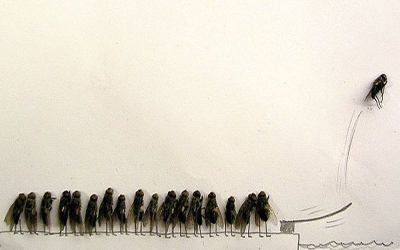
It dovetails with human progress:
Once, houseflies emerged from horseshit by the billions. When that ran out (thanks to the invention of cars), they turned to our garbage and so we collected it more frequently and took it far away. When the garbage become rare (some places, though not everywhere), they found the dog waste we left behind in cities. And now that New Yorkers, for instance, in their fancy shoes and dark clothes, gather the dog poop in bags, the flies have found those places we have taken our waste to hide it from them (and from ourselves). At garbage dumps flies flock in dense halos. They are born too out of the rough parts of towns—smoke signals of neglect. They have even found the places we have moved our animals, the modern mangers of chickens and pigs where waste is dumped into vast pools.
The piece then takes an ominous turn to describe the threat that flies on factory farms pose when carrying new strains of bacteria resistent to antibiotics.
(Image by Marcus Moore)
 The Dish