Getting Good At Zoning Out

It can be a key element in creativity, if done right:

Letting the mind drift off is the easy part. What’s much more difficult (and more important) is maintaining a touch of meta-awareness, so that if you happen to come up with a useful new idea while in the shower or sitting in traffic you’re able to take note; the breakthrough isn’t squandered. 

Kids’ Vocab These Days

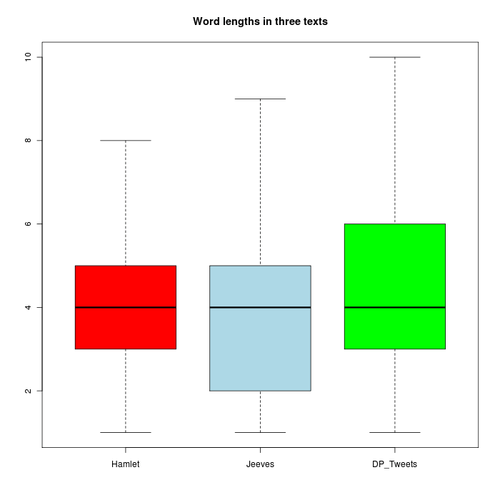
Hamlet2TheDP

Ralph Fiennes recently claimed that Twitter is eroding language:

Our expressiveness and our ease with some words is being diluted so that the sentence with more than one clause is a problem for us, and the word of more than two syllables is a problem for us.

Mark Liberman counters by charting the text of Hamlet, a number of P.G. Wodehouse stories about Jeeves, and the 100 most recent tweets from the Daily Pennsylvanian, a student newspaper: 

The mean word length in Hamlet (in modern spelling) was 3.99 characters; in P.?G. Wodehouse's Jeeves stories, the mean word length was 4.05 characters; in the DP's tweets, the mean word length was 4.80 characters. … The business about word lengths is the easiest to check of the article's assertions about linguistic decay, and it's false. Trivially and transparently so, as such plaints usually are.

But Liberman does note that word and sentence length in presidential inaugurations has decreased over the years.

The Mystery Of A Murmuration

Brandon Keim conveys the physics behind starling formations, which were featured a recent Mental Health Break:

Mathematical analysis of flock dynamics show how each starling’s movement is influenced by every other starling, and vice versa. It doesn’t matter how large a flock is, or if two birds are on opposite sides. It’s as if every individual is connected to the same network. That phenomenon is known as scale-free correlation, and transcends biology. The closest fit to equations describing starling flock patterns come from the literature of "criticality," of crystal formation and avalanches — systems poised on the brink, capable of near-instantaneous transformation.

Alexis is awestruck:

It's a beautiful phenomenon to behold. And neither biologists nor anyone else can yet explain how starlings seem to process information and act on it so quickly.

The View From Your Window Contest

Screen shot 2011-11-04 at 7.46.46 PM

You have until noon on Tuesday to guess it. City and/or state first, then country. Please put the location in the subject heading, along with any description within the email. If no one guesses the exact location, proximity counts.  Be sure to email entries to VFYWcontest@gmail.com. Winner gets a free The View From Your Window book. Have at it.

For RSS Enthusiasts Only, Ctd

Lance Ulanoff ruminates over Google's redesigns:

I’m reading Steve Jobs’s biography right now and learned that he hated — HATED — corners. Everything had to be curved. He was obsessed with chamfers. Take a look at your iPhone or iPad and you’ll see that design sensibility. Google, though, is going the other way.

Gmail for the iPhone is all hard lines of black, white and gray. There are thin lines and black bars. The icons are simply reverses on their black backgrounds.There’s just a tiny bit of color and impishness in there, like the use of a 3.5-inch floppy icon for "Save." Otherwise, it’s the culmination of a trend that’s been running through all of Google’s products for months and accelerating in recent days.

Alan Jacobs draws an analogy for the Reader row:

Google is saying to social-minded Reader users, "We’re going to kill the social network we’ve been freely providing for you. Please use this other social network we’re now freely providing for you. Because of course there’s no way we’ll ever kill that one." User = Charlie Brown, Google = Lucy, Google’s services = the football. I’ve seen how that turns out.

The Sweatshop Debate

Last week we highlighted a defense of sweatshops by Matt Zwolinski and Benjamin Powell. Ari Kohen wasn't persuaded:

I would take a smaller profit as a shareholder or pay more for a product as a consumer if it meant that those products weren’t being made on the backs of labor that couldn’t complain of their poor pay and poor conditions for fear of losing the only job that keeps them (and their families) from even worse conditions and/or death. 

Jeff Miller counters:

How much would Ari have been willing to pay for his new iPhone 4S?  $1000?  Maybe $1500?  Well, he is perfectly free to give his $200 to Apple and then write a check for $800 or $1300 to a charity that helps the global poor.  And he’s free to do this for every product he buys.  His new toaster?-$20 to the manufacturer and $80 to the charity.  His car?—How about $25,000 to the manufacturer, and another $15,000 to the charity.  

Zwolinski responds:

Miller’s response sounds glib, but it makes an important point.  Why do people think that sweatshops should do more to help workers in the developing world, especially since (as I’ve noted elsewhere on this blog) they already do more than most of us do to help?

Zwolinski also pens an answer to arguments about the motivation of sweatshop operators.

One Percent Spoils The Bunch

As a father, TNC is distressed by a series of scandals over abuse of power within the NYPD. Here he responds to the police chief estimating that only 1% of cops will violate the oath of office:

That may well be true — but it misses the point. If you own a restaurant and your customers see a rat, claiming that on 364 out 365 days of the year, your facilities are vermin-free, will do very little to assuage them or mollify your critics. They will likely avoid your establishment as much as humanely possible. This would strike most people as sensible. In terms of the police, one must factor not just cops who are crooked, but those who think it's appropriate to pepper-spray people for fun, those who leave people in detention over a missing ID, those who kill innocent people by mistake. You are then talking about something a bit more dangerous than the One Percent rule implies.