Thanks to the nearly 200 Dishheads who wrote in with feedback, ranging from simple web links to expert analyses into the thousands of words.
The overwhelming consensus from readers and the economic writers they cite is that the government-sponsored enterprises (GSEs) Fannie Mae and Freddie Mac did not solely cause the financial crisis, contrary to Mayor Bloomberg's recent assertion. The most cited debunking of Bloomberg was written by Mike Konczal:
For some data, start here: ”More than 84 percent of the subprime mortgages in 2006 were issued by private lending institutions [not GSEs]….Private firms made nearly 83 percent of the subprime loans to low- and moderate-income borrowers that year."
As Center For American Progress’ David Min pointed out to me, the timing doesn’t work at all: "But from 2002-2005, [GSEs] saw a fairly precipitous drop in market share, going from about 50% to just under 30% of all mortgage originations. Conversely, private label securitization [PLS] shot up from about 10% to about 40% over the same period. This is, to state the obvious, a very radical shift in mortgage originations that overlapped neatly with the origination of the most toxic home loans."
This paragraph from Min is pretty devastating to Bloomberg's position:
Did Fannie and Freddie buy high-risk mortgage-backed securities? Yes. But they did not buy enough of them to be blamed for the mortgage crisis. Highly respected analysts who have looked at these data in much greater detail than [American Enterprise Institute's Peter] Wallison, [AEI consultant Ed] Pinto, or myself, including the nonpartisan Government Accountability Office [pdf], the Harvard Joint Center for Housing Studies [pdf], the Financial Crisis Inquiry Commission majority [pdf], the Federal Housing Finance Agency [pdf], and virtually all academics, including the University of North Carolina [pdf], Glaeser et al at Harvard [pdf], and the St. Louis Federal Reserve [pdf], have all rejected the Wallison/Pinto argument that federal affordable housing policies were responsible for the proliferation of actual high-risk mortgages over the past decade.
A chart from Min:

Konzcal's caption:
Even this "high risk" category [devised by Pinto] isn’t risky compared to subprime, and looks like the national average. When you slice it by private-label, the numbers are even worse. Private label loans "have defaulted at over 6x the rate of GSE loans, as well as the fact that private label securitization is responsible for 42% of all delinquencies despite accounting for only 13% of all outstanding loans (as compared to the GSEs being responsible for 22% of all delinquencies despite accounting for 57% of all outstanding loans)."
Konzcal's bottom line:
The GSEs had a serious corruption problem and were flawed in design - Jeff Madrick and Frank Partnoy had a good column about the GSEs in the NYRB recently that you should check out about all this – but they were not the culprits of the bubble.
Dean Baker of the Center for Economic and Policy Research takes that same position – Fannie and Freddie were participants but not instigators of the crisis – in his takedowns of George Will and David Brooks earlier this year. The aforementioned Pinto and Wallison were involved in the bipartisan Financial Crisis Inquiry Commission, which released a January 2011 report on the cause of the crisis. In an analysis of that report, Jennifer S. Taub tackles the "myth" that Fannie and Freddie were to blame:
Both the Report and the primary dissenting statement agree that on their own Fannie and Freddie did not cause the financial crisis. [Of the ten commission members, including four Republicans, Wallison was the lone dissenter on that point.] … The Report states that, "Affordable housing goals imposed by the Department of Housing and Urban Development (HUD) did contribute marginally" to Fannie and Freddie’s collapse. However, it was the voluntary, profit, not mission-motivated decision by the management teams of the GSEs to load up on Wall-Street and other private bank created securities, coupled with a 75-1 leverage ratio that brought them to the brink. It was clear that the "private-sector, publicly traded, profit-making companies with implicit government backing and a public mission was fundamentally flawed."
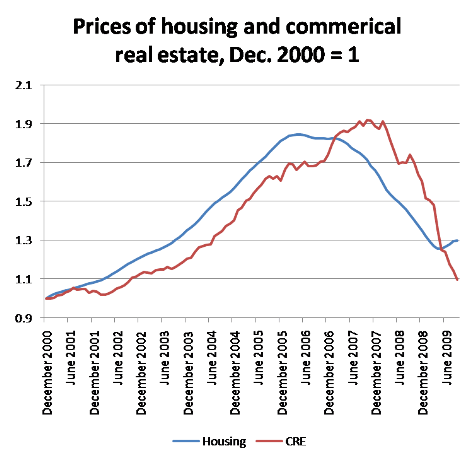
A Krugman post from 2009 adds more compelling evidence against Bloomberg:
[R]eading this scary piece about commercial real estate, I realized that [Commercial Real Estate] offers yet another debunking. After all, there was no federal act driving banks to lend money for office parks and shopping malls; Fannie and Freddie weren’t in the CRE loan business; yet 55 percent — 55 percent! — of commercial mortgages that will come due before 2014 are underwater. The lenders didn’t need government urging to dive deep into a property bubble, and drown.
In a subsequent post, Krugman illustrated that point with a chart:
A reader adds more data to the debate:
Far from being a cause of the subprime meltdown, the Community Reinvestment Act actually facilitated more prudent lending from the small segment of the mortgage lending industry actually subject to the CRA (i.e. FDIC-insured banks, as opposed to non-depositary mortgage lenders like Countrywide). Take a look at this study [pdf] of publically available loan data, released before the meltdown. It concludes that lenders subject to the CRA (CRA Banks) were substantially less likely than other lenders to make the kinds of risky home purchase loans that helped fuel the foreclosure crisis, specifically that:
(1) CRA Banks were significantly less likely than other lenders to make a subprime loan;
(2) The average APR on subprime loans originated by CRA Banks was appreciably lower than the average APR on subprime loans originated by other lenders;
(3) CRA Banks were more than twice as likely as other lenders to retain originated loans in their portfolio rather than selling them in the secondary market ; and
(4) Foreclosure rates were lower in MSAs with greater concentrations of bank branches.
Another reader crafts an excellent narrative of Fannie and Freddie's role in the crisis:
I have worked in the non-profit affordable housing world for most of my adult life. The best way to think about Fannie and Freddie in the '00s is as "wannabes." The senior executives in the corporations made a lot of money, but not as much as their peers in the private sector. They wanted to make more money. The investors in Fannie and Freddie wanted the corporations to make more money. Many in the non-profit community wanted to see Fannie and Freddie make money (they wanted to see that money invested in subsidizing more affordable housing, not in executive bonuses, but…). You get the picture.
In the '80s and into the '90s, Fannie and Freddie owned much of the "affordable housing" market. In the '00s, because of cash freed up in the 2000 internet crash, "financial innovation," and more specifically rampant securitization, all sorts of new mortgage products and investment vehicles were being developed in the private sector, and Fannie and Freddie rapidly began to lose market share, particularly in the sub-prime and Alt-A (e.g. "liar-loans," "stated income" loans, "no-money down" loans) – markets where Fannie and Freddie were not allowed to buy mortgages.
You see, Fannie and Freddie are not really your garden variety lenders; they are what are referred to as market makers. They set the standards for what are called "conforming mortgages." If a bank, or mortgage broker writes a mortgage that conforms to their guidelines (in terms of paperwork, documentation, interest rate, down-payment, loan-to-value, collateral, loan size, etc), then they will buy the loan, no questions asked.
The problem that they were running into the early to mid-'00s, was that less and less of the mortgage business was focused on issuing conforming mortgages, and more and more was focused on sub-prime and alt-A (as well as on larger mortgage loans, which were also out of bounds). Fannie and Freddie lobbied quite hard for a loosening of their guidelines, under the banner of promoting more affordable housing (and the ownership society). In this they enjoyed some (qualified) support from the non-profit affordable housing community. They were able to successfully lobby for some loosening of the guidelines around conforming mortgages, and by 2006, they were able to start buying some sub-prime loans and Alt-A that were previously off-limits. When the music stopped, these loans were still a minority of their balance sheets, but created most of their losses. Paul Krugman provides some of the best graphs illustrating this point (and his description is succinct).
In summary, Fannie and Freddie were very late to the party. They were followers (seeking the windfall profits being enjoyed by the private investment banks) and wannabes, not leaders. The Republicans would like this to be because they were "forced" into it by congress, but really, they were forced into it by their executive's greed. What's clear from the data is that Fannie and Freddie's government leashes didn't start to get loosened until 2006. They were more like the sucker investors who joined the real estate boom late and got screwed out of their money while Goldman/Paulson were placing desperate counter-bets on what they knew to be a bubble by 2006/2007.
Of course Fannie and Freddie's business really spiked in 2008, 2009, 2010, when they (and the FHA) were the only organizations still buying mortgages from originators. If they hadn't continued to buy conforming loans (they did re-tighten the guidelines, but they continued to lend), then the mortgage market would have dried up completely after the crash, and we would have been totally screwed as the bottom dropped out of the entire mortgage finance market. This is a little told part of the Fed's role in saving our bacon.
In no way did Fannie and Freddie provide a "model" for the private sector to follow. It was the other way around, with the executives and shareholders of Fannie and Freddie desperate to get more lee-way from the feds to be able to buy into the markets that were spiking. CRA as the root of the crisis is a complete red-herring, in my opinion.
Another complements that narrative:
I have been originating loans for private lenders since 2003. More than 95% of all of my loans have ultimately been insured by Fannie or Freddie. So I have had a front-row seat as to how they have operated over the years. The Media Matters piece misses the mark. Here is an excerpt of your "money quote":
[Bloomberg] claims Fannie Mae and Freddie Mac 'made a bunch of loans' even though they (1) do not make loans, and (2) were backing out of insuring subprime loans as private, unregulated firms rushed into the derivatives casino.
While it is true the GSEs do not make loans, they establish the underwriting rules. Lenders underwrite to these standards. This is an important point that is glossed over. From 2003 until 2008, the GSEs relaxed their underwriting standards. They increased acceptable debt-to-income ratios, reduced minimum down payments and credit scores, and almost eliminated the need for documentation for some loans. By 2007, the GSEs were insuring "alt-A" loans, or loans with low- or no-documentation, but with average to above-average credit scores. They were NOT backing out of insuring subprime loans. Just the opposite was occurring – they were backing in, as they watched their market shares slip.
Dish check conclusion: Fannie and Freddie played at best a marginal role in the crisis, largely by belatedly following the private sector's reckless innovations in the sub-prime market, from 2006 onwards. They are not beyond criticism, but Bloomberg's off-the-cuff remarks are baseless. He should withdraw or amend them.
In the second half of the Dish Check, we will focus on who exactly did cause the financial collapse, and how. We'll be using exactly the same emails that we have now. And if you have any empirical data to amend this post, please send it in, and we'll review. (Remember to put "Dish Check" in the contents line.)

 The Dish