Hitch’s Courage

Peter Hitchens remembers his brother:

Here’s a thing I will say now without hesitation, unqualified and important. The one word that comes to mind when I think of my brother is ‘courage’. By this I don’t mean the lack of fear which some people have, which enables them to do very dangerous or frightening things because they have no idea what it is to be afraid. I mean a courage which overcomes real fear, while actually experiencing it …

[T]he word ‘courage’ is often misused today. People sometimes tell me that I have been ‘courageous’ to say something moderately controversial in a public place. Not a bit of it. This is not courage. Courage is deliberately taking a known risk, sometimes physical, sometimes to your livelihood,  because you think it is too important not to. My brother possessed this virtue to the very end, and if I often disagreed with the purposes for which he used it, I never doubted the quality or ceased to admire it. I’ve mentioned here before C.S.Lewis’s statement that courage is the supreme virtue, making all the others possible.

It should be praised and celebrated, and is the thing I‘d most wish to remember.

“Nor Law, Nor Duty Bade Me Fight”

Hitch loved poetry, as he expresses in this brief flash of brilliance here. But he knew this one by Yeats by heart:

An Irish Airman Foresees His Death

I know that I shall meet my fate
Somewhere among the clouds above;

Those that I fight I do not hate,
Those that I guard I do not love;

My country is Kiltartan Cross,

My countrymen Kiltartan's poor,
No likely end could bring them loss
Or leave them happier than before.

Nor law, nor duty bade me fight,
Nor public men, nor cheering crowds,

A lonely impulse of delight

Drove to this tumult in the clouds;

I balanced all, brought all to mind,

The years to come seemed waste of breath,

A waste of breath the years behind

In balance with this life, this death.

Christmas Hathos Alert

Tis the season for forced displays of marital fidelity:

Herman Cain is back, this time with his wife Gloria. The former GOP presidential campaign has just cut a new holiday video featuring families around the nation wishing viewers a Merry Christmas as the couple sit in front of a glowing fireplace, the word "Peace" on the mantle, with Gloria's hand in her husband's. Cain his shown reading the Christmas story from a dog-eared Bible in a family living room. "Peace be with you," says Gloria Cain. "Merry Christmas and a happy holiday season from our family to yours," adds Cain as the two share flirty looks.

One abiding thing that Hitch and I shared was a passionate hatred of the Christmas season. He rightly saw it as a fascistic enterprise to insist that your mood be in sync with everyone else. And that your mood also be happy. Fuck that. I think one reason we got along so easily was our mutual passion about personal freedom, to live our lives as we fucking well choose. That kind of meddling – from right and left – was something up with which he would not put. Here's a classic moment when Hitch devastates the know-nothing Christianism of our time:

Of course, Hitch was not a Puritan in this. He just insisted on pleasure when he chose, not on when some cultural consensus or divine sadist (as he would put it) told him so. And for those who somehow see in his shortened life a salutary lesson about the long-term effects of prodigious functional alcoholism, may I offer Christopher's own retort:

I always knew there was a risk in the bohemian lifestyle… I decided to take it because it helped my concentration, it stopped me being bored — it stopped other people being boring. It would make me want to prolong the conversation and enhance the moment. If you ask: would I do it again? I would probably say yes. But I would have quit earlier hoping to get away with the whole thing. I decided all of life is a wager and I'm going to wager on this bit… In a strange way I don't regret it. It's just impossible for me to picture life without wine, and other things, fueling the company, keeping me reading, energising me. It worked for me. It really did.

And therefore it worked for all of us. God Bless Johnnie Walker Black.

One Of Hitch’s Finest Hours

On the death of Jerry Falwell:

But he saved his best line for Sean Hannity. Somehow the Hitchens-Hannity combo is compelling. Because one is a man dedicated to truth and freedom, and the other is committed to propaganda and power. There are few more pernicious liars and propagandists in this country than Hannity, and in the face of such poison, Hitch never wavered. He attacked:

Savor this line – at the end of the clip:

If you gave [Jerry Falwell] an enema, you could bury him in a matchbox.

Quotes For The Day II

"[Mother Teresa]  was not a friend of the poor. She was a friend of poverty. She said that suffering was a gift from God. She spent her life opposing the only known cure for poverty, which is the empowerment of women and the emancipation of them from a livestock version of compulsory reproduction. And she was a friend to the worst of the rich, taking misappropriated money from the atrocious Duvalier family in Haiti (whose rule she praised in return) and from Charles Keating of the Lincoln Savings and Loan. Where did that money, and all the other donations, go? The primitive hospice in Calcutta was as run down when she died as it always had been—she preferred California clinics when she got sick herself—and her order always refused to publish any audit. But we have her own claim that she opened 500 convents in more than a hundred countries, all bearing the name of her own order. Excuse me, but this is modesty and humility?" – Hitch, in a rant called Mommie Dearest.

"[Princess Diana] was in Angola on her landmine campaign, and there was a hushed, reverent BBC commentator. And he said, 'The thing about mine fields is that they're very easy to lay, but they're very difficult and dangerous, and even expensive to get rid of' – the perfect description of Prince Charles's first wife," – Hitch, on CBS.

Poem For The Day II

Poem of Advice

(by Jim Holt, for his stalwart but sometimes uncouth friend, Christopher Hitchens)

Don't tipple at tiffin(1)
Or roar(2) for your rum.
Don't scowl at a griffin(3)–
You'll only look dumb.

Don't nobble your neighbors(4)
Or haver(5) at bees;
But strive to be kindly
And always to please(6).

Notes:

(1) Hitchens is known to imbibe immoderately at luncheon.

(2) When his spirituous beverage is slow in coming to the table, Hitchens often raises his voice at the waiter/bartender.

(3) The griffin, being a union of terrestrial beast and aerial bird, is seen in Christianity as a symbol of Jesus, whom Hitchens deplores.

(4) In the "Watkins leaving-present affair"of the late '70s, Hitchens collected handsome subscriptions from his fellow New Statesman staffers for the departing Alan Watkins, yet produced a meagre gift.

(5) Hitchens is wont to haver at any animate audience, including bees.

(6) Although he is a man of great courage and conviction, Hitchens is not known for his complaisance.

Poem For The Day

Fuck_you_press.auden.platonic-blow

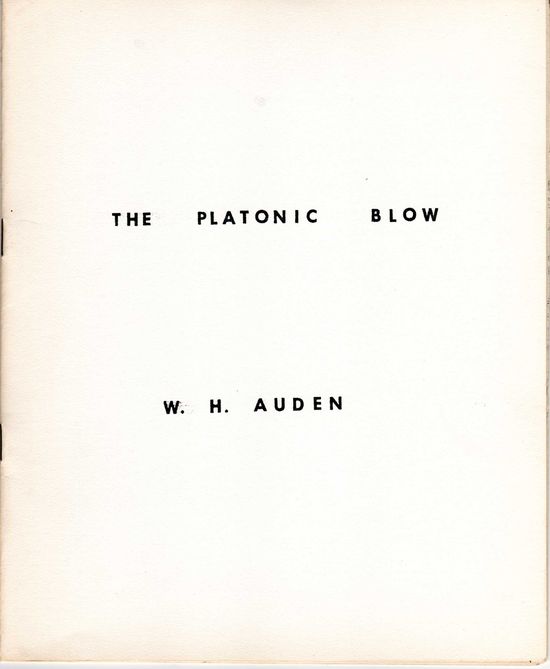
I thought I’d read a lot of Auden when his name came up in a conversation with Hitch long ago. But Christopher – suddenly animated – asked if there was one poem I had read, because, he felt, it might be salient. He jumped to his vast library and dashed around it, until the tiny slim, one-poem volume fell out. He had a samizdat copy and he gave it to me. I have it still.

We talked a lot about sex, actually, a lot of the time. It took a while for me to persuade him that homosexuality wasn’t only about sex, but love, and I almost regretted it because it made our discussions less salty. I could sit there and listen to his reminiscences of the great gay wits of the past for ever – Tom Driberg was one of his favorites. One of my favorite out-of-the-blue email headers from him was a contination of the theme: “A PS On Handjobs”.

Anyway, in memory of his great defense of life and love and passion and blasphemy, here’s the poem. It was published in 1965 by the Fuck You Press, an imprint that would, I suspect, have appealed to Christopher. May it offend you all:

The Platonic Blow (A Day For A Lay)
by W.H. Auden
It was a spring day, a day, a day for a lay when the air
Smelled like a locker-room, a day to blow or get blown.
Returning from lunch I turned my corner and there
On a near-by stoop I saw him standing alone.

I glanced as I advanced. The clean white T-shirt outlined
A forceful torso, the light-blue denims divulged
Much. I observed the snug curves where they hugged the behind,
I watched the crotch where the cloth intriguingly bulged.

Our eyes met, I felt sick. My knees turned weak.
I couldn’t move. I didn’t know what to say.
In a blur I heard words myself like a stranger speak.
“Will you come to my room?” Then a husky voice, “O.K.”

I produced some beer and we talked. Like a little boy
He told me his story. Present address next door.
Half Polish half Irish The youngest. From Illinois.
Profession mechanic. Name Bud. Age twenty-four.

He put down his glass and stretched his bare arms along
The back of my sofa. The afternoon sunlight struck
The blond hairs on the wrist near my head. His chin was strong,
His mouth sucky. I could hardly believe my luck.

And here he was sitting beside me, legs apart.
I could bear it no longer. I touched the inside of his thigh.
His reply was to move closer. I trembled. My heart
Thumped and jumped as my fingers went to his fly.

I opened a gap in the flap. I went in there.
I sought for a slit in the gripper shorts that had charge
Of the basket I asked for. I came to warm flesh then to hair,
I went on. I found what I hoped. I groped. It was large.

He responded to my fondling in a charming, disarming way:
Without a word he unbuckled his belt while I felt
And lolled back, stretching his legs. His pants fell away.
Carefully drawing it out, I beheld what I held.

Continued fantastically here.